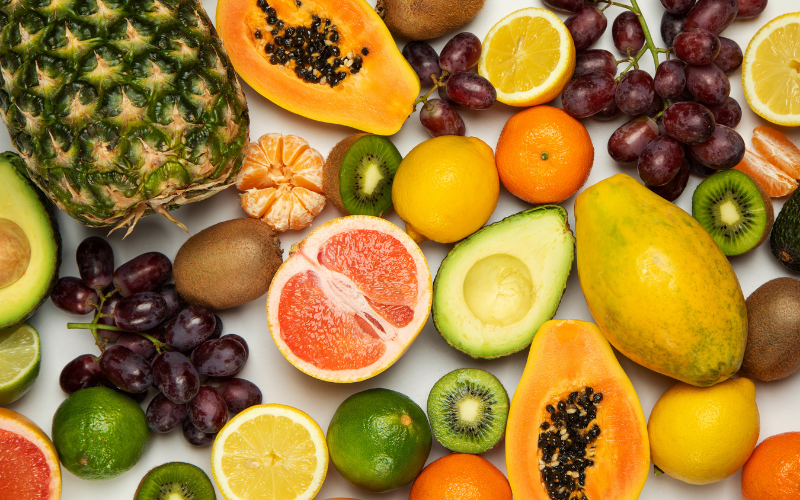
If you're trying to lose weight, the fruits worth watching are mango, grapes, bananas (especially ripe ones), dried fruit, and pineapple, since they pack more sugar and calories into a small serving and are easy to overeat.
None of them need to disappear from your plate, though — keep reading to see exactly how much is a smart portion and what actually matters more than the fruit itself.
Why These 5 Fruits End Up on “Avoid” Lists (And Why That's the Wrong Framing)
Search “fruits to avoid for weight loss” and you'll keep seeing the same five names: mango, grapes, banana, dried fruit, and pineapple.
They show up so consistently across dietitian recommendations and health publications that it's worth asking why these specific fruits keep making the list.
The honest answer has nothing to do with any of them being unhealthy. They land on these lists because they're calorie-dense, sugar-dense, or both, and because their texture and size make them unusually easy to overeat.
A mango eaten whole, a bowl of grapes eaten while watching TV, a second banana added to a smoothie — none of that takes much effort, and that's exactly the problem.
Compare that to something like watermelon or berries, where the sheer water and fiber content make overeating physically harder.
This is where glycemic index (GI) trips people up. GI measures how fast 50 grams of carbohydrate from a food spikes your blood sugar, but nobody eats 50 grams of pure carbs from watermelon in one sitting.
Glycemic load (GL) fixes that by factoring in the actual serving size you'd realistically eat, which is why a fruit can have a “scary” GI number but a genuinely low GL.
GL is the more useful number for real-world eating decisions, and it's the reason several fruits on caution lists don't deserve to be there.
There's also a difference worth understanding between natural sugar and added sugar. Chemically, once absorbed, sugar is sugar.
But whole fruit doesn't hand you that sugar in isolation — it comes bundled with fiber, water, and micronutrients that slow digestion and blunt the blood sugar response you'd get from an equivalent amount of table sugar or syrup. Strip that packaging away, through juicing or drying, and the sugar hits your system much faster.
So the fruits below aren't a blacklist. They're a portion-control list — five fruits where a little awareness about serving size goes a long way, without requiring you to cut any of them out entirely.
Mango and Grapes: Small Portions, Big Sugar Load
Mango
A single cup of sliced mango runs about 99 calories and roughly 22.6 grams of sugar. That number climbs fast once you factor in that a whole medium mango, not just a cup of it, can carry 30 to 40-plus grams of sugar on its own.
Its glycemic numbers actually look decent on paper. GI sits around 51, which is low-to-moderate, and glycemic load comes in around 8 per cup, which counts as low.
Credit goes to the roughly 2.6 grams of fiber per cup along with the fruit's antioxidants, both of which help blunt the blood sugar spike you'd expect from that much sugar.
The real issue is portion behavior, not chemistry. Mango gets called “the king of fruits” for a reason, and that appeal is exactly why people tend to eat a whole one in a single sitting rather than measuring out a cup. Do that, and you've quietly doubled or tripled the intended serving.
Keep it simple: stick to about half a cup, diced. Pair it with a handful of nuts or a serving of yogurt to add protein or fat, which slows down how fast that sugar hits your bloodstream.
Grapes
Grapes look almost identical to mango on the numbers: about 104 calories and 23 grams of sugar per cup. Where they differ is fiber — grapes offer only about 1 to 1.4 grams per cup, which is low enough that they do very little to slow you down or fill you up.
That combination of small size, sweetness, and low fiber is what makes grapes dangerous in a specific way: a few handfuls, eaten mindlessly, can deliver as much sugar as a can of soda.
Their glycemic index runs moderate at around 53, though it can range from 46 to 59 depending on variety and ripeness, and the glycemic load lands around 8 to 11 per cup.
Grazing is the core problem. Grapes rarely get eaten as a measured serving; they get eaten from the bag or the fridge, a few at a time, over the course of an afternoon.
- A real serving is about 1 cup, or roughly 15 to 20 grapes
- Portion them into a bowl before eating, rather than pulling from the container
- Skip dried grapes (raisins) if portion control is already a struggle — drying triples the glycemic load
The common thread
Mango and grapes share the same underlying trap: both are easy to eat well past a single serving without any conscious decision to overeat. Neither is dangerous in a proper portion.
The fix in both cases is the same — measure it out, pair it with protein or fat, and treat the “serving size” as a real number rather than a suggestion.
Bananas: Why Ripeness Changes Everything
A medium banana runs about 105 to 110 calories, with 14 to 15 grams of sugar and 27 to 28 grams of total carbohydrate.
It also brings roughly 3 grams of fiber and 450 milligrams of potassium to the table, which is more than most fruits on this list offer. So on paper, a banana isn't especially high in sugar or low in nutrients — it's a solid, balanced piece of fruit.
What makes bananas different is that ripeness completely rewrites their glycemic profile:
- Green or unripe: GI around 30 to 42, thanks to high resistant starch content that digests slowly
- Ripe (yellow, no spots): GI around 51
- Very ripe or overripe (brown-spotted): GI climbing to 62 or higher
A green banana and an overripe one are, metabolically, almost different foods. Glycemic load for a medium banana averages around 11 to 13, which counts as moderate, but that number shifts along with ripeness in the same direction as GI.
None of this makes bananas the villain they're often made out to be. Bananas get labeled the “number one fruit to avoid” more often than any other fruit on this list, and dietitians consistently push back on that claim.
The reality is more nuanced: bananas are higher in sugar and calories and lower in water than fruits like watermelon or berries, which means they're easier to overconsume, especially in multiples.
Smoothies are the usual culprit — it's common to toss two bananas into a blender without a second thought, doubling the intended serving without registering it as “eating two bananas.”
A few adjustments make bananas easy to keep in a weight-loss diet:
- Choose a slightly greener banana. Lower ripeness means a lower GI and slower sugar release.
- Eat half at a time if you're pairing it with something else, like peanut butter or oats.
- Pair with protein or fat — nut butter, Greek yogurt, or a handful of nuts — to slow digestion and improve satiety.
- Watch smoothie portions specifically. One banana per smoothie is a reasonable habit; two turns a snack into a much bigger calorie and sugar load than intended.
One medium banana a day fits comfortably into most weight-loss plans. The fruit isn't the problem — losing track of ripeness and portion size is.
Dried Fruit and Pineapple: The Concentrated Sugar Problem
Dried Fruit
Removing water from fruit doesn't remove calories or sugar — it just concentrates everything that's left into a much smaller volume.
That's the entire story behind why dried fruit is so easy to overeat: an ounce of raisins runs about 85 calories and 17 grams of sugar, and scaled up to 100 grams, that's roughly 299 calories and 59 grams of sugar.
Dates land around 77 calories and 16 grams of sugar per ounce, translating to about 282 calories per 100 grams, while dried figs sit near 250 calories per 100 grams. Most common dried fruits end up somewhere between 38 and 66 percent sugar by weight.
Glycemic index varies more than you'd expect across dried fruit types. Raisins sit at a medium GI of about 64, while dates range widely, anywhere from 42 to 62 depending on variety.
Interestingly, research out of a Toronto hospital found that dates, apricots, raisins, and sultanas actually carry a lower GI than white bread, which makes them a reasonable low-GI snack swap in the right portion — the caveat being “right portion” is doing a lot of work in that sentence.
Here's the comparison that matters: a small handful of raisins, about one ounce, contains roughly the same sugar as a full cup of fresh grapes.
The difference is that a cup of grapes has volume and water content that help you feel full, while an ounce of raisins doesn't — you can eat that ounce in under a minute and not feel like you've eaten anything substantial.
Pineapple
A cup of pineapple chunks comes in at about 83 calories and 16 grams of sugar, with a modest 2.3 grams of fiber. Per 100 grams, that's closer to 50 calories and 10 grams of sugar.
Pineapple's glycemic index runs moderate-to-high, somewhere between 59 and 66, which sounds like a reason for caution.
But glycemic load tells a more forgiving story: a half-cup serving carries a GL of only about 7 to 8, which is moderate.
The gap between GI and GL here is a good reminder that serving size changes the real-world impact far more than the raw GI number suggests.
Where pineapple actually becomes a problem is in its processed forms. Canned pineapple packed in syrup pushes the effective GI above 70, turning a moderate fruit into a genuinely high-glycemic food.
Juiced pineapple carries the same issue — all of the sugar, none of the fiber that would normally slow it down.
Portion Benchmarks and Pairing
- Dried fruit: 2 to 3 dates, or 1 to 2 tablespoons of raisins, per serving
- Pineapple: about ½ cup of fresh chunks
- Best pairing for both: a source of protein or fat — nuts alongside dried fruit, or cottage cheese and Greek yogurt alongside pineapple — to slow digestion and blunt the blood sugar spike
The pattern across both is the same: choose fresh or unsweetened-frozen pineapple over canned-in-syrup, and treat dried fruit as a concentrated ingredient rather than a casual snack you eat by the handful.
Two Fruits That Get Wrongly Blamed: Avocado and Watermelon
Avocado
Avocado sometimes shows up on “fruits to avoid” lists, but the reasoning behind it has nothing to do with sugar.
A whole medium avocado runs about 240 calories, with roughly 160 calories and 22 grams of fat packed into just 100 grams, or about half a fruit. That's calorie density most fruits don't come close to.
But look at the sugar content and the picture flips entirely: half an avocado carries only about 0.2 grams of sugar, essentially none. Meanwhile, a whole avocado delivers around 10 grams of fiber, which is more than almost any other fruit on this list.
That fiber, combined with the fat content, is exactly why avocado gets linked to satiety and better weight outcomes in research — it fills you up and keeps you full, rather than spiking blood sugar and leaving you hungry an hour later.
This makes avocado a portion issue, full stop. A real serving is about a third of a medium avocado, roughly 50 grams or 80 calories. Eating half or a whole one as a “serving” is where the calorie count gets out of hand, not because the avocado itself is problematic.
Watermelon
Watermelon is the clearest example of a fruit punished for the wrong number. Its glycemic index is genuinely high — Harvard Health Publishing puts it at 80, and Diabetes Canada's tables place it a bit lower, in the 56 to 69 range depending on the source. Either way, that GI number alone makes watermelon look like something to avoid.
Glycemic load says otherwise. A typical serving carries a GL of only about 5, which is low, because watermelon is roughly 92 percent water and simply doesn't contain much carbohydrate per cup — about 46 calories per cup, to be exact.
You'd need to eat an unrealistic amount of watermelon in one sitting to get anywhere near the blood sugar spike its GI number implies.
Why This Matters
Avocado and watermelon sit at opposite ends of the nutrition spectrum — one is fat-dense with almost no sugar, the other is nearly all water with moderate natural sugar — yet both get miscategorized by lists that stop at a single metric:
- Avocado gets flagged for calories, ignoring its fiber and satiety benefits
- Watermelon gets flagged for GI, ignoring its low carb density and low GL
The lesson carries over to every fruit on this list: a single number, whether it's calories or glycemic index, never tells the full story.
Serving size, fiber content, and water content all shape how a fruit actually behaves once you eat it — which is exactly why glycemic load, not glycemic index, deserves more attention in real-world decisions.
The Real Risk Isn't Whole Fruit — It's Juice, Smoothies, and Syrup
If there's one takeaway that outweighs everything else in this article, it's this: whole fruit and processed fruit behave like two different food categories, even when they come from the same plant.
The Juice Problem, Backed by Numbers
One of the largest studies on this question pooled data from three long-running cohorts: 66,105 women followed from 1984 to 2008, another 85,104 women followed from 1991 to 2009, and 36,173 men followed from 1986 to 2008.
Combined, that's 187,382 people tracked across more than 3.46 million person-years, during which 12,198 developed type 2 diabetes.
The results were about as clear as observational data gets:
- Fruit juice: each additional three servings per week was associated with an 8 percent higher risk of type 2 diabetes
- Whole fruit: each additional three servings per week was associated with a slightly lower risk
Same fruit, opposite outcomes, depending entirely on whether the fiber stayed intact. Removing fiber through juicing strips out the exact mechanism that slows sugar absorption, which is why juice raises blood sugar faster and more sharply than eating the fruit whole.
Why Smoothies Don't Fill You Up the Same Way
Smoothies get a health halo because they contain whole fruit, but blending changes the equation. Liquid calories are consistently less satiating than solid food — research shows people don't naturally eat less later to compensate for a high-calorie smoothie the way they would after a high-calorie meal.
A smoothie can easily land between 400 and 800 calories, and because it doesn't register the same way solid food does, it often becomes an addition to your normal intake rather than a replacement for it.
Blending also physically disrupts the fiber structure that whole fruit relies on. Even though the fiber is technically still there, it's no longer intact enough to slow digestion the way it would if you ate the fruit by hand.
Canned Fruit: Syrup vs. Water or Juice
Packaging matters as much as preparation. A cup of mixed fruit canned in heavy syrup runs about 183 calories. Compare that to pears specifically:
- Packed in heavy syrup: about 100 calories and 19 grams of sugar per half cup
- Packed in juice: about 60 calories and 12 grams of sugar per half cup
That's nearly double the calories and sugar for the same fruit, just because of what it's sitting in. Choosing fruit canned in water or 100 percent juice instead of syrup is a small label check that makes a real difference.
What to Actually Do
- Eat the whole fruit instead of drinking it. This single swap does more for weight loss than worrying about which fruit is “worse” than another.
- Measure portions rather than eyeballing them — a cup, a half cup, a tablespoon, whatever the fruit calls for.
- Pair higher-sugar fruit with protein or fat — nuts, yogurt, or cottage cheese — to slow absorption and improve fullness.
- Choose fresh or unsweetened-frozen over dried, canned-in-syrup, or juiced whenever you have the option.
- Tighten portions further only if you have diabetes, prediabetes, or insulin resistance. Outside of those conditions, there's no evidence that restricting whole fruit improves weight-loss results, and cutting it out often backfires by increasing cravings elsewhere.
None of the five fruits in this article need to leave your kitchen. What matters far more is the form they show up in and how much of them lands on your plate.
Conclusion
None of these fruits deserve a permanent ban from your diet — mango, grapes, bananas, dried fruit, and pineapple are all perfectly compatible with weight loss when you measure servings and pair them with protein or fat.
The bigger opportunity is swapping juice, smoothies, and syrup-packed fruit for whole, fresh versions, since that's where the real sugar overload happens.
Keep portions in check, favor whole fruit over its processed forms, and there's no reason to cut any of these five from your plate.