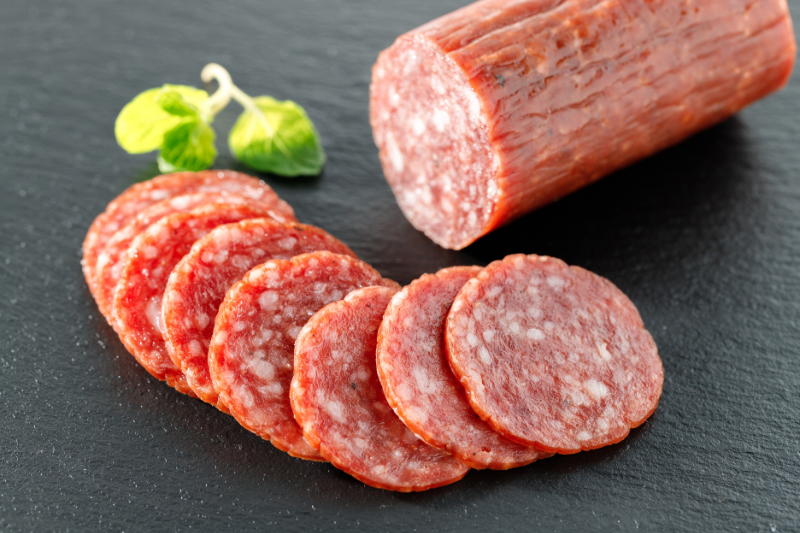
Salami is not a good food for weight loss — at 425 calories per 100 grams, poor protein efficiency, and a sodium load that can hit 82% of your daily limit in a single small portion, it works against almost every goal a dieter has.
Keep reading to see exactly what's in salami, what the research says, and how to handle it if you're not ready to cut it out completely.
What's Actually in Salami — The Calorie and Macro Breakdown
Salami is one of the most calorie-dense foods you'll find in a deli case. At 425 calories per 100 grams, it packs roughly 2.5 times the energy of chicken breast into the same weight.
The macronutrient split explains why: 79% of those calories come from fat, 20% from protein, and just 1% from carbs. Fat carries 9 calories per gram compared to protein's 4, so every bite carries a heavy caloric price tag.
Water content makes this worse. Salami sits at just 36–41% water, versus 65% in chicken breast — meaning calories are far more concentrated per bite. To hit 500 calories, you'd need only 118 grams of salami but over 300 grams of chicken.
Sodium is the other issue, at 1,890 mg per 100 grams — 82% of the FDA's entire daily limit in a portion smaller than a deck of cards.
Not all salami is equal, though:
- Pepperoni: 504 cal/100g — the worst offender
- Hard salami: 407 cal/100g, highest sodium of traditional varieties
- Cooked salami: 336 cal/100g — lightest traditional option
- Turkey salami: 172 cal/100g — nearly half the calories of pork-based salami
Salami's Protein Problem — Why It Wastes Your Calorie Budget
For weight loss, the number that matters most isn't total protein — it's protein per calorie. Salami delivers just 5.1 grams of protein per 100 calories.
Chicken breast gives you 18.8 grams for the same spend. Canned tuna pushes that to 22 grams. The gap is striking: to hit 30 grams of protein from salami, you'd consume around 588 calories. From chicken breast, that same 30 grams costs you roughly 97 calories.
This inefficiency has a direct impact on hunger. Protein triggers satiety hormones — PYY, GLP-1, and CCK — that tell your brain to stop eating.
When your protein-per-calorie ratio is as poor as salami's, you end up eating more calories before those signals kick in. Small portions of salami simply don't satisfy the way an equivalent calorie spend on lean protein would.
Digestion compounds the problem. Your body burns 20–30% of protein calories just processing them — a metabolic bonus called the thermic effect. For fat, that figure drops to 0–3%.
A 2010 study found processed food meals produced 47% lower diet-induced thermogenesis than whole food meals, meaning you're not only getting less protein per calorie with salami — you're also burning fewer calories digesting it.
What the Research Says About Processed Meat and Weight Gain
Several large studies point in the same direction, though the strength of that evidence deserves honest scrutiny.
The most cited is a 2011 Harvard study published in the New England Journal of Medicine, which tracked 120,877 men and women over 12 to 20 years.
Each additional daily serving of processed meat was linked to 0.93 pounds of weight gain per four-year period — placing it among the top five dietary predictors of weight gain across all foods assessed.
The EPIC-PANACEA study reinforced this, following 373,803 Europeans for roughly five years and finding that a 250-gram daily increase in meat intake predicted 2 kilograms of extra weight gain, with processed meat contributing independently even after accounting for total calorie intake.
A 2014 meta-analysis pooling data from over a million participants found 37% higher odds of obesity among the heaviest processed meat consumers compared to the lowest.
More recent data from Händel et al. (2025), a systematic review of 381,291 participants, associated each daily serving of processed meat with 0.26 kg of weight gain per year and 0.14 cm of waist expansion annually.
That said, the same review rated its certainty of evidence as “low” due to serious risk of bias — and no randomized controlled trial has ever isolated processed meat's specific effect on body weight.
These studies show a consistent pattern, but they can't fully rule out confounding factors. The direction of the evidence is clear; the precise magnitude, less so.
Why Salami Makes Overeating So Easy
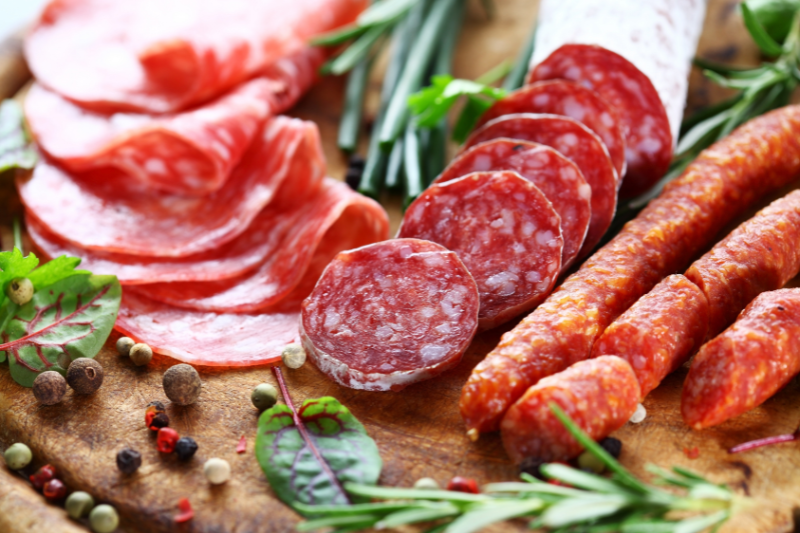
The calorie density alone doesn't fully explain why salami is such a problem for dieters. The way it's designed — intentionally or not — makes it remarkably easy to eat more than you planned.
A 2019 NIH randomized trial by Hall and colleagues put this on full display. Participants offered ultra-processed diets consumed roughly 500 extra calories per day compared to those eating unprocessed food, gaining 0.9 kg over just two weeks.
The unprocessed group lost the same amount. Critically, eating speed was faster on ultra-processed foods even when both diets were matched for available calories and macronutrients.
Salami hits several of the triggers researchers believe drive this overconsumption:
- Fat and salt together create a hyper-palatable combination that keeps you eating past the point of fullness
- Soft texture means less chewing, which reduces the oral processing time that normally helps trigger satiety signals
- The protein leverage effect — with salami's 79/20 fat-to-protein split, your body may push you to eat more overall just to meet its protein needs
Sodium adds a quieter problem. A single ounce of salami can deliver 23% of your daily sodium limit, promoting water retention that masks real fat loss on the scale — which can be discouraging enough to derail progress entirely.
Which Diets Allow Salami — and Which Don't
Where salami fits depends entirely on what framework you're following. The answer ranges from “actively encouraged” to “essentially off the table.”
Keto and low-carb are where salami genuinely belongs. Its high fat content supports ketosis, it has near-zero carbs, and it stays well within the typical 20–50 gram daily carb ceiling. On Atkins, it works as a convenient grab-and-go snack without requiring much planning.
For every other diet, the picture gets less favorable:
- Calorie counting (CICO): Technically allowed, but one ounce already burns through 8–10% of a 1,500-calorie daily budget while delivering poor satiety. You're spending a significant chunk of your allowance on food that won't keep you full.
- Weight Watchers: Salami costs 5–7 points per ounce. Lean chicken breast frequently scores zero. That point gap adds up fast.
- Mediterranean diet: Despite its Italian roots, this diet places processed meat at the very top of its food pyramid — meaning rare consumption only. Traditionally, cured meats weren't treated as real food at all, more as a seasoning used sparingly to add flavor.
If you're counting calories or following a Mediterranean approach, salami isn't forbidden — but the math and the philosophy both push against making it a regular part of your meals.
How to Eat Salami Without Derailing Your Diet
Salami doesn't have to be completely off the table — it just needs to be handled with some intention. The core principle is simple: treat it as a flavor accent, not a protein source.
Here's what that looks like in practice:
- Cap portions at 1 oz (2–3 thin slices) per sitting. That keeps the damage to roughly 120 calories. More than that and the calorie cost climbs quickly with little additional satiety to show for it.
- Switch to turkey salami when you can. At 172 calories per 100 grams versus 425 for pork-based salami, and with nearly double the protein-to-fat ratio, it's a meaningfully better option — not just marginally.
- Pair it with high-volume foods. Vegetables and whole grains alongside a small amount of salami stretch the meal's satiety without a proportional calorie increase.
- Choose reduced-sodium varieties. Standard salami runs 1,890 mg of sodium per 100 grams; reduced-sodium versions bring that down to around 623 mg — a significant difference for water retention and cardiovascular health.
- Track it carefully. Small slices are easy to underestimate, and casual nibbling can quietly add hundreds of uncounted calories to your day.
One common misconception worth addressing: “uncured” salami is not a better choice for weight loss.
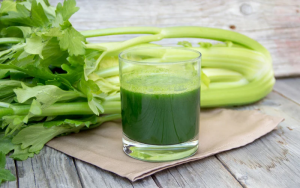
These products typically swap conventional nitrates for celery powder as a natural nitrate source, but the calorie and fat content stays virtually identical.
The label distinction matters if you're concerned about additives — not if your goal is a calorie deficit.
Conclusion
For most dieters, salami is a poor fit — its calorie density, weak protein efficiency, and high sodium content all push against weight loss rather than supporting it.
The one real exception is keto, where its fat-heavy profile actually works in your favor.
Everyone else is better off treating it as an occasional garnish, switching to turkey salami when possible, and leaning on lean proteins that deliver far more satiety per calorie.