Yes, lettuce is good for weight loss — not because it burns fat or speeds up your metabolism, but because its extremely low calorie density (just 13–17 calories per 100 grams) and high water content let you eat large, filling portions without consuming much energy at all.
Keep reading to see what the clinical research actually shows, which varieties work best, and the common mistakes that cancel out the benefit entirely.
Why Lettuce Is Built for Weight Loss
Lettuce sits at the extreme low end of the caloric spectrum, with an energy density of just 0.13–0.17 kcal/g — a range that places every variety firmly in the “very low” category, lower than virtually any other food you can eat.
At 94–96% water by weight, there's simply not much room for calories.
To put that in perspective:
- Cooked rice: 1.30 kcal/g
- Chicken breast: 1.65 kcal/g
- Cheddar cheese: 4.03 kcal/g
An entire head of romaine lettuce contains roughly the same number of calories as a single tablespoon of olive oil.
That gap is what makes lettuce useful — you can eat a genuinely large amount of it without putting a dent in your daily calorie budget.
Its glycemic index hovers around 15, with a glycemic load that rounds to near zero, meaning it has essentially no impact on blood sugar — a relevant point for anyone managing insulin sensitivity alongside their weight.
What Clinical Trials Actually Found
Most of the hard evidence on lettuce and weight loss traces back to Penn State researcher Barbara Rolls, whose volumetrics program has produced over 250 publications on energy density and eating behavior.
Her 2004 landmark study is where the salad preload concept gets its strongest support.
In that study, 42 women ate lunch weekly over seven weeks, with varying first-course salads or no salad at all.
The findings were clear: a large, low-calorie salad (300g, ~100 kcal) eaten before pasta reduced total meal intake by 12%.
A smaller version cut it by 7%. Follow-up studies held up: a 2012 study confirmed that a 300g salad preload reduced energy intake by 11% (about 57 calories), and a 2014 study measured a 123-calorie reduction in test meal intake after a compulsory salad preload.
That same 2014 study also found that serving the salad before the main course — rather than alongside it — increased vegetable consumption by 23%.
There's an important warning buried in Rolls' 2004 data, though.
When salads were loaded with cheese, croutons, and heavy dressings, they didn't reduce intake — they increased it by 8–17%. The preload only works when it stays low-calorie.
The most consequential evidence came from a year-long trial published in 2007.
Ninety-seven obese women were split into two groups: one followed a reduced-fat diet, the other added water-rich produce like lettuce-based salads to the same reduced-fat approach.
Neither group counted calories. After one year, the produce-rich group lost 7.9 kg versus 6.4 kg — about 40% more weight.
At the six-month mark, the gap was even wider: roughly 20 pounds versus 15. They also reported significantly less hunger throughout.
How Lettuce Makes You Feel Full
Lettuce triggers satiety through at least four distinct mechanisms — which helps explain why it tends to outperform simple calorie restriction.
Physical volume is the most immediate. Three cups of romaine weighs about 140 grams but delivers only 24 calories.
That bulk physically distends the stomach, activating stretch receptors that signal the vagal nerve, which then prompts cholecystokinin (CCK) release and trips the hypothalamus's satiety circuits — all before any meaningful number of calories has been absorbed.
Water content plays a separate but equally important role.
A 1999 study by Rolls and colleagues found that water bound within food — as in lettuce at 95% water — reduces subsequent energy intake more effectively than drinking the same volume of water alongside a meal.
The hydration in lettuce creates satiety that a glass of water simply can't replicate.
Thylakoids — the chloroplast membranes found in lettuce and other greens — add a hormonal dimension.
Research from Lund University showed that thylakoids inhibit pancreatic lipase, slowing fat digestion and giving intestinal satiety hormones more time to signal the brain.
A 2014 trial found 43% more weight loss and a 95% reduction in sweet cravings in participants receiving daily thylakoid supplementation; a 2015 study measured a 21% reduction in hunger and a 14% increase in satiety from a single dose.
One important caveat: both studies used concentrated thylakoid extracts, not whole raw lettuce.
Eating lettuce provides partial thylakoid benefit, but cell walls need to be disrupted — through chewing or processing — for full release.
Chewing time rounds out the picture. Lettuce demands more mastication than most processed foods, and slower eating consistently correlates with lower overall intake and earlier satiety signaling.
Which Type of Lettuce Is Best for Weight Loss
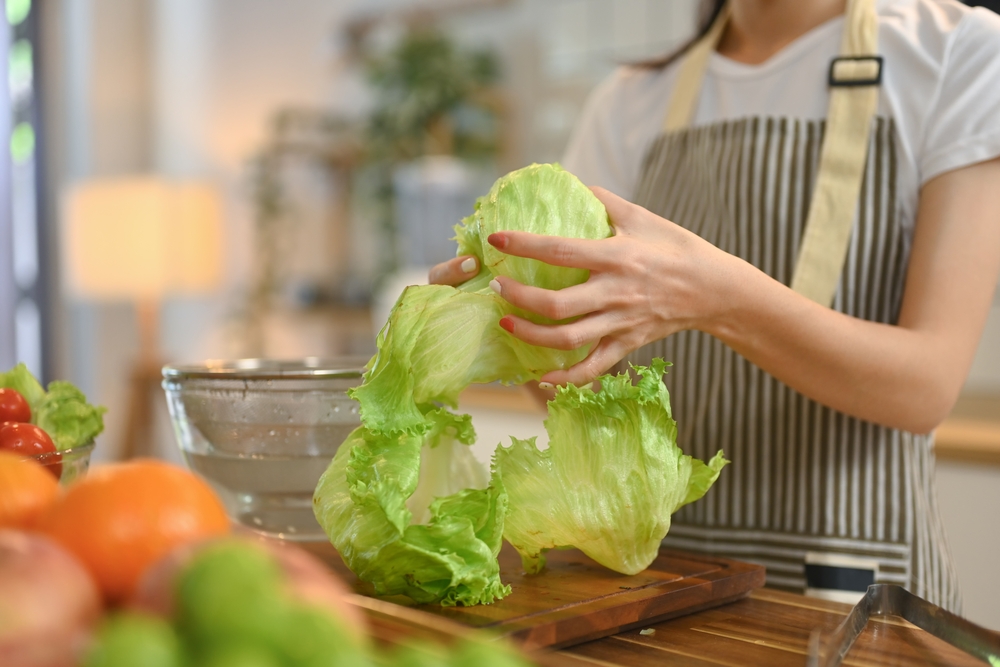
Not all lettuce varieties are equal — and the differences matter depending on what you're trying to accomplish.
Romaine is the strongest all-around choice.
It has the highest fiber content among true lettuces at 2.1g per 100g, 17 times more vitamin A than iceberg, and the most folate of any variety.
A 2021 randomized crossover trial found that adding romaine to a moderately high-fat meal trended blood glucose downward in the post-meal period — an effect not replicated by other greens tested.
Butterhead (Boston/Bibb) has the lowest calorie density of any variety at 0.13 kcal/g, but its most practical weight-loss application is as a wrap. Its large, pliable leaves work well as a direct substitute for bread or tortillas — swapping a flour tortilla (~150 calories) for two butterhead leaves (~3 calories) saves roughly 147 calories per wrap without reducing portion size at all.
Red leaf lettuce won't win on fiber or vitamins, but it carries the highest antioxidant capacity of any lettuce type, driven by anthocyanins — specifically cyanidin 3-O-malonylglucoside — found in meaningful quantities only in this variety.
Chronic inflammation is increasingly linked to obesity and insulin resistance, so its anti-inflammatory properties may offer indirect metabolic support.
Iceberg is the least nutritious option by a significant margin — 17 times less vitamin A and five times less vitamin K than romaine. That said, it still serves a purpose: maximum volume per calorie.
For anyone who needs the physical sensation of eating a large quantity of food, iceberg's high water content and satisfying crunch make it a reasonable addition, just not a sole green.
Arugula is technically a cruciferous vegetable rather than a true lettuce, and its nutritional profile reflects that. It delivers 2.58g of protein per 100g, 160mg of calcium, 369mg of potassium, and the highest dietary nitrate content of any common salad green.
Its peppery flavor also tends to make salads feel more complete on their own — which can reduce the temptation to pile on calorie-dense toppings.
The Biggest Mistakes That Cancel Out the Benefit
The most important principle from the research is that lettuce works through substitution, not addition. Simply adding a salad on top of an otherwise unchanged diet produces minimal results.
The weight loss benefit emerges specifically when lettuce-based foods replace higher-calorie options — a lettuce wrap instead of a bread sandwich, a large salad in place of half a plate of pasta, or a pre-meal salad that reduces appetite enough to lower how much you eat afterward.
Toppings are where most people quietly undo the math. Two tablespoons of ranch dressing add roughly 130 calories and 14 grams of fat — and most people pour considerably more than that.
A restaurant Caesar salad loaded with croutons, parmesan, and creamy dressing can easily hit 800 to 1,000 calories, which is more than a cheeseburger.
Barbara Rolls' own research confirmed that energy-dense salads increased total meal intake by up to 17%, completely reversing the preload benefit the salad was supposed to create.
If you're using a salad as a pre-meal strategy, here's what the evidence actually supports:
- Keep it under 100 calories total
- Use oil-based dressings in measured portions — no more than 2 tablespoons
- Skip croutons, bacon, fried proteins, and heavy cheese
The salad preload only works when it stays lean. The moment it becomes calorie-dense, it stops reducing intake and starts adding to it.
What Lettuce Can't Do (And What to Watch Out For)
Lettuce is a useful tool, but it's nutritionally thin — and leaning on it too heavily creates real problems.
It contains negligible protein, zero vitamin B12, minimal iron and calcium, and essentially no fat.
That last point is particularly worth noting: dietary fat is required to absorb the fat-soluble vitamins A, D, E, and K — some of which lettuce itself provides.
A diet built too heavily around lettuce can actually undermine the absorption of its own nutrients.
Over-reliance on lettuce as a primary food source carries a specific set of risks: muscle wasting, metabolic slowdown, iron-deficiency anemia, bone loss, and hormonal disruption.
It works as one component of a balanced diet, not as the foundation of one.
Food safety is a separate concern worth taking seriously. Romaine in particular has been linked to at least nine E. coli O157:H7 outbreaks since 2017. The 2018 outbreak alone sickened 210 people across 36 states, resulting in 27 cases of kidney failure and 5 deaths.
Washing thoroughly, refrigerating below 40°F, and discarding outer leaves reduces risk — but doesn't eliminate it entirely.
Finally, lettuce isn't universally well-tolerated.
Despite its low-FODMAP classification, the insoluble fiber in lettuce can trigger intestinal contractions and significant abdominal distension in people with IBS or impaired gut motility.
If raw lettuce consistently causes digestive discomfort, that's a documented physiological response — not something to push through.
Conclusion
Lettuce earns its place in a weight loss diet through simple physics — low calorie density, high water content, and enough volume to genuinely reduce how much you eat at a meal — not through any metabolic shortcut.
The clinical evidence is clear: it works when it replaces calorie-dense foods, and it stops working the moment high-calorie toppings or unchanged eating habits cancel out the deficit.
Use it as one well-placed tool within a balanced, protein-adequate diet, and it's one of the few foods that lets you eat more while consistently consuming less.