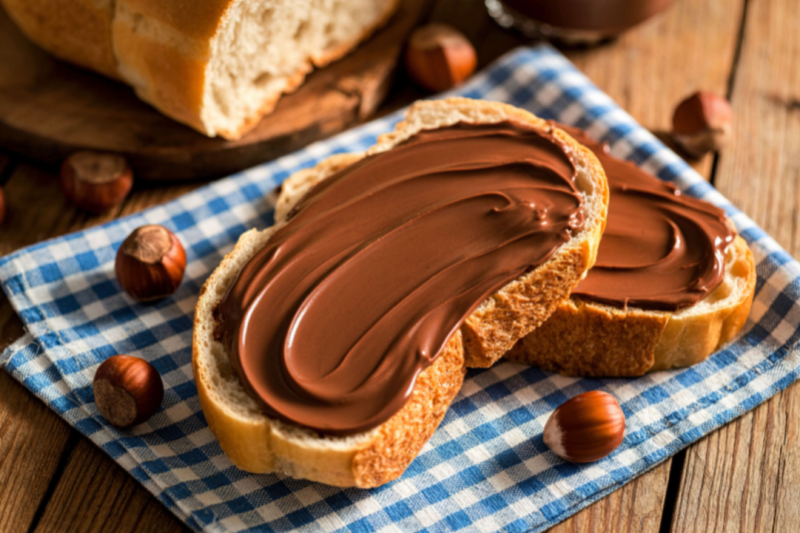
Nutella is not good for weight loss — a single two-tablespoon serving packs 200 calories, 21 grams of sugar, and barely 2 grams of protein, making it one of the least satisfying ways to spend calories on a restricted diet.
That said, small amounts can fit into a calorie-controlled plan without derailing your progress, and the full picture is worth understanding before you decide whether to keep the jar or ditch it.
What's Actually Inside a Jar of Nutella
The ingredient list settles the debate before you even get to the nutrition label. Sugar comes first, followed by palm oil — and only then hazelnuts at just 13%.
Skim milk powder (8.7%) and cocoa (7.4%) round out the list. Together, sugar and fat account for 89% of Nutella by weight and 96% of its calories, which means almost nothing you're eating serves any nutritional purpose.
Per two-tablespoon (37g) serving, the numbers look like this:
- 200 calories
- 11g total fat, 4g saturated
- 21g sugar
- 2g protein
- 1g fiber
The caloric density sits at 5.4 calories per gram — higher than jam (2.6 cal/g) or honey (3.0 cal/g). It's in peanut butter territory, but that comparison actually works against Nutella.
Peanut butter delivers 7–8 grams of protein per serving; Nutella delivers 2. The calories look similar on paper, but the nutritional return is completely different.
The fat deserves a closer look too. Roughly one-third of it is saturated, sourced from refined palm oil that's been processed in a way that strips out whatever beneficial compounds the raw oil might have had.
And if you're still thinking of Nutella as something vaguely wholesome, consider this: one serving contains more sugar than a serving of Betty Crocker Milk Chocolate Frosting — 21 grams versus 17.
At its core, Nutella is a dessert ingredient, and the numbers make that hard to argue with.
How Nutella Stacks Up Against Your Daily Limits
On a 1,500-calorie diet, one two-tablespoon serving of Nutella takes up 13.3% of your daily calories — yet covers only 2.7% of your protein needs and 3.3% of your fiber needs.
That's a poor trade-off by any measure, but the sugar numbers are where things get particularly stark.
The American Heart Association recommends women limit added sugar to 25 grams per day and men to 36 grams.
A single Nutella serving contains 19 grams of added sugar — that's 76% of a woman's entire daily allowance in one sitting.
Men fare better but still burn through 53% of their limit.
The WHO's guideline is even stricter, capping free sugars at 5% of total energy intake. On a 1,500-calorie diet, one serving of Nutella blows past that ceiling entirely.
Saturated fat follows a similar pattern. The 4 grams per serving represents 24% of the daily saturated fat budget on a 1,500-calorie plan, and 31% under the AHA's tighter recommendation of keeping saturated fat below 5–6% of total energy.
One number that tends to mislead people is Nutella's glycemic index of 33, which technically falls in the “low” range.
The catch: that low GI is a function of Nutella's high fat content slowing digestion and glucose absorption — not any inherent nutritional quality.
The sugar is still absorbed; it just enters your bloodstream more gradually. A low GI doesn't make a food healthy, and in Nutella's case, it doesn't come close.
Why Nutella Makes Overeating So Easy
Nutella isn't just high in sugar and fat — it's specifically the combination of the two that makes it so hard to stop eating.
With roughly 54% of its calories coming from fat and 42% from sugar, it meets the clinical definition of a hyperpalatable food: one where that fat-sugar overlap actively works against your ability to stop at a reasonable amount.
Research by Dr. Tera Fazzino at the University of Kansas found that hyperpalatable foods bypass normal satiety mechanisms and activate the brain's reward circuitry, pushing you toward overconsumption before your body has a chance to register fullness.
Neuroimaging studies reinforce this — when fat and carbohydrates combine, the brain's reward response is stronger than it would be from either macronutrient on its own. Nutella delivers both simultaneously, in every bite.
What makes this worse is what Nutella doesn't have.
With only 2 grams of protein and 1 gram of fiber per serving, there's almost nothing present to create a satiety signal and push back against that reward response.
Your brain is getting the green light to keep eating while your stomach gets very little reason to stop.
Then there's the portion reality. A true two-tablespoon serving — the one the nutrition label is based on — is roughly the size of a walnut in its shell.
Most people spread considerably more than that without realizing it, which means the already unfavorable numbers on the label are frequently an undercount of what's actually being consumed.
Nutella's thick, creamy texture makes it especially easy to misjudge, and that's a problem when every extra teaspoon adds roughly 33 calories of mostly sugar and fat.
The Case for Not Banning It Entirely
The nutritional case against Nutella is clear, but that doesn't automatically mean cutting it out completely is the right move.
A substantial body of dieting research suggests the opposite approach often works better.
Smith et al. found in 1999 that flexible dieting — allowing occasional treats within a calorie budget — correlated with lower body mass, less overeating, and lower rates of depression and anxiety compared to rigid restriction.
Westenhoefer's research across multiple studies reached a consistent conclusion: people who follow strict, all-or-nothing dietary rules tend to experience more disinhibited eating and carry higher BMIs than those who allow themselves some flexibility.
The restrict-crave-binge cycle is a real pattern, and for many people, banning a specific food outright is precisely what triggers it.
The underlying principle here is CICO — calories in, calories out.
No single food prevents weight loss if your overall caloric deficit is maintained.
Nutella is a poor use of calories, but a small, measured amount within a well-structured diet doesn't have the power to derail your progress on its own.
The practical application of this is simpler than it sounds.
One registered dietitian approach worth noting: stir one teaspoon of Nutella into plain Greek yogurt.
You get the chocolate-hazelnut flavor you're craving, the portion stays around 33 calories, and the yogurt's protein content gives the snack actual nutritional substance.
It's a strategy that's helped some people maintain long-term consistency precisely because it removes the feeling of deprivation that tends to backfire.
The goal isn't to find room for Nutella — it's to avoid letting the pursuit of perfection become the enemy of steady, sustainable progress.
How to Actually Use Nutella Without Wrecking Your Progress
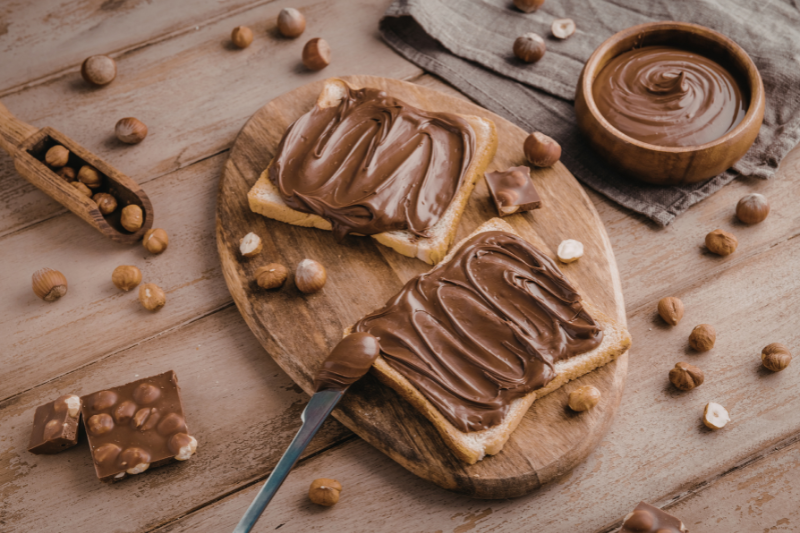
The single biggest variable between Nutella fitting your diet and derailing it is serving size. One teaspoon runs about 33 calories and works as a flavor accent.
Two tablespoons — what most people actually use — hits 200 calories with 21 grams of sugar.
That 167-calorie gap is the difference between a manageable treat and a significant chunk of your daily budget spent on something with almost no nutritional return.
A few rules that make this workable in practice:
- Measure every time. Nutella's thick, sticky consistency makes estimating by eye genuinely unreliable. Use actual measuring spoons — not a knife, not a rough scoop.
- Always pair it with protein and fiber. On its own, Nutella provides almost no satiety. Adding it to something substantial changes the equation. Nutella swirled into Greek yogurt with berries, or spread thinly on whole-grain toast alongside scrambled eggs, turns a sugar hit into a balanced snack.
- Keep frequency in check. Two to three times a week as an occasional treat is manageable. Daily use adds up faster than most people track.
If you know portion control with Nutella is a weak spot, pre-portioned formats remove the guesswork entirely.
Nutella Mini Cups come in at 15 grams and around 80 calories. Justin's single-serve squeeze packs land at the same calorie count with better macros.
For reference, two combinations that actually work calorie-wise:
- Rice cake + 1 tsp Nutella + half a banana ≈ 130 calories
- ¾ cup nonfat Greek yogurt + 1 tsp Nutella + ¼ cup blueberries ≈ 180 calories, 15g+ protein
Both satisfy a chocolate craving while delivering real nutrition alongside it — which is the entire point.
Better Alternatives If Portion Control Is a Struggle
If you find that keeping Nutella in the house reliably leads to overusing it, switching products is a smarter move than white-knuckling your way through every craving.
Several alternatives deliver a similar flavor experience with meaningfully better numbers.
Justin's Chocolate Hazelnut & Almond Butter is the closest like-for-like swap.
It matches Nutella at 200 calories per two tablespoons, so the serving size math stays the same — but the composition is substantially different: 8 grams of sugar instead of 21 (58% less), 4 grams of protein instead of 2, and 2 grams of fiber instead of 1.
Hazelnuts are the first ingredient, not sugar. For people who want the same format with less dietary damage, this is the obvious starting point.
If you're open to making something at home, a blend of roasted hazelnuts, dates, and raw cacao cuts calories by roughly 50% and sugar by around 70% compared to Nutella.
It takes some prep, but the macro difference is significant enough to be worth it for regular users.
For simpler options with less effort:
- Plain natural hazelnut butter — same nutty flavor profile, virtually zero added sugar
- PB2 powdered peanut butter — 60 calories per two tablespoons, 6 grams of protein, useful when you want something chocolate-adjacent with minimal caloric cost
To put Nutella's diet cost in concrete terms: Noom classifies it as Orange, its most restricted category, recommending it make up less than 25% of daily intake.
Weight Watchers estimates 10–12 Points per two-tablespoon serving — a substantial cut into a typical daily budget of 23–30 Points.
Those classifications exist for a reason, and the alternatives above largely avoid them.
Conclusion
Nutella is a dessert spread that happens to come in a jar — at 200 calories, 21 grams of sugar, and next to no protein per serving, it offers very little that supports weight loss and a few things that actively work against it.
The fix isn't necessarily removing it from your diet altogether, but rather shrinking the serving from a spread to a measured teaspoon and pairing it with protein and fiber every time.
If you find that hard to stick to consistently, the alternatives covered above give you the same general experience with numbers that are much easier to work with.