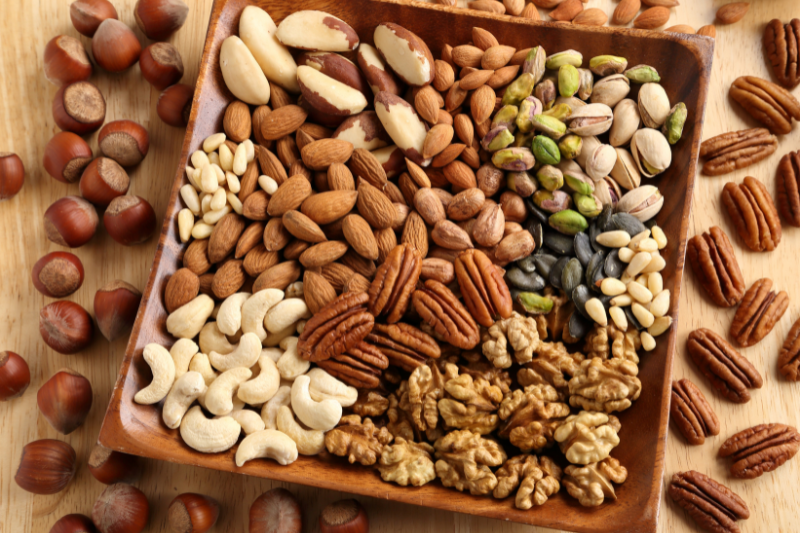
Almonds, pistachios, walnuts, peanuts, and pecans are the five best nuts for weight loss — each one high in protein, fiber, and healthy fats that keep you full longer and help you eat less overall.
Keep reading to see exactly what makes each one worth adding to your diet and how to eat them in a way that actually moves the needle.
Why Nuts Can Help With Weight Loss
Nuts are calorie-dense, yet study after study shows they don't cause the weight gain you'd expect. A few mechanisms explain why.
The biggest one is incomplete calorie absorption. Nuts have rigid cell walls that trap fat during digestion, so your body actually absorbs fewer calories than the nutrition label implies — anywhere from 5% to 32% fewer depending on the nut.
The second factor is satiety. The combination of protein, fiber, and unsaturated fat slows digestion and keeps hunger at bay longer than a comparable serving of chips, crackers, or pretzels would. On top of that, eating nuts regularly produces a small but measurable increase in resting energy expenditure — meaning your body burns slightly more calories at rest.
That said, none of this works if you're simply adding nuts to what you already eat. The benefit comes from replacing a less nutritious snack, not stacking on top of one.
Almonds — The Strongest Evidence
Almonds have the most compelling weight loss data of any nut. In a meta-analysis covering 62 randomized controlled trials and over 7,000 participants, almonds were the only nut individually linked to a significant reduction in body mass — roughly 0.5 kg more than control diets. A separate 3-month trial where participants ate 50g of almonds daily on a reduced-calorie diet produced greater weight loss and better cholesterol numbers than the no-almond group.
A big part of why comes down to how your body processes them. Almonds deliver the largest calorie discount of the five nuts covered here — your body absorbs about 32% fewer calories than the label suggests. That means a 1 oz serving listed at ~164 calories lands closer to 129 in practice, thanks to fat being trapped inside the nut's cell walls during digestion.
One important detail: that discount only applies to whole almonds. Almond butter and ground or finely chopped almonds break down those cell walls, so you absorb calories much closer to what the label says.
How to eat them: 1 oz (about 23 almonds) once daily, raw or dry-roasted, unsalted.
Pistachios and Walnuts — Satiety and Smart Snacking
Pistachios
Pistachios are the portion-control nut. At roughly 49 kernels per ounce, you get more pieces per serving than any other nut on this list, which naturally slows how fast you eat. Buy them in-shell and that effect amplifies considerably — one study found people ate 41% fewer calories from in-shell pistachios compared to pre-shelled ones, simply because the extra step creates a natural pause between handfuls.
The nutrition profile holds up too. Pistachios have a glycemic index of around 15, contain all nine essential amino acids, and deliver a modest calorie discount of about 5% versus label values. In a 4-month weight loss trial, the pistachio group lost comparable weight to the control group while also lowering blood pressure and cutting back on sweets — a meaningful side effect if sugar cravings are part of your challenge.
How to eat them: 1–1.5 oz daily, in-shell where possible, unsalted.
Walnuts
Walnuts work a little differently. They carry the highest plant-based omega-3 content of any common nut at 2.5g per ounce, and research using brain imaging found that eating them activated the region responsible for hunger regulation and impulse control — a genuinely interesting finding that goes beyond standard satiety metrics. They also absorb about 21% fewer calories than their label indicates.
How to eat them: 1 oz (~14 halves) daily, raw or lightly toasted. Store in the fridge — walnuts go rancid faster than other nuts, and the omega-3 ALA degrades with heat.
Peanuts and Pecans — The Underrated Two
Peanuts
Peanuts deliver the highest protein of any nut on this list — about 7g per ounce, roughly the same as a small egg. That protein load is a big reason they suppress hunger more effectively than high-carb snacks, keeping you satisfied for noticeably longer after eating them.
The calorie absorption story is interesting here too. Whole peanuts produce more unabsorbed fat in digestion than peanut butter does, meaning you get a meaningful calorie discount from eating them whole that you don't get from the spread. A 19-week study found that regular whole peanut intake increased resting energy expenditure by 11% — and participants gained less weight than predicted given the extra calories.
The long-term data is hard to ignore. An 18-month Harvard trial compared a nut-inclusive moderate-fat diet against a standard low-fat diet. The nut group lost 4.1 kg and shed 6.9 cm from their waist. The low-fat group gained 2.9 kg and added 2.6 cm.
How to eat them: 1 oz of whole dry-roasted unsalted peanuts, or 2 tablespoons of natural peanut butter. Check the label — ingredients should be peanuts, and nothing else.
Pecans
Pecans bring two standout qualities: the highest fiber content of any tree nut at 2.7g per ounce, and a spot in the USDA's top 20 foods for dietary antioxidants. The fiber drives satiety, while the polyphenols and vitamin E work against the inflammation that often accompanies excess weight.
A 4-week trial found that a pecan-rich diet significantly improved fasting insulin and insulin resistance. Perhaps more telling, a separate study added 68g of pecans daily — nearly 470 extra calories — for 8 weeks and found no statistically significant weight gain, which strongly supports the idea that nuts displace other calories rather than simply pile on top.
How to eat them: 1 oz (~19 halves) daily, raw or dry-roasted. Honey-roasted and candied versions add sugar and extra calories that work directly against the benefits above.
How to Eat Nuts for Weight Loss Without Overdoing It
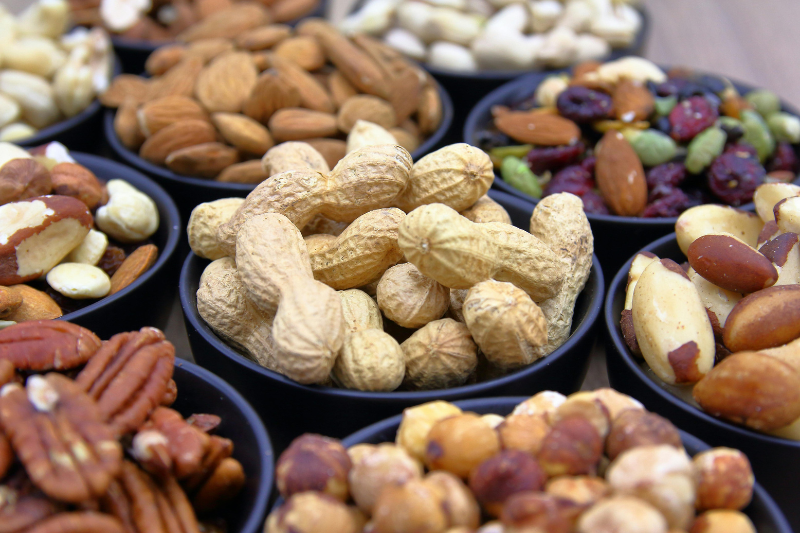
The research is clear on portions: 1 oz once or twice a day is the sweet spot. Go beyond that regularly and the calorie density works against you, regardless of how nutritious the nut is.
Get the portion right
Visual estimates for nuts are notoriously inaccurate — most people pour out significantly more than an ounce without realizing it. A kitchen scale removes the guesswork entirely. If that feels like too much friction, in-shell pistachios are the next best option; the physical act of shelling naturally slows you down and research confirms people eat substantially less as a result.
When to eat them
Timing matters more than most people think. Eating nuts at hunger gaps — mid-morning, mid-afternoon, or about an hour before a meal — puts their satiety effect to work when you need it most, reducing how much you eat at the next meal.
What to buy
Raw or dry-roasted, unsalted, whole nuts. That combination preserves the cell-wall structure that reduces calorie absorption and keeps sodium and added sugar out of the equation. Avoid these varieties:
- Oil-roasted
- Honey-roasted
- Candy-coated
- Heavily salted
Mix them up
No single nut covers everything. Rotating between almonds, pistachios, walnuts, peanuts, and pecans gives you a wider range of fiber, omega-3s, and polyphenols than sticking to just one variety.
What Nuts Won't Do (And How to Set Realistic Expectations)
Nuts are a useful tool, not a solution on their own. Even almonds — the nut with the strongest individual weight loss signal — show roughly 0.5 kg of additional loss compared to control diets. That's worth having, but it won't move the needle if the rest of your diet is working against you.
It's also worth knowing that a large share of the most-cited nut studies are funded by industry groups. Independent meta-analyses still confirm that nuts are at minimum weight-neutral and at best modestly weight-reducing, so the direction of the evidence holds — just temper expectations around the magnitude.
A few practical realities to keep in mind:
- The benefit depends on substitution. Adding nuts on top of what you already eat will likely stall or reverse progress.
- If you've eaten nuts consistently for 12 weeks without any change in weight or waist, the issue is total calorie intake elsewhere — not your nut choice.
- If stopping at 1 oz is genuinely difficult, switch to in-shell pistachios. The extra friction of shelling them makes overconsumption much less likely.
Finally, none of this applies if you have a tree nut or peanut allergy — in that case, these five options are simply off the table.
Conclusion
Almonds, pistachios, walnuts, peanuts, and pecans each bring something different to the table — whether that's a significant calorie discount, built-in portion control, or hunger-suppressing protein and fiber.
The single move that ties it all together is simple: swap your current snack for a 1 oz serving of any of these, keep it consistent, and let the substitution do the work. Small change, solid evidence behind it.