
Yes, jumping on a trampoline can help you lose weight, but only when it's paired with a calorie deficit—rebounding burns roughly 7 to 12 calories per minute, putting it on par with jogging or moderate cycling.
Keep reading to see exactly how the numbers break down and how to build it into a routine that actually gets results.
Does Jumping on a Trampoline Actually Help You Lose Weight?
Weight loss comes down to one basic equation: you need to burn more calories than you take in. No workout changes that math, and rebounding is no exception.
What trampoline jumping does offer is a genuine way to raise your calorie burn for the day, which puts you in a better position to hit that deficit.
The best evidence for rebounding's real-world impact comes from a 12-week study on overweight women. Over that period, participants saw measurable improvements across several markers:
- Reduced body circumferences and fat mass
- Increased lean and muscular mass
- Improved VO2max (a marker of cardiovascular fitness)
- Lower blood pressure
That's a solid list of benefits, and it lines up with what you'd expect from a moderate-intensity cardio routine done consistently for three months.
But the study wasn't perfect. It included only 18 women, and there was no control group to compare against, so the results are suggestive rather than proof that rebounding outperforms other forms of exercise.
What it does show is that rebounding can work as part of a structured routine, not that it works better than the alternatives.
It's worth being clear about what's actually happening physiologically. Rebounding doesn't melt fat through some unique mechanism tied to bouncing.
It burns calories the same way any moderate cardio activity does, through sustained effort that raises your heart rate and energy expenditure. The results people see come from consistency and adherence, not a special metabolic trick.
This is also where a popular myth needs correcting. You've probably heard some version of the claim that “10 minutes of rebounding equals 30 minutes of running.”
That idea traces back to a real NASA-affiliated study from 1980, but it's been misapplied. The original research compared the biomechanical loading and joint impact of jumping versus running, not calorie burn.
It found that for a given heart rate and oxygen consumption, trampoline jumping puts different mechanical stress on the body than running does.
That's a finding about physics and joint stress, not about how many calories you torch. Treating it as a calorie-burning shortcut misreads the entire point of the study.
How Many Calories Does Trampoline Jumping Actually Burn?
The number of calories you burn on a trampoline depends entirely on how hard you're working, and the range is wider than most people expect:
- Light, casual bouncing: around 5-7 calories per minute (roughly 150-210 calories in 30 minutes)
- Moderate, structured rebounding: around 7-10 calories per minute (roughly 210-300 calories in 30 minutes)
- Vigorous or HIIT-style rebounding: 10-12.4+ calories per minute (roughly 300-370+ calories in 30 minutes)
That's a big spread, and it explains why some people report modest results while others see faster progress with what looks like the same activity.
Several factors determine where you land on that scale. Your body weight plays a role, since heavier individuals burn more calories performing identical movements simply because moving more mass takes more energy.
Effort level matters just as much: a slow, relaxed bounce burns far less than a controlled routine with intentional height and pace.
The specific movements you choose also shift the number, since adding arm swings, tuck jumps, or lateral movements increases the muscle groups involved and pushes the intensity higher. Session length factors in too, though it's a straightforward multiplier once you know your per-minute rate.
One finding worth paying attention to: rebounding tends to feel easier than it actually is. Research measuring heart rate and oxygen consumption during trampoline workouts found intensity levels that qualify as moderate to vigorous, yet participants rated their perceived effort as lower than the objective data suggested it should be.
In practice, this means you could be getting a solid cardiovascular workout while feeling like you're barely trying. That's useful information if you're gauging your effort by feel alone, since it's easy to underestimate how much work your body is actually doing.
This also has a psychological upside. Workouts that feel easier while still delivering a real calorie burn tend to get repeated more often, and consistency is what drives results over time.
How Rebounding Compares to Other Cardio Workouts
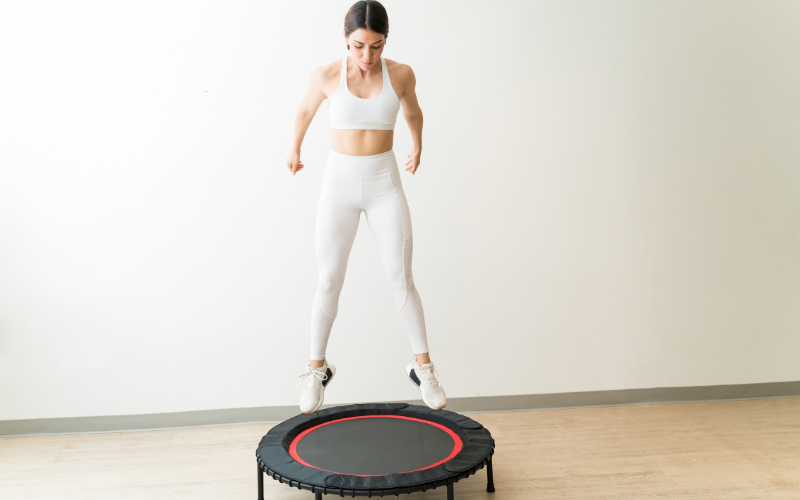
Numbers mean more with context, so here's how a 30-minute trampoline session stacks up against other common cardio options for a 155-pound person:
- Walking (3.5 mph): ~149 calories
- Trampoline, mini (moderate): ~210-252 calories
- Trampoline, full-size (moderate): ~246 calories
- Cycling, moderate: ~252 calories
- Rowing, moderate: ~252 calories
- High-impact aerobics: ~252 calories
- Jogging (6 mph): ~372 calories
- Elliptical: ~324 calories
- Jump rope: ~372 calories
- Cycling, vigorous: ~378 calories
Looking at this lineup, rebounding settles into the middle of the pack. It clearly outperforms walking, and at moderate intensity it lands close to cycling, rowing, and high-impact aerobics, while roughly matching jogging at 6 mph.
Vigorous running, jump rope, and hard cycling still burn more per minute, so if pure calorie burn is your only goal, those options edge out rebounding.
Calorie burn isn't the full story, though. The real advantage of rebounding shows up when you factor in joint impact.
You can get a calorie burn comparable to jogging or moderate cycling while putting significantly less stress on your ankles, knees, and hips, since the trampoline mat absorbs a large portion of the landing force that would otherwise transfer straight into your joints on pavement or a treadmill.
For anyone managing joint sensitivity, recovering from impact-heavy training, or simply looking to reduce wear and tear over time, that trade-off matters as much as the raw numbers.
One detail worth addressing: full-size trampolines do burn slightly more than mini-trampolines, largely because they allow a greater range of motion per jump. But the difference is modest, and it comes with real downsides.
Full-size trampolines take up considerably more space, cost more, and carry a higher risk of falls and injury.
For most people, that small calorie bump isn't worth the added footprint, expense, and risk. A quality mini-trampoline delivers nearly the same benefit in a fraction of the space.
Why Rebounding Works the Body Differently Than Running
Running is mostly a lower-body activity. Rebounding recruits far more of your body at once, and that difference shows up in both how the workout feels and what it does for you over time.
Full-body engagement starts with your core. Every time you land on an unstable, bouncy surface, your core and stabilizer muscles fire to keep you balanced and upright. Running on solid ground doesn't demand this kind of constant micro-adjustment, since the surface itself does the stabilizing for you. On a trampoline, your body has to do that work continuously, which means your abs, obliques, and deep stabilizing muscles are getting trained alongside your legs on every single bounce.
Add arm movements, and you extend that engagement even further. Swinging your arms, pumping them overhead, or incorporating light hand weights brings your shoulders, chest, and upper back into the workout, turning what could be a purely lower-body activity into something closer to a full-body session.
The mat itself changes the physics of impact. When you land on pavement or a treadmill belt, nearly all of that force travels straight up through your ankles, knees, and hips. A trampoline mat absorbs a large share of that landing force instead, which is why rebounding is so often recommended for people managing joint pain, recovering from injury, or simply looking to reduce cumulative wear over years of training.
Beyond the calorie burn, rebounding brings a set of health benefits that extend well past the scale:
- Improved cardiovascular fitness, including measurable gains in VO2max
- Lower blood pressure with consistent training
- Better blood sugar regulation and insulin sensitivity
- Improved balance, which matters increasingly with age
- Support for bone health through repeated, low-impact loading
One claim you'll run into often is that rebounding triggers “lymphatic detox,” flushing toxins out of the body in a way other exercise can't.
This deserves a direct answer: it's overstated. Muscle contractions do help move lymph fluid through the body, and that part is true of any movement, not just bouncing.
But the idea that rebounding produces some special detoxifying effect beyond what your liver, kidneys, and lymphatic system already handle on their own isn't backed by solid evidence.
Your body clears waste products through its normal organ function regardless of which cardio you choose.
Rebounding earns its benefits through real, measurable physiological effects like the ones above. It doesn't need an unproven detox claim to make it worth doing.
How to Build a Trampoline Workout Routine for Weight Loss
Getting results from rebounding isn't about bouncing harder or longer right away. It's about setting up the right equipment, building intensity gradually, and staying consistent enough for the calorie burn to add up.
Start with the right equipment. A mini-trampoline is the standard choice for fitness rebounding, and a few features separate a good one from a frustrating one:
- Spring vs. bungee cord: Springs offer a firmer, more responsive bounce, while bungee cords provide a softer landing that's gentler on the joints. If you're managing joint sensitivity, bungee cords are usually the better fit.
- Stability bar: A handlebar attachment adds confidence and control, especially useful for beginners or anyone working on balance.
- Build quality: Skip the cheap, saggy models. A worn-out mat or weak frame doesn't just limit your workout, it increases your risk of losing balance or landing awkwardly.
Beginner phase: build control first. In the early weeks, the goal isn't calorie burn, it's learning to move safely on an unstable surface. Keep sessions short, focus on smooth, controlled bounces, and aim for consistency over intensity. Several short sessions a week at this stage build the coordination and balance you'll need before adding real intensity.
Progression phase: build volume gradually. Once control feels natural, start extending session length and adding more days per week. The goal is to work up toward a higher weekly minute total over time, since consistent volume is what drives visible results. This is a gradual process. Adding too much too quickly increases injury risk and rarely speeds up results.
Introduce interval training. Once you have a solid base, alternating short bursts of high-intensity bouncing with recovery-paced bouncing pushes your calorie burn higher without requiring longer sessions. A simple structure:
- Bounce at a hard, fast pace for a short burst
- Drop to an easy, controlled bounce to recover
- Repeat the cycle for the length of your session
This kind of interval work also boosts your calorie burn after the workout ends, since your body keeps working harder to recover even once you've stopped.
Add variety to keep progressing. Once the basics feel comfortable, layer in changes that increase intensity and prevent plateaus:
- Incorporate arm swings or overhead movements
- Add light hand weights for extra resistance
- Mix steady-state sessions with interval days across the week
Sample weekly structure:
- 2-3 moderate, steady-paced sessions
- 1-2 interval sessions
- 1-2 rest or active recovery days
This kind of balance builds fitness while giving your body time to recover, which keeps you consistent over the long run.
None of this replaces the other half of the equation. A trampoline routine, no matter how well-structured, won't move the scale if your diet isn't in a deficit.
The workout builds the calorie burn; your eating habits determine whether that burn translates into actual weight loss.
Safety, Precautions, and Realistic Expectations
Rebounding is low-impact compared to running, but it's not risk-free. Knowing what to watch for, and what to expect, keeps your routine sustainable rather than sidelined.
Common injuries come from a few predictable causes:
- Ankle strain from awkward landings or repeated compression
- Knee irritation from poor form or overuse
- Lower back flare-ups, especially with improper posture during bounces
- Falls resulting from lost balance, often tied to worn-out equipment or overreaching with intensity too soon
Most of these are preventable with a stable trampoline, gradual progression, and attention to landing technique.
Some people should check with a doctor before starting. This isn't a workout everyone should jump into without guidance. Talk to a physician first if you have:
- A heart condition
- Osteoporosis
- A hernia
- Back or nerve issues
- A history of seizures
These conditions don't automatically rule out rebounding, but they change how it should be approached, and a professional is better positioned to make that call than a general guideline.
Pelvic floor health deserves its own mention. Repeated bouncing puts downward pressure on the pelvic floor, which can be a concern for women generally and especially for postpartum individuals still rebuilding pelvic floor strength. Landing softly, keeping the core engaged, and avoiding overly aggressive height in the early weeks all reduce strain in this area. If you notice any leakage or discomfort, that's a signal to scale back and possibly consult a pelvic floor specialist rather than pushing through it.
One myth worth clearing up: spot reduction doesn't work. No amount of bouncing will burn fat from one specific area, whether that's your stomach, thighs, or arms. Fat loss happens across the body as a whole, driven by your overall calorie deficit, not by which body part is doing the most work during a workout. Rebounding builds strength and burns calories everywhere at once; it doesn't let you choose where the results show up first.
Timelines matter too. Visible changes from a consistent rebounding routine typically take weeks, not days. Expect early progress to show up gradually, usually becoming noticeable somewhere in the range of a month to a few months of steady effort. Anyone expecting dramatic results in the first week is setting themselves up for disappointment before the routine has had a real chance to work.
Know when to adjust course. A few signals mean it's time to change something rather than push through:
- Pain that persists beyond normal muscle soreness
- Stalled progress despite consistent workouts and a controlled diet
- Any symptom, like joint pain or pelvic discomfort, that doesn't resolve with rest
Any of these is a cue to scale back intensity, revisit your form, or bring in a professional, rather than assuming more effort alone will fix the problem.
Conclusion
Jumping on a trampoline is a legitimate way to support weight loss, offering a real calorie burn with far less joint stress than running or other high-impact cardio, all while feeling more like play than exercise.
But it works the same way any cardio does: it's a tool that supports a deficit, not a substitute for one.
What actually determines your results is consistency and diet, not the workout itself.
Showing up regularly and keeping your eating in check will move the needle far more than chasing a harder bounce or a longer session ever could.
Start small, build gradually, and adjust your intensity as your fitness improves. Given enough consistency, the results tend to follow.