
Yes, women can absolutely lose weight and body fat while strength training — in fact, lifting weights while eating in a moderate calorie deficit is one of the most effective ways to lose fat without sacrificing muscle.
Keep reading to see exactly how this works and how to set up your training and nutrition to get there.
Yes, Women Can Lose Weight (and Fat) While Strength Training — Here's the Science
Fat loss comes down to one thing: eating fewer calories than you burn. Strength training doesn't change that math, but it changes something just as important — what kind of weight you actually lose.
When you diet without lifting, your body doesn't discriminate much between fat and muscle. Somewhere between 20% and 40% of the weight you lose in an unsupported deficit can come straight from lean mass, which means a chunk of every pound lost on the scale is muscle you probably wanted to keep.
Add resistance training and higher protein intake to that same deficit, and the ratio flips: your body holds onto muscle, sometimes even builds a little, while fat makes up the bulk of what you lose.
This distinction matters more than it might seem at first glance. Losing 20 pounds of mostly fat leaves you leaner, stronger, and with a metabolism that's still humming.
Losing 20 pounds where a third of that is muscle leaves you smaller but softer, weaker, and more prone to regaining the weight as fat once the diet ends. Short-term, both scenarios might look identical on a scale. Long-term, they're completely different outcomes.
There's also a common assumption worth addressing here: that women can't build or preserve muscle the way men do because of lower testosterone.
Physiologically, that's not how muscle growth works. Women have roughly 15 to 20 times less testosterone than men, yet the muscle-building response to resistance exercise — the actual cellular signaling that tells your body to repair and grow muscle tissue — activates just as strongly in women as it does in men.
The hormone that spikes after a workout isn't the one driving the process. So the same principle that helps men retain muscle during a diet applies to women too, just as effectively.
Why the Scale Doesn't Tell the Whole Story (Body Recomposition Explained)
There's a process called body recomposition where you lose fat and build (or hold onto) muscle at the same time. It's not a myth or a marketing term — it happens routinely in women who strength train while eating enough protein, and it's the reason the number on your scale can be a pretty unreliable way to track progress.
Here's why: muscle and fat take up different amounts of space for the same weight. Muscle is denser and more compact, while fat is bulkier for the same mass.
So if you lose three pounds of fat and gain three pounds of muscle, your scale weight doesn't move at all — but your waist shrinks, your clothes fit differently, and you look visibly leaner.
Someone watching only the scale would assume nothing happened. Someone tracking their body would see a completely different story.
This is why relying on bodyweight alone during a strength training program sets you up to misread your own results. Better markers include:
- Tape measurements — waist, hips, thighs, arms; these shift even when weight doesn't
- Progress photos — taken in consistent lighting and poses every few weeks, since visual changes often show up before the scale or tape catch up
- How your clothes fit — a surprisingly accurate real-world gauge of fat loss
- Strength numbers — steady increases in the weight you lift signal muscle retention or growth, which matters just as much as fat loss
As for timeline, don't expect dramatic changes overnight. Most women need at least 8 to 12 weeks before recomposition becomes visibly obvious, and a fairer overall assessment usually takes 3 to 6 months.
Progress isn't linear, and a quiet scale for a few weeks doesn't mean nothing is happening underneath.
Recomposition also isn't equally fast for everyone. It tends to happen quickest in a few specific groups:
- Beginners — anyone new to strength training has the most “newbie” muscle-building potential
- Returners — people getting back into training after a break often rebuild muscle faster than they built it the first time
- Higher starting body fat — more stored fat gives the body more fuel to draw on while building muscle simultaneously
If you fall into one of these categories, expect faster, more noticeable recomposition. If you're already lean and well-trained, progress will be slower and more incremental — which is normal, not a sign that something's wrong.
Strength Training vs. Cardio for Fat Loss — Do You Need Both?
Both strength training and cardio can help you lose fat, but they don't do it the same way, and the difference matters when you're deciding how to split your time.
Resistance training on its own has a meaningful, measurable effect on body composition. Studies looking specifically at lifting without any dietary changes show it reduces body-fat percentage, shrinks fat mass, and even lowers visceral fat — the deeper, more metabolically harmful fat stored around your organs.
And this effect holds up equally well for women as it does for men, despite the two groups often being studied separately.
Cardio, on the other hand, tends to win on raw numbers. It burns more calories per session than a typical lifting workout, which translates to a slightly larger reduction in fat mass over time when compared directly to resistance training.
If your only goal is to move the scale as much as possible, cardio has a real edge.
But calories burned per session isn't the whole picture. Here's what resistance training does that cardio doesn't: it protects your muscle.
When you're in a calorie deficit, your body is at constant risk of breaking down muscle tissue for energy alongside fat. Cardio does little to prevent this.
Lifting sends a strong signal to your body to hold onto that muscle, which is exactly why two people can lose the same amount of scale weight and end up looking completely different — one leaner and more defined, the other just smaller.
This is why combining both, alongside a calorie deficit, consistently produces the best overall results.
Pairing resistance training with cardio reduces abdominal and visceral fat more effectively than cardio alone, while also preserving the muscle that cardio-only approaches tend to sacrifice.
So which one should you prioritize? It depends on what you're actually optimizing for:
- If your main goal is the lowest possible number on the scale — cardio plus a calorie deficit will get you there fastest, since it burns more calories per minute spent.
- If your goal is a leaner, stronger body with muscle intact — resistance training plus a calorie deficit and adequate protein is the better long-term strategy, even if the scale moves a bit slower.
- If you want the best of both — combine the two. Use lifting as the foundation of your routine and add cardio on top for extra calorie burn and cardiovascular benefits, without letting it replace your strength work.
The two aren't in competition. They just serve different priorities, and knowing which one you're chasing makes the decision easy.
Building a Strength Training Program That Supports Fat Loss
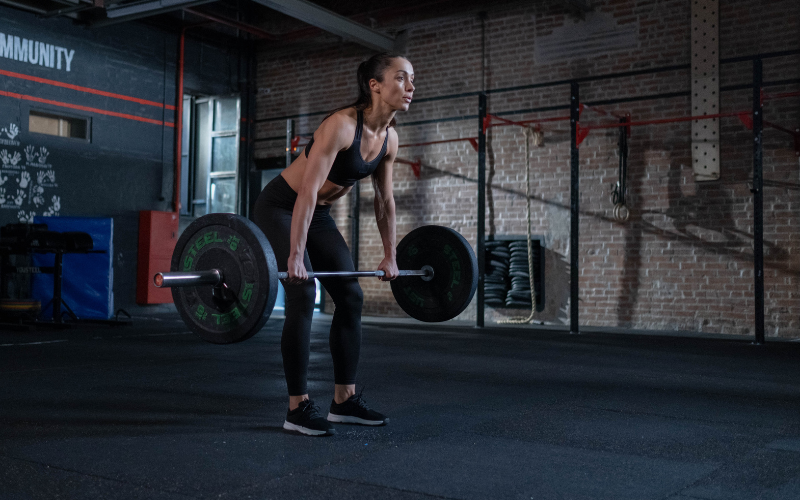
Knowing that strength training preserves muscle during fat loss is one thing. Actually structuring a program that delivers on that promise is another. A few key variables determine whether your training does its job.
Frequency
Each major muscle group needs attention at least twice a week to keep the muscle-retention signal strong. Training a muscle once a week and then not touching it again for seven days isn't enough stimulus, especially while you're in a deficit and your body is looking for any excuse to let muscle go.
Most women do well landing somewhere between three and four total training sessions per week — frequent enough to hit everything twice, but not so much that recovery becomes a problem.
Load and intensity
What you lift, and how heavy, depends on what you're prioritizing:
- For strength — heavier loads, around 80% of your one-rep max, for two to three sets per exercise
- For muscle growth — slightly lighter loads but more total volume, aiming for roughly ten or more sets per muscle group across the week
Both approaches build muscle, and consistency and effort matter more than the exact rep range you choose. What kills results isn't picking the “wrong” number of reps — it's not training hard enough, whichever range you pick.
Exercise selection
Compound, multi-joint movements should form the backbone of any fat-loss-focused program. Squats, deadlifts and hip hinges, presses, rows, and lunges recruit far more muscle mass per exercise than isolation moves like bicep curls or leg extensions.
That matters for two reasons: they burn more calories per session, and they create a stronger overall signal for muscle retention.
Free weights, machines, resistance bands, and bodyweight exercises can all deliver this — the tool matters less than whether the movement challenges a large amount of muscle.
Progressive overload
This is the one non-negotiable in the entire program. Progressive overload just means gradually increasing the demand on your muscles over time — more weight, more reps, or more sets than you managed last week or last month.
Without it, your body has no reason to hold onto muscle during a deficit, since nothing is telling it that muscle is still needed. With it, even in a calorie deficit, your body gets a clear signal to protect what you've built rather than break it down for energy.
Putting it together: sample splits
Two structures cover most needs well:
- Full-body, three times a week — hits every muscle group each session, works well for beginners, and fits easily around a busy schedule
- Upper/lower split, four times a week — allows slightly more volume per muscle group and suits people with more training experience or more time available
Either way, keeping sessions under about an hour helps with consistency, since shorter, sustainable workouts are easier to stick with long-term than marathon gym sessions.
Cardio still has a place here — one or two sessions of something moderate, like a 30-minute brisk walk, adds extra calorie burn and supports heart health without eating into recovery or interfering with muscle gains.
The key is treating cardio as an addition to your strength training, not a replacement for it.
Nutrition Rules That Make Strength Training Actually Work for Weight Loss
You can build the perfect training program and still not lose fat if your nutrition doesn't match it. Diet is what makes strength training actually pay off, and a few specific numbers determine whether you're doing it right.
Setting your calorie deficit
Aim for a moderate deficit of roughly 300 to 500 calories per day, which typically translates to losing about 0.5% to 1% of your bodyweight per week. This range is deliberate, not arbitrary.
Cut calories more aggressively than that, and you push your rate of loss past 1% a week — a threshold where the share of weight lost as muscle roughly doubles. In other words, going faster doesn't just risk feeling worse; it directly undermines the muscle you're working to protect.
Protein: how much you actually need
Protein targets shift depending on your priority:
- General training and maintenance — 1.4 to 2.0 grams per kilogram of bodyweight per day is enough for most people who train regularly
- Maximizing muscle retention during a deficit — this needs to climb to 2.3 to 3.1 grams per kilogram per day, since a calorie deficit puts extra pressure on your muscle and higher protein intake is what counteracts it
The tighter your deficit, the more this higher range matters. Protein is doing a specific job here — protecting lean mass while you lose fat — and under-eating it is one of the fastest ways to end up losing muscle alongside fat, even with a solid training program.
Spreading protein across the day
Rather than front- or back-loading your protein into one or two big meals, split it across three to four meals of about 20 to 40 grams each.
This distribution supports muscle repair more consistently throughout the day than trying to cram it all into dinner.
Why crash dieting backfires
Cutting calories aggressively might sound like a shortcut, but it tends to work against you in several ways:
- Training performance drops — severe restriction leaves you without the energy to lift heavy or push hard, weakening the very stimulus that protects your muscle
- Muscle loss accelerates — as covered above, faster weight loss skews the ratio toward more muscle and less fat
- Hormonal function can suffer — for women, extreme restriction can disrupt menstrual cycles, a sign the body is under more stress than it can handle
None of this trades off in your favor. A slower, sustainable deficit consistently outperforms an aggressive one for both fat loss and muscle retention.
Sleep and recovery
Nutrition and training don't operate in isolation from sleep. Poor sleep interferes with muscle recovery and tends to disrupt appetite regulation, making it harder to stick to your calorie target and recover properly between sessions.
Treating sleep as part of your nutrition plan, not separate from it, makes the rest of the plan easier to follow.
Common Myths, Women-Specific Factors, and When to Adjust Your Approach
A few misconceptions keep women away from strength training or away from lifting hard enough to get results. It's worth clearing these up directly.
The “bulky” myth
This is the most persistent fear, and it's not physiologically supported for the vast majority of women. Women have roughly 15 to 20 times less testosterone than men, which means muscle gain happens slower and in smaller amounts, not at the same rate.
Realistic muscle gain for a woman new to lifting is around 0.5 to 1 pound per month — a pace that builds a leaner, more defined look over time, not sudden bulk.
The heavily muscled female physiques sometimes used to justify this fear are typically the result of years of specialized training, strict dieting, and in many cases performance-enhancing drugs — not what happens from a normal strength training routine.
“Toning” isn't a real training method
There's no separate physiological process called toning. Your body either builds muscle or loses fat — the “toned” look people describe is simply the combination of both: enough muscle underneath and low enough body fat on top to see it.
Training with very light weights for high reps, often marketed as the way to “tone,” provides a weak stimulus. Moderate-to-heavy loads are more effective for building the muscle that actually creates that appearance.
Menstrual cycle and training
Some research has suggested that strength and training capacity might peak during the follicular phase, when estrogen is elevated, and that structuring workouts around it could help.
But more recent evidence hasn't found a reliable effect of cycle phase on strength performance or on long-term training results.
The practical approach is to train consistently through your whole cycle and only adjust individual sessions if symptoms genuinely make a specific workout harder to complete.
Menopause changes the picture
Falling estrogen during menopause shifts fat storage toward the abdomen and speeds up both muscle and bone loss.
This makes resistance training more important during this stage, not less — supervised strength training two to three times a week has been shown to meaningfully reduce visceral and abdominal fat in postmenopausal women.
Pairing that training with higher protein intake helps preserve and build muscle during a life stage when the body is working against you on both fronts.
Signs it's time to adjust
Your deficit or program needs a change if you notice:
- Losing more than about 1% of bodyweight per week — deficit is too aggressive
- Strength going backward across sessions — usually a sign of inadequate recovery or too large a calorie deficit
- Persistent fatigue or a missed/lost menstrual cycle — a clear signal to increase calories
- No change in measurements, scale, or strength for three to four weeks — deficit may be too small, or training/protein isn't providing enough of a stimulus
A quick note on individual variability
Results vary widely between individuals, even with identical programs and diets. Some women recomp quickly; others need more time and patience.
Thyroid function, iron and vitamin D levels, and certain medications can all affect outcomes, so if progress stalls despite doing everything right, a conversation with a doctor or registered dietitian is a reasonable next step — especially around menopause or if your cycle stops.
This article is meant as general education, not a substitute for personalized medical guidance.
Conclusion
Strength training doesn't just help women lose weight — it determines whether that weight loss comes from fat or muscle, which is what separates a body that looks and feels stronger from one that's just smaller.
The formula is straightforward: lift with progressive overload, eat enough protein, and keep your calorie deficit moderate rather than aggressive.
Follow that combination consistently, and the results will show up in your measurements and strength long before the scale fully catches up.