
Yes, roller skating can help you lose weight — it's a real aerobic workout that burns roughly 300 to 600 calories an hour, putting it in the same league as jogging or cycling.
Keep reading to see exactly how the calories add up, how skating stacks up against other cardio, and what it actually takes to turn those sessions into real results.
Does Roller Skating Actually Help You Lose Weight?
The short answer is yes, but with a condition attached: skating only leads to weight loss when it helps you burn more calories than you take in.
It's not magic, and it's not exempt from the basic rules of energy balance that govern every form of exercise.
What makes skating a genuine contender for weight loss is its aerobic intensity. It's rated at 7.0 METs, a measure of how much energy an activity demands compared to sitting still.
That places it solidly in moderate-to-vigorous territory, on par with activities most people already recognize as effective cardio.
This isn't a fringe claim either — both Harvard Health and the American Heart Association classify roller skating as legitimate aerobic exercise, not just a recreational pastime that happens to involve some movement.
Here's the part that's easy to overlook: skating raises your heart rate and torches calories, but that alone doesn't guarantee the number on the scale will drop.
Your body responds to total energy balance — everything you eat and drink weighed against everything you burn across the entire day, not just during your session at the rink.
Skate for an hour and then eat back double the calories you burned, and you'll stay exactly where you started.
One honest caveat worth knowing before you lace up: the research backing skating is strong on calorie burn and cardiovascular fitness, but no controlled study has directly tracked body fat loss in people following a skating program over time.
The case for skating and weight loss is built by connecting two solid pieces of evidence — how many calories it burns, and how that fits into the broader science of fat loss — rather than a single study that measured skaters shedding pounds from start to finish.
That's a meaningful distinction, and it's one reason consistency and diet matter just as much as the activity itself.
How Many Calories Does Roller Skating Really Burn?
The number depends on your weight and pace, but Harvard Health's data gives a solid starting point for 30-minute sessions:
Casual skating:
- 125 lb: 311 calories
- 155 lb: 386 calories
- 185 lb: 461 calories
Fast skating:
- 125 lb: 340 calories
- 155 lb: 421 calories
- 185 lb: 503 calories
Double those numbers for an hour-long session, and you're looking at roughly 300 to 600 calories burned, depending on where you fall on the weight and intensity spectrum.
These figures line up with MET-based calculations, which estimate energy expenditure using your body weight and the intensity of the activity.
At 7.0 METs, skating burns calories at a rate that scales directly with how much you weigh — heavier bodies burn more simply because they require more energy to move.
This is why a single “calories burned skating” number is misleading without accounting for who's doing the skating.
Push into more vigorous or interval-style skating, and the burn climbs past 600, sometimes reaching 700 calories an hour. That's the realistic ceiling for most recreational and fitness-focused skaters putting in real effort.
You'll also come across commercial fitness calculators claiming numbers as high as 700 to 1,350 calories an hour. Treat these as outliers, not benchmarks.
They typically assume speeds and intensities most people can't sustain for a full session, closer to competitive inline racing than a rink workout or neighborhood cruise.
Anchoring your expectations to these figures sets you up for disappointment when your actual burn falls well below them.
Beyond weight and pace, a few other factors shift your calorie burn up or down:
- Skill level — beginners move slower and less efficiently, burning fewer calories per minute than someone with refined technique
- Terrain — outdoor surfaces, hills, and wind resistance demand more effort than a smooth indoor rink
- Consistency of effort — steady cruising burns less than skating with intervals or sustained speed bursts
The takeaway: 300 to 600 calories an hour is a fair, evidence-backed range to plan around. Anything beyond that requires real intensity, and anything claiming far more should be viewed with skepticism.
How Roller Skating Compares to Running, Cycling, and Walking
Put skating side by side with other common cardio options, and the picture gets more interesting than a simple ranking of calories burned:
- Running: ~720 calories/hour at a comfortable pace
- Skating: ~528 calories/hour at a steady pace
- Walking: noticeably less than skating, even at a brisk clip
Running wins the calorie-burn contest, and the reason comes down to mechanics. When you run, every stride requires active propulsion — there's no gliding, no free momentum, just continuous muscular effort against gravity and ground contact.
Skating lets you coast between strokes, which saves energy but also means your body isn't working quite as hard per minute. Push skating into faster paces, add hills, or work in intervals, though, and the burn can climb past 900 calories an hour, closing much of that gap.
Cycling tells a different story. Calorie burn between skating and cycling runs fairly close, but skating actually builds aerobic fitness more effectively for one specific reason: you can't coast on skates the way you can on a bike.
Pedaling allows for genuine rest periods mid-ride, while skating demands more continuous engagement to maintain balance and momentum, keeping your heart rate more consistently elevated.
Here's where skating pulls ahead in a category that matters more than most people realize: joint impact. Skating produces less than half the impact shock that running does.
Every foot strike while running sends force through your joints, ankles, knees, hips absorbing that load with each stride. Skating replaces those repeated impacts with a smoother, gliding motion, cutting the physical toll on your joints dramatically.
This impact difference isn't just a minor perk. It's arguably the most practical advantage skating offers over running:
- Lower impact means less cumulative wear on joints over months and years of training
- Reduced injury risk keeps you exercising consistently instead of sidelined by overuse issues
- Consistency, not raw intensity, is what actually drives long-term weight loss
A workout burning slightly fewer calories per hour but sustainable for years beats a higher-burn activity that wears down your knees within months.
Skating's real strength isn't out-burning running, it's giving you a comparable aerobic workout with a body that can keep showing up for it.
What Muscles Does Roller Skating Work (and Why It Matters for Fat Loss)
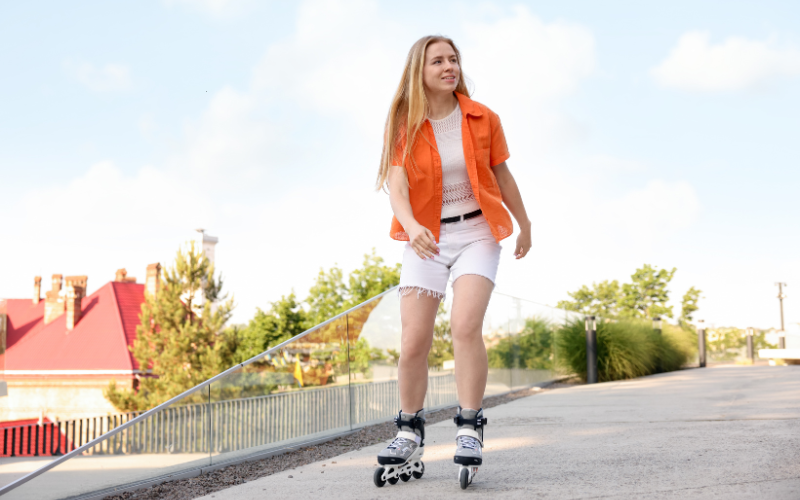
Skating is a lower-body dominant workout, and the muscles doing the heaviest lifting are the ones that generate power with every stride:
- Glutes — the primary driver behind each push-off
- Quads — stabilize and extend the knee through every stroke
- Hamstrings — control the backward leg motion and support balance
- Calves — fine-tune ankle movement and add propulsion
- Hip abductors — manage the lateral stability skating demands
That glute emphasis is worth pausing on, because it's what sets skating apart from running. Running propels you forward through a straight backward push, so your glutes contribute but share the load with other muscles.
Skating works differently. Each stroke pushes outward and back at an angle, combining hip extension with lateral abduction.
That angled push-off recruits the glutes more directly than running ever does, making skating one of the more effective glute-building cardio activities available.
Don't overlook the core, either. Balancing on wheels forces your abdominals, obliques, and lower back to fire continuously just to keep you upright and stable.
There's no built-in stability the way there is standing flat-footed on pavement, so your trunk muscles stay switched on for the entire session, adding a stabilization workout on top of the cardio.
This muscle engagement connects to fat loss in a subtle but real way. Building lean muscle, even modestly, nudges your resting metabolic rate upward, meaning you burn slightly more energy even when you're not exercising.
It's not a dramatic shift, and skating alone won't transform your metabolism, but it adds a small compounding benefit on top of the calories burned during each session.
One thing skating can't do, no matter how targeted your strides feel, is spot-reduce fat. There's no version of skating that melts fat specifically from your belly, thighs, or any other chosen area.
Fat loss happens systemically, drawing from stores across your entire body based largely on genetics, not on which muscles you're working hardest.
Skate to strengthen your glutes and core, build endurance, and create a calorie deficit, but don't expect to choose where the fat comes off. That part is out of your hands.
How to Structure a Roller Skating Routine for Weight Loss
Skating a few times when you feel like it won't move the needle much. Turning it into a real weight-loss tool means treating it like any other training program, with a target frequency, a progression plan, and enough structure to keep improving.
Frequency and duration
Aim for 3 to 5 sessions a week, each lasting 30 to 60 minutes. That puts you at 150 minutes or more of moderate activity weekly, the threshold most health guidelines point to for meaningful cardiovascular and weight-management benefits. Consistency here matters more than any single long session.
Add intervals to boost the burn
Steady cruising works, but alternating effort levels pushes your results further. Try something like six rounds of two minutes hard, one minute easy, bookended by a warm-up and cooldown.
Interval work does two things: it raises your total calorie burn during the session, and it keeps your body burning slightly more energy afterward as it recovers.
Refine your technique
Small adjustments compound over a session:
- Deeper knee bend — engages more muscle and improves power per stroke
- Longer, controlled strides — increases distance covered per push-off, reducing wasted effort
- Vigorous arm swing — adds upper-body engagement and helps drive momentum
These aren't cosmetic tweaks. Better technique directly increases how many calories you burn per minute on skates.
Choose your terrain strategically
- Indoor rinks offer smooth, predictable surfaces, ideal for building skill and consistency early on
- Outdoor surfaces add resistance through rougher pavement, uneven ground, and wind
- Hills demand significantly more effort than flat terrain, boosting intensity without needing to skate faster
As your skill improves, shifting outdoors and adding elevation is one of the simplest ways to increase difficulty without changing your routine's length.
A week-by-week progression
- Weeks 1–2: Focus on safety and skill. Short 20 to 30 minute sessions, three times a week, on smooth flat ground, full protective gear. Calorie burn will be modest here, and that's expected.
- Weeks 3–6: Extend sessions to 40 to 60 minutes, 3 to 5 times weekly, at a brisk pace. Start logging food intake to establish a modest deficit.
- Week 6 onward: Introduce intervals and outdoor or hilly terrain, pushing your burn toward 500 to 700+ calories an hour.
Pair it with a real calorie deficit
None of this works in isolation. Skating creates the calorie burn; your diet determines whether that burn actually translates into weight loss.
A modest, sustainable deficit, paired with consistent skating, is what turns a fun cardio habit into visible results over weeks and months.
Safety, Limitations, and When to Adjust Your Approach
Skating comes with real risks that are easy to underestimate once you get comfortable on wheels. Falls are the obvious one, and they can result in wrist sprains, fractures, or head injuries if you go down hard. Protective gear isn't optional if you're serious about sticking with this long-term:
- Helmet — protects against the most serious potential outcome
- Wrist guards — wrists are the most common casualty in falls, since instinct sends your hands out first
- Knee and elbow pads — cushion the joints most likely to hit the ground
Beginners face a specific hurdle worth knowing upfront: skating has a real learning curve, unlike walking or running.
Early on, you'll move slower and less efficiently, which means your calorie burn stays lower than the numbers you've read about until your technique catches up. That's normal, not a sign you're doing something wrong.
Pregnancy adds another layer of caution. Balance and fall risk are elevated, and most guidance recommends avoiding skating while pregnant given the potential consequences of a fall in that situation.
It's also worth remembering that every calorie estimate you'll come across is exactly that, an estimate. Age, sex, body composition, and movement efficiency all shift the real number up or down for you specifically.
Two people at the same weight, skating at the same pace, can burn meaningfully different amounts of energy depending on these individual factors. Treat every figure in this article as a reasonable ballpark, not a precise measurement of your own output.
Here's a practical decision point worth committing to: if you've skated consistently for 3 to 4 weeks and the scale hasn't moved, don't respond by skating harder or longer.
Look at your diet first. At this stage, the issue is almost always net calories, not insufficient exercise. Tighten up your food tracking before you assume you need to add more workouts.
And if joint pain shows up along the way, that's a signal to scale back or bring in a lower-impact cross-training day rather than push through it.
One last point matters more than any statistic in this article: adherence beats intensity every time. The best workout is the one you'll actually keep doing months from now.
If skating feels more enjoyable and sustainable to you than running or the gym, its lower injury risk and higher fun factor make it a legitimately strong primary cardio choice, not just a backup option. Consistency, not perfection, is what turns any exercise into real, lasting weight loss.
Conclusion
Roller skating genuinely burns calories and builds fitness, but it only leads to weight loss when paired with a real calorie deficit through consistent effort and mindful eating.
Its biggest edge over running isn't raw calorie burn, it's the lower joint impact that lets you stay consistent for months instead of getting sidelined by injury.
Start slow, build your skill and intensity gradually, track your progress, and remember that the workout you'll actually stick with beats the one that burns slightly more calories on paper.