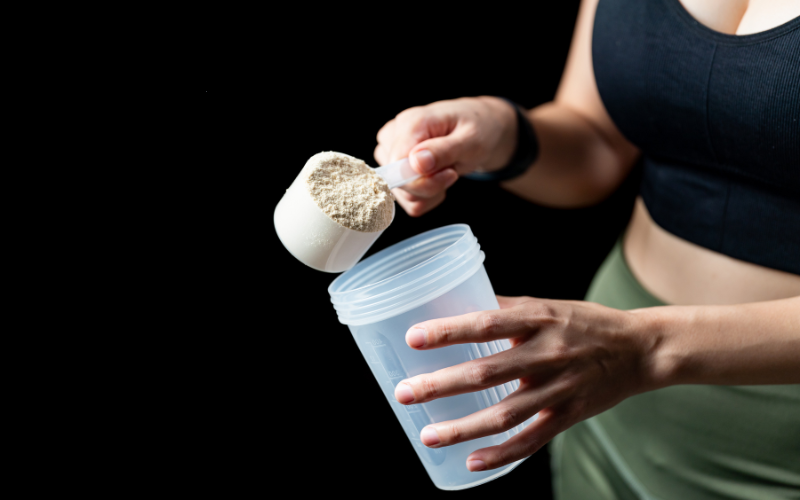
Yes, protein drinks can help you lose weight, but only when they replace calories rather than add to them, working mainly by keeping you fuller and preserving muscle during a deficit rather than through any special fat-burning effect.
Keep reading to see exactly how they work, how much protein you actually need, and the mistakes that can turn a helpful shake into a weight-gain trap.
How Protein Actually Helps With Weight Loss
No matter how much protein you drink, losing weight still requires burning more calories than you take in. Protein doesn't get around this rule — what it does is make that deficit easier to create and easier to live with, through a few distinct mechanisms working together.
The biggest one is appetite control. Protein is the most filling macronutrient you can eat, and it works by shifting your hormones in your favor: it raises GLP-1, PYY, and CCK, which all signal fullness to your brain, while lowering ghrelin, the hormone that drives hunger.
The effect isn't subtle either. In one controlled feeding study, simply doubling protein's share of total calories from 15% to 30% caused people to spontaneously eat over 400 fewer calories a day, without anyone telling them to restrict anything.
Protein also costs more to process than the other macronutrients, a phenomenon known as the thermic effect of food. Your body burns off 20–30% of protein's calories just digesting and metabolizing it, compared to 5–10% for carbs and next to nothing — 0–3% — for fat.
That means a 100-calorie serving of protein effectively delivers closer to 70–80 usable calories once digestion takes its cut.
Then there's muscle. Cutting calories tends to shrink both fat and muscle tissue, and losing muscle is bad news for your metabolism since it's metabolically active tissue that keeps your resting calorie burn higher.
Adequate protein intake helps protect that muscle during a deficit, which in turn helps preserve your resting energy expenditure rather than letting it slide as you lose weight.
Worth keeping in perspective: these are real, evidence-backed effects, but they're modest and additive, not dramatic. Protein won't melt fat on its own — it just stacks a few small advantages that make the calorie deficit you're already in a bit more manageable and a lot more sustainable.
Replacing a Meal vs. Adding a Shake On Top
If there's one factor that decides whether a protein shake helps or hurts your progress, it's this: are you using it to replace calories, or adding it on top of what you already eat? Get this wrong and even the highest-quality protein powder won't save you.
Replacement works because it subtracts calories. Swap out a higher-calorie meal or snack for a shake, and you've created a real deficit without much extra effort. Say you trade a 450-calorie pastry for a 220-calorie shake — that's a 230-calorie daily cut, stacked up automatically, day after day. Programs built around this kind of meal replacement have shown meaningful weight loss sustained over a full year, particularly when paired with some structure or support around the habit.
Addition works against you because it adds calories. Pour a shake into a diet that hasn't otherwise changed, and you're simply eating more. This is exactly what one well-known whey protein trial found: participants drank a protein beverage twice daily with no other dietary advice and no instruction to cut calories anywhere else. The people who did lose modest amounts of weight and fat did so only because their appetite naturally adjusted downward to compensate for the added calories — not because they were following any kind of deliberate diet. That's a fragile mechanism to rely on, and it doesn't work for everyone.
This is also why shakes added to an unchanged diet can quietly stall or even reverse weight loss. The calories from the shake are real, and if nothing else shifts to offset them, the math simply doesn't move in your favor.
A practical way to check yourself: if the scale hasn't budged after three to four weeks of drinking shakes, ask whether you're actually replacing something or just adding a shake to your usual routine. That one audit often explains a plateau better than anything else.
Protein Drinks vs. Whole Food — What Matters More
Here's the good news: your body doesn't much care whether protein arrives in a shake or on a plate. What matters for weight loss is your total daily intake — hit your number, and the source becomes a secondary decision based on convenience and preference rather than biology.
That said, whole foods and drinks each bring something different to the table:
- Whole foods — eggs, chicken, fish, legumes, dairy — come packaged with fiber and micronutrients you won't find in a scoop of powder. They also take longer to chew, which itself contributes to feeling full.
- Protein drinks — offer precise dosing, low calories per gram of protein, and the kind of portability that makes hitting your target realistic on a busy day.
There's a catch worth knowing about, though: liquid calories don't fill you up the same way solid food does. Because shakes move through your stomach faster and skip the chewing process entirely, they tend to register less strongly with your brain's fullness signals — even when the calorie and protein content match a solid meal exactly. So if appetite control is your main goal, a solid high-protein snack may outperform the same protein in liquid form.
The practical takeaway: build your diet around whole-food protein sources, and use drinks strategically to close whatever gap your schedule leaves — a rushed morning, a workout you're heading to straight from work, a day where you're otherwise short on your target.
If you're choosing a protein type, the differences are smaller than marketing suggests:
- Whey — the most researched option, fast-absorbing, high in leucine, and the type with the strongest evidence behind it for satiety and fat loss.
- Casein — digests slowly, often used before bed, associated with fullness and helping retain lean mass.
- Soy — evidence is mixed, and it hasn't shown a clear advantage over other protein sources for weight or fat loss.
- Pea and rice blends — a genuinely competitive plant-based option, with research showing comparable results to whey for body composition and strength.
For weight loss specifically, none of these differences are large enough to build your whole strategy around. Pick what you tolerate well and will actually use consistently — that matters more than the label on the tub.
How Much Protein You Need and When to Drink It

The official RDA of 0.8 grams per kilogram of body weight is designed to prevent deficiency, not to support active weight loss. If you're aiming to lose fat while holding onto muscle, that number is too conservative to do much for you.
How much you actually need:
- Most people trying to lose weight do well with roughly 1.2–1.6 grams per kilogram of body weight per day
- If you're strength training regularly, that range climbs to about 2.0–2.4 grams per kilogram, since resistance training increases your body's protein needs for muscle repair and retention
- A 70 kg person aiming for the lower end of that range would need around 84–112 grams of protein daily — noticeably more than most people eat without paying attention to it
How you spread it out matters almost as much as the total. Rather than loading up on protein at one meal, aim for roughly 20–30 grams per meal or snack across the day. This distributed approach supports muscle protein synthesis more effectively than a single large dose, since your body can only use so much protein for muscle building at once.
Timing strategies that can help:
- Preload before meals — drinking a protein shake 20–30 minutes before eating reduces how much you end up consuming during the meal itself, giving your fullness hormones a head start.
- High-protein breakfast — starting the day with a protein-rich meal has been shown to reduce evening snacking, particularly cravings for high-fat foods, even in studies where total daily calorie intake didn't drop significantly.
- Post-workout — useful mainly for muscle building and recovery rather than weight loss specifically. If fat loss is your main goal, hitting your total daily protein target matters far more than what time you drink your shake.
The overarching point: get your daily total right first, spread it across your meals, and treat timing tactics as fine-tuning — not the main lever.
Risks, Downsides, and What to Watch Out For
Protein shakes aren't automatically a healthy choice just because they're marketed for weight loss. A few real downsides can quietly work against you if you're not paying attention.
Hidden calories are the most common trap. Some powders carry over 20 grams of added sugar per scoop — enough on its own to eat into a big chunk of your recommended daily sugar limit. And what you mix your powder into matters just as much as the powder itself: blend it into whole milk with extras like peanut butter or fruit, and a “diet” shake can easily climb past 1,000 calories, turning a weight-loss tool into a calorie bomb.
Contamination is a bigger issue than most people realize. Independent testing across the protein powder market has found that a large share of tested products exceed safety thresholds for heavy metals like lead and cadmium. Two patterns stand out:
- Plant-based powders tend to test higher than whey, since plants absorb metals from the soil they're grown in
- Chocolate-flavored powders often carry more contamination than vanilla varieties
This doesn't mean every product on the shelf is dangerous, but it's a real reason to be selective rather than grabbing whatever's cheapest.
Digestive side effects are common with dairy-based whey. A large share of adults worldwide have some degree of lactose intolerance, and for them, whey protein — especially the concentrate form — can trigger bloating, gas, cramping, or diarrhea. Whey also contains no fiber, so relying on shakes to replace whole meals over the long term can contribute to constipation, particularly if fiber-rich foods aren't making it into your diet elsewhere.
Sustainability is the quiet failure point. Shakes can support weight loss while you're using them, but the results tend to fade once you go back to normal eating — unless you've built lasting habits along the way. A shake is a tool, not a permanent fix.
Regulation is looser than you'd expect. Supplements don't go through the same tight oversight as food and drugs, which means label claims about protein content, purity, or ingredients aren't guaranteed to be accurate. Third-party testing is the only real safeguard here, not the packaging.
None of this means protein drinks are a bad choice — it just means picking one carelessly can undercut the benefits you're trying to get.
How to Choose a Protein Drink and Use It Effectively
With so many products on the shelf, picking the right one comes down to a short checklist rather than guesswork.
What to look for on the label:
- At least 20 grams of protein per serving — anything less makes it hard to hit your daily target efficiently
- Under 5–10 grams of added sugar, since sugar-heavy formulas can quietly cancel out your calorie deficit
- Third-party testing certification, which screens for contaminants and verifies that what's on the label actually matches what's in the tub
- For weight loss specifically, a calorie count generally under 150–200 per serving, keeping the shake genuinely useful for a deficit rather than working against it
- If you're using it as a meal replacement rather than a snack, check for at least 3 grams of fiber plus added vitamins and minerals, since a shake standing in for a full meal should offer more than protein alone
If dairy doesn't agree with you, whey isolate is worth trying before giving up on whey altogether — it's processed to remove most of the lactose that causes digestive issues. A pea-and-rice blend is a solid plant-based alternative that performs comparably to whey for body composition, without the dairy concern at all.
One thing worth being skeptical about: products marketed explicitly as “weight loss” shakes aren't necessarily better formulated than standard protein powders, and sometimes they're lower quality despite the premium price and messaging. Read the label the same way regardless of what the front of the package promises.
Beyond the product itself, how you use it matters:
- Pair shakes with resistance training — this is what actually protects your muscle and metabolic rate during a deficit, rather than protein intake alone.
- Treat shakes as a short-to-medium-term tool rather than a permanent replacement for meals.
- Use the time you save or the structure a shake provides to build sustainable whole-food habits, so your results hold once you stop relying on shakes day to day.
Get the product right and use it as part of a broader strategy, and a protein drink becomes a genuinely useful tool — not a shortcut, but a solid piece of a plan that actually works.
Conclusion
Protein drinks can support weight loss, but only as one piece of a larger strategy built on a calorie deficit, adequate total protein, and consistent habits.
Used to replace higher-calorie meals or snacks, paired with resistance training, and chosen carefully for quality and sugar content, they're a genuinely useful tool.
Used carelessly or added on top of an unchanged diet, they're just extra calories dressed up as a health product.