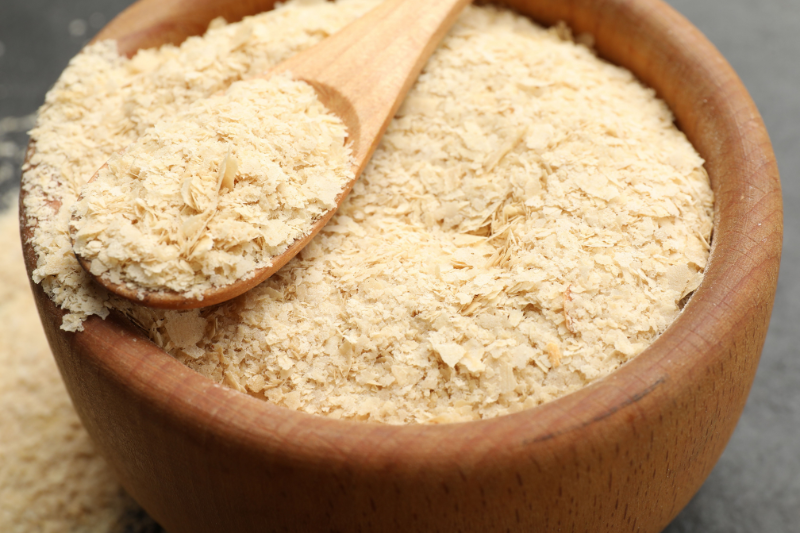
Nutritional yeast can support weight loss, but not because it has any fat-burning magic — its real value comes from its high protein content, fiber, and ability to replace calorie-dense ingredients like cheese in your everyday meals.
Keep reading to see exactly how it works, what the research actually says, and how to use it effectively.
What Nutritional Yeast Actually Is (and What's in It)
Nutritional yeast is a deactivated form of Saccharomyces cerevisiae — the same yeast species used in baking and brewing.
The difference is that it's been heat-killed and dried into yellow flakes or powder, which means it won't make bread rise or ferment anything. It's just food.
A standard 2-tablespoon serving (about 16 grams) packs a surprising amount into very few calories:
- Calories: 40–60
- Protein: 5–8g (complete — all nine essential amino acids)
- Fiber: 2–4g
- Net carbs: ~1g
- Fat and sugar: virtually zero
That protein-to-calorie ratio is worth pausing on. Roughly half its calories come from protein, which puts it in the same range as many protein powders — just in a form you sprinkle on food rather than blend into a shake.
Fortified brands take the nutritional profile further, delivering 300–1,000% of the daily value for B vitamins — B1, B2, B3, B6, and B12 — in that same 2-tablespoon serving, though this varies quite a bit between brands. You'll also get moderate amounts of zinc, selenium, phosphorus, and potassium.
One thing worth clarifying: chromium, which gets mentioned in weight loss circles, is found in brewer's yeast — not nutritional yeast. The two are often confused, but they're different products.
Four Ways It Can Support Weight Loss
None of these mechanisms are unique to nutritional yeast — they're rooted in general nutrition science. But nutritional yeast happens to combine all four in a single low-calorie ingredient.
1. Protein burns calories just by being digested
Your body expends 20–30% of the calories from protein just breaking it down — compared to 5–10% for carbohydrates and nearly nothing for fat. On top of that, protein triggers the release of fullness hormones like GLP-1, CCK, and PYY while suppressing ghrelin, the hormone that signals hunger.
A single serving only provides 5–8 grams, but if you're adding it across multiple meals throughout the day, the cumulative effect on satiety is real.
2. Its fiber slows everything down
The fiber in nutritional yeast is primarily beta-glucan, which comes from the yeast cell walls. In your stomach, it absorbs water and forms a gel-like substance that slows both gastric emptying and glucose absorption.
The practical result: you stay full longer and avoid the blood sugar swings that tend to trigger cravings between meals.
3. It's a direct swap for Parmesan — at half the calorie cost
This is arguably its most practical weight loss application. Compared to Parmesan, nutritional yeast delivers comparable protein with roughly half the calories, zero saturated fat, less sodium, and added fiber. For anyone who uses cheese as a finishing ingredient regularly, that substitution adds up.
4. It makes lower-calorie meals taste more satisfying
Nutritional yeast is naturally high in glutamic acid, the compound behind umami flavor. Research has found that umami-rich foods can calm appetite centers in the brain, which means your calorie-restricted meals feel less like deprivation.
That psychological dimension is easy to underestimate — but anything that makes a diet more pleasant to stick to has real weight loss value.
What the Clinical Research Shows
Before diving into the studies, one limitation is worth stating upfront: no randomized controlled trial has ever tested the nutritional yeast flakes you buy at the store.
Every piece of clinical research uses concentrated, pharmacologically prepared yeast-derived supplements — think purified yeast hydrolysate peptides or isolated beta-glucan fractions at standardized doses. That's a meaningful distinction.
With that caveat in place, here's what the research on yeast-derived supplements actually shows.
The hydrolysate studies are the strongest evidence
Two trials by Jung et al. produced notable results. The 2014 study gave 56 obese adults 1 gram per day of yeast hydrolysate for 10 weeks.
The yeast group lost 2.60 kg versus just 0.83 kg in the placebo group, with measurable reductions in body fat mass, abdominal fat area, and BMI.
A 2017 follow-up found that even half the dose — 0.5 grams per day — reduced fat mass from 25.9 kg to 23.8 kg over 8 weeks in 30 obese women. Both studies attributed the effect to appetite suppression leading to naturally lower calorie intake.
A 2025 meta-analysis pooled six RCTs covering 262 participants and found yeast-derived supplements reduced body weight by 3.08 kg, BMI by 0.87 kg/m², and fat mass by 1.93 kg compared to placebo.
Those numbers look encouraging — but two important caveats apply. Evidence certainty was rated LOW under the GRADE framework, and two of the lead authors were employees of a company that manufactures yeast hydrolysate supplements.
That conflict of interest doesn't invalidate the findings, but it does warrant skepticism.
The beta-glucan evidence is weaker
Studies isolating yeast beta-glucan as the active ingredient tell a less convincing story. One trial found that 500 mg per day added no weight loss benefit beyond caloric restriction alone.
Another showed reductions in waist circumference and inflammation markers but no significant change in body weight.
A systematic review of animal studies concluded that yeast beta-glucans don't significantly affect body weight — though about 75% of obese animal models did show some qualitative reduction, suggesting a possible effect that human trials haven't yet confirmed.
The honest read on all of this: the evidence is real but limited, and none of it applies directly to using nutritional yeast as a condiment.
Side Effects and Who Should Be Careful
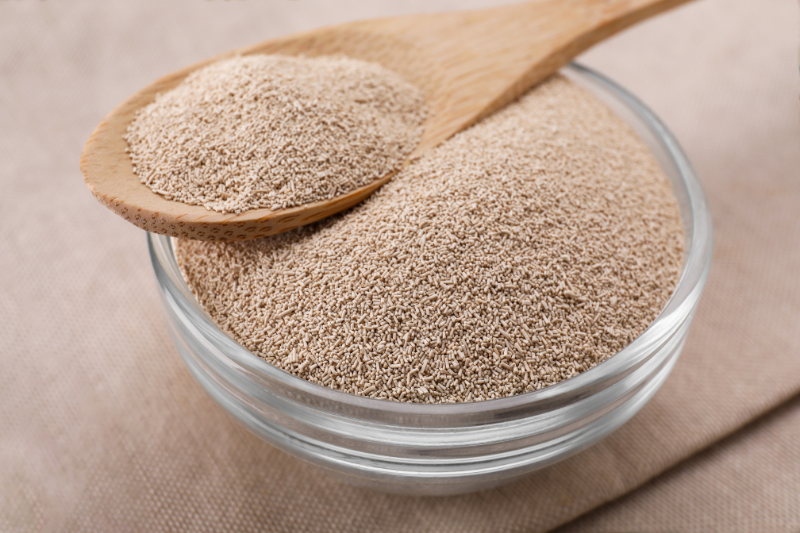
Nutritional yeast is safe for most people at normal condiment-level amounts, but a few situations warrant a closer look before making it a daily habit.
Niacin flush is the most common complaint with fortified brands. Some products contain 35 mg or more of niacin per 2-tablespoon serving — at or above the tolerable upper limit — which can cause facial redness, burning, and tingling.
If you're already taking a multivitamin, the combined intake pushes that risk higher. Switching to an unfortified brand solves this immediately.
Digestive discomfort is common when people add it too quickly. The fiber content that makes it useful for satiety can also cause gas, bloating, and cramping if your gut isn't used to it.
Start with half a teaspoon and gradually increase over one to two weeks rather than jumping straight to full servings.
A few groups should approach nutritional yeast with more caution — or avoid it altogether:
- MAOI users: Nutritional yeast contains tyramine, which can trigger migraines in sensitive individuals and cause dangerous blood pressure spikes when combined with MAOI antidepressants. This interaction is serious enough to warrant a conversation with your doctor before using it.
- Gout sufferers: Purines in nutritional yeast break down into uric acid. At 1–2 tablespoons a day the risk appears minimal, but larger amounts could be problematic.
- People with Crohn's disease or IBD: This is the one group that should avoid nutritional yeast entirely. Some Crohn's patients carry antibodies against Saccharomyces cerevisiae, and yeast exposure can trigger immune responses that worsen symptoms.
Finally, if you're combining heavily fortified nutritional yeast with other supplements, it's worth tracking your total B vitamin intake. Label accuracy on these products isn't always reliable, and consistently exceeding recommended levels across multiple sources isn't a risk worth taking.
Expectation Check — What It Won't Do
Nutritional yeast has a genuinely useful nutritional profile, but it's worth being direct about what that profile doesn't include: any meaningful ability to burn fat or speed up your metabolism.
B vitamins come up often in this context because they're involved in converting food into energy. That part is true. What doesn't follow from it is that loading up on B vitamins accelerates the process — once your body has what it needs, extra amounts don't make the machinery run faster.
There's also some evidence suggesting that high B vitamin intake may actually increase appetite in certain people, which would work against weight loss goals rather than supporting them.
The underlying reality is straightforward. Nutritional yeast works for weight loss only to the extent that it helps you maintain a caloric deficit — through better satiety, fewer cravings, and lower-calorie meals that don't feel like a compromise.
That's genuinely useful, but it's a support tool, not a driver. If your diet isn't already structured around a caloric deficit, sprinkling nutritional yeast on your food won't change the outcome.
Think of it less like a weight loss ingredient and more like a smart dietary habit — one that makes eating less a little easier to sustain over time.
How to Actually Use It Day-to-Day
The standard recommendation from most dietitians is 1–2 tablespoons per day, introduced gradually if you're new to it. The framing matters here too — it's a condiment, not a supplement. Using it as a flavor-adding finishing ingredient is exactly the right approach; eating it in large amounts isn't.
Where it works best
Nutritional yeast is most useful anywhere you'd normally reach for cheese, cream, or butter to add depth. Some practical applications:
- Popcorn: Air-popped with nutritional yeast adds roughly 40 calories — one of the more satisfying low-calorie snacks you can put together
- Pasta sauces, soups, and mashed vegetables: Stirs in easily and replaces the need for cheese or cream
- Salad dressings and roasted vegetables: Adds umami without added fat
- Smoothies: Works as a low-key protein boost with no noticeable flavor impact
One practical note on form: powder dissolves better in liquids and sauces, while flakes work better as a topping where a little texture is welcome.
Fortified or unfortified?
That depends on what else you're already taking. Fortified brands make sense for vegans who need B12 and for anyone not on a multivitamin.
If you're already supplementing, unfortified is the safer choice to avoid pushing B vitamin intake too high. For brand reference — Bragg and Bob's Red Mill are widely available fortified options; Sari Foods is a clean unfortified choice if you want a single-ingredient product.
Conclusion
Nutritional yeast earns its place in a weight loss diet through a combination of modest but real advantages — high protein density, useful fiber, near-zero fat, and the ability to make lower-calorie meals genuinely more satisfying.
The clinical evidence for yeast-derived supplements shows promise, but it's limited in scope and doesn't directly apply to the flaked product you'd use in your kitchen.
Used as a daily condiment alongside a calorie-controlled diet, it's a smart and practical dietary tool — just not a shortcut.