Oatmeal is not bad for weight loss — in fact, clinical research consistently links it to reduced waist circumference, better satiety, and lower calorie intake throughout the day.
But whether it actually works for you depends almost entirely on how you prepare it, so keep reading for a full breakdown of the science, the common mistakes, and exactly how to build a bowl that delivers results.
What the Research Says About Oatmeal and Weight Loss
The short answer is that oatmeal does support weight loss — just not dramatically. Across clinical trials and large population studies, the pattern is consistent: people who eat oatmeal tend to weigh less, carry less abdominal fat, and feel fuller longer.
A 2025 systematic review described the effect as “modest” and made clear it shouldn't be treated as a standalone solution. That's an accurate characterization, but modest doesn't mean meaningless.
The clinical evidence tilts positive. A 2016 randomized controlled trial of 298 overweight adults with type 2 diabetes found that daily oat consumption led to 0.89 kg more weight lost over a year compared to a healthy-diet control group.
More striking was a 204-person RCT by Maki et al., where total weight loss between the oat and control groups was similar — but waist circumference dropped 3.3 cm in the oat group versus just 1.9 cm in controls.
That gap suggests oatmeal may preferentially reduce abdominal fat, which matters beyond aesthetics since visceral fat carries its own health risks.
Large observational data reinforces this picture. An analysis of 22,823 adults from NHANES found oatmeal consumers were 25% less likely to be overweight or obese and had a 21% lower risk of elevated waist size.
Among 14,690 children in a separate analysis, oatmeal eaters showed 40% lower obesity risk. These are associations, not proof of causation — oatmeal eaters may simply maintain healthier habits overall — but the consistency across age groups and data sets is hard to dismiss.
That said, the effect size in controlled settings is small. A 2022 meta-analysis of 74 randomized controlled trials found oat supplementation reduced BMI by just 0.13 kg/m² on average — statistically significant, but clinically modest.
And a trial by Beck et al. found that when calories were controlled, adding oat beta-glucan didn't enhance weight loss beyond the diet itself.
The takeaway from the research is straightforward: oatmeal works primarily through satiety and reduced calorie intake at subsequent meals. There's no metabolic magic at play — it just helps you eat less without feeling deprived.
How Oatmeal's Fiber Actually Suppresses Hunger
Oatmeal's ability to keep you full comes down to one compound: beta-glucan, a soluble fiber that behaves differently from most dietary fibers. When it hits your digestive tract, it absorbs water and forms a thick, viscous gel.
That gel physically slows digestion, delays how quickly food leaves your stomach, and reduces how fast glucose enters your bloodstream. The result is a slower, steadier energy release — and a longer window before hunger returns.
What makes beta-glucan particularly interesting is that it works through more than one pathway. On the hormonal side, it triggers the release of three satiety signals — PYY, GLP-1, and CCK — in a dose-dependent way, meaning more beta-glucan produces a stronger response.
There's also a gut microbiome angle: bacteria in your colon ferment beta-glucan and produce short-chain fatty acids, particularly butyrate, which independently stimulates additional GLP-1 release. So the hunger-suppressing effect continues well after the meal itself.
The real-world data backs this up. In a crossover trial by Geliebter et al., participants consumed significantly fewer calories at lunch after eating oatmeal compared to an isocaloric bowl of cornflakes — and the effect was more pronounced in overweight subjects.
A separate study by Rebello et al. found oatmeal measurably increased fullness, reduced hunger, and lowered energy intake at the next meal compared to ready-to-eat oat cereal.
A 2025 dose-response study added further weight: 4g of beta-glucan at breakfast enhanced satiety through the morning and even improved glycemic response after lunch.
Beta-glucan also appears to outperform other plant fibers for this purpose. In a 2025 University of Arizona controlled feeding study that tested five plant-based fibers head to head, only beta-glucan reduced body weight and body fat — with butyrate identified as the key metabolite driving the effect.
One honest caveat though: a 2022 trial in the American Journal of Clinical Nutrition found that while increased beta-glucan viscosity slowed gastric emptying and improved glycemic response, it didn't significantly affect subjective hunger ratings or actual food intake.
The mechanism is real, but oatmeal isn't an appetite suppressant in any clinical sense. It takes the edge off hunger — reliably and through well-understood pathways — but it won't override a calorie surplus on its own.
Steel-Cut vs. Rolled vs. Instant — Does the Type Actually Matter?
Steel-cut, rolled, and instant oats all start as the same thing: an oat groat. Per 40g dry serving, they deliver nearly identical macros — around 150 calories, 5–6g protein, 27g carbohydrates, and 3–5g of fiber.
If you pulled a nutrition label from each, the differences would be minimal. So in terms of raw nutritional content, the type of oat you choose matters less than most people assume.
Where the differences become meaningful is glycemic index — and the gap is significant.
| Oat Type | Glycemic Index |
|---|---|
| Steel-cut | 42–53 (low) |
| Rolled | 55–59 (low) |
| Quick oats | 65–66 (medium) |
| Instant | 79–83 (high) |
For context, white bread scores around 75. Instant oatmeal sits right alongside it — which should give pause to anyone eating it specifically for weight management.
The reason comes down to surface area. The more an oat is processed — steamed, flattened, pre-cooked — the thinner and more fragmented it becomes, exposing more starch to digestive enzymes.
Steel-cut oats resist breakdown because their dense, intact structure slows enzymatic access. Instant oats, rolled paper-thin and pre-cooked, offer almost no resistance at all.
Processing also degrades beta-glucan itself. More aggressive manufacturing reduces the fiber's molecular weight and viscosity, which directly weakens both its glycemic-lowering effect and its ability to trigger satiety hormones.
This is why two products with similar beta-glucan quantities on paper can behave very differently in your body — molecular integrity matters, not just the amount.
That said, plain instant oats are not the enemy. Their base nutrition is comparable to rolled oats, and a 2016 crossover trial found that even plain instant oatmeal (with 2.6g beta-glucan) significantly outperformed ready-to-eat oat cereal for satiety — because it still retained higher beta-glucan viscosity than a heavily processed cereal.
The real problem is flavored instant packets. These typically contain 10–17g of added sugar per packet, and since most people use two, that's potentially 26g or more of added sugar before you've added a single topping.
Quaker Maple & Brown Sugar, for example, delivers around 12g of added sugar per 43g packet. You're essentially pairing high-GI oats with a sugar load — exactly the combination that drives the blood sugar spike-and-crash cycle that makes you hungry again by mid-morning.
The practical takeaway: steel-cut or rolled oats are the better default. Plain instant works in a pinch. Flavored packets undermine the whole point.
The Mistakes That Turn Oatmeal Into a Weight-Gain Food
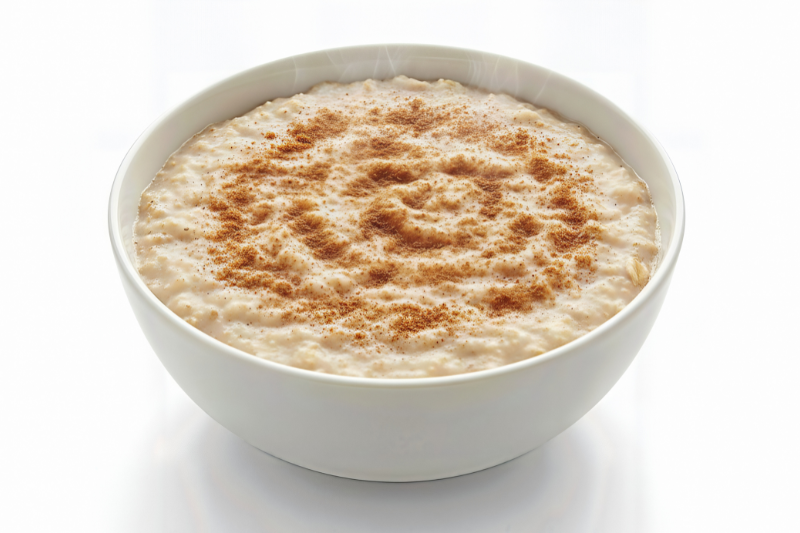
A plain bowl of oatmeal starts at around 150 calories. A carelessly assembled one can easily hit 500–700. That gap isn't the oatmeal's fault — it's entirely a preparation problem, and it's more common than most people realize.
Uncontrolled Toppings
This is where the most calories quietly accumulate. Each of these additions is individually “reasonable” but collectively damaging:
- 2 tbsp maple syrup — 104 calories
- 2 tbsp peanut butter — 190 calories
- ¼ cup granola — 140 calories
- ¼ cup dried cranberries — 130 calories, 29g sugar
Add two or three of these together and you've tripled the calorie count before finishing breakfast. One registered dietitian documented a client whose daily oatmeal habit was delivering 700 calories per bowl — all from unmeasured but individually “healthy” toppings.
The Dried Fruit Trap
Dried fruit deserves its own mention because the calorie gap is staggering and most people don't see it coming. One cup of fresh blueberries contains 84 calories. One cup of sweetened dried blueberries contains around 600 — roughly a 7x difference.
Dried cranberries run about 8x the calories of fresh. The water has been removed, concentrating both sugar and calories into a much smaller volume that doesn't register as much food in your hand or your bowl.
Portion Creep
Even without toppings, unmeasured oats are a slow leak. An extra quarter-cup of dry oats adds just 75 calories — barely visible in a bowl — but if that goes uncompensated every day, it amounts to more than 7 pounds of potential weight gain over a year.
Without a measuring cup, portions naturally drift upward over weeks without any conscious decision being made.
Two Underrated Mistakes
Cooking liquid choice is an easy calorie swap most people overlook. Whole milk adds 150 calories per cup; even low-fat milk adds around 105. Water adds nothing, and unsweetened almond milk adds just 35. Over a week, that difference adds up to several hundred calories.
Skipping protein is subtler but equally consequential. Oatmeal delivers only 5–6g of protein per serving — not enough to sustain satiety past mid-morning.
Without added protein, blood sugar drops within two hours and hunger returns, often leading to snacking that erases whatever calorie advantage breakfast provided.
A 2020 study found that a 25g-protein breakfast led to 264 fewer calories consumed at lunch compared to a lower-protein one. That's a significant downstream effect from one meal decision.
The Health Halo Problem
All of these mistakes are amplified by a well-documented cognitive bias: the health halo effect. When people perceive a food as healthy, they tend to underestimate how many calories it contains and relax their portion control — reasoning that because it's a “good” food, more of it can only be better.
Oatmeal triggers this bias reliably. The result is systematic calorie underestimation that compounds across every bowl, every morning.
How to Build Oatmeal That Actually Supports Weight Loss
The research points clearly to what works: plain oats, measured portions, added protein, and toppings that stay within a defined calorie budget.
A well-built bowl should land between 300–400 total calories with enough protein and fiber to sustain satiety for four or more hours. Here's how to get there.
The Base Formula
Start with ½ cup of dry steel-cut or rolled oats — that's 150 calories — and measure it every time. This isn't about being obsessive; it's about countering the portion creep that silently inflates bowls over weeks.
Cook with water or unsweetened almond milk (35 calories) rather than whole milk, which adds 150 calories before you've touched a single topping.
The Protein Fix
Plain oatmeal's 5–6g of protein isn't enough to hold hunger past mid-morning. Closing that gap is probably the single most impactful change you can make. Aim for 20–30g of total protein at breakfast through any combination of these:
- Greek yogurt stirred in or served alongside
- A scoop of protein powder mixed into the oats while cooking
- Cottage cheese as a base or topping
- Eggs on the side
The method matters less than hitting the target. That protein load is what extends satiety from two hours to four or more.
Toppings: A Budget, Not a Guess
Cap your toppings at 150 calories total and choose them deliberately. A few options that add flavor without significant caloric cost:
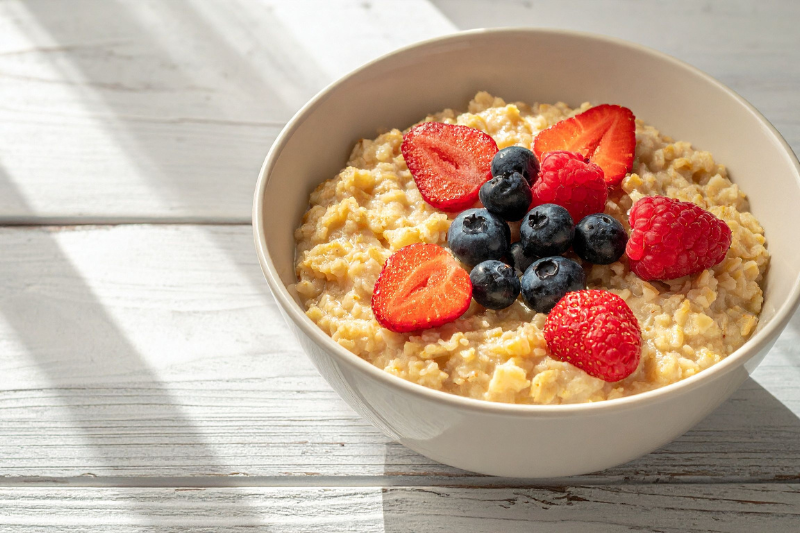
- ½ cup fresh berries — 42 calories, natural sweetness, no added sugar
- 1 tbsp chopped walnuts — 48 calories (measure this; nuts pour freely and costs accumulate fast)
- Cinnamon, vanilla extract, or nutmeg — zero calories, surprisingly effective at reducing the urge for sweetener
- A pinch of salt during cooking, which sharpens flavor and makes plain oats taste considerably better than most people expect
Three Swaps That Recover Nearly 300 Calories
If you're currently making oatmeal the typical way, these changes alone bring a high-calorie bowl back into a useful range:
- Swap maple syrup for fresh berries and cinnamon — saves 62 calories and eliminates 24g of added sugar
- Swap dried cranberries for fresh fruit — saves 84 calories
- Cook with water instead of whole milk — saves 150 calories
Combined, that's close to 300 calories recovered — roughly the caloric equivalent of the oatmeal itself. None of these swaps require sacrifice; they just replace high-density additions with lower-density ones that do the same job.
The goal is a bowl that sits at 300–400 total calories, with balanced macros and enough beta-glucan intact to do its job. That version of oatmeal is genuinely useful for weight management. The version most people are actually eating is something else entirely.
The Bottom Line — Is Oatmeal Bad for Weight Loss?
No. The evidence across clinical trials, meta-analyses, and large population studies consistently points toward modest but real benefits — reduced waist circumference, improved satiety, lower BMI associations, and meaningfully fewer calories consumed at subsequent meals.
A 2025 systematic review described the effect as modest and not a standalone solution, which is fair. But modest and useful are not mutually exclusive.
The food itself is not the problem. Preparation almost always is.
A plain, measured bowl of steel-cut or rolled oats with added protein is one of the more evidence-backed breakfast choices available for weight management.
It delivers beta-glucan that genuinely suppresses hunger through well-understood biological pathways, and it does so with a glycemic index roughly half that of instant oatmeal — and well below white bread.
That's a meaningful advantage at breakfast, when glycemic response sets the tone for hunger and energy levels through the rest of the morning.
What undermines oatmeal isn't a flaw in the food — it's the cumulative effect of unmeasured portions, calorie-dense toppings, dried fruit swapped for fresh, whole milk instead of water, and flavored instant packets loaded with added sugar.
Any one of these is manageable. All of them together can quietly quadruple a bowl's calorie count while you're convinced you're eating healthily.
The right frame for oatmeal is this: it's a useful tool with real but limited power. It won't offset a poor overall diet, and it won't produce dramatic weight loss on its own.
What it will do — when prepared correctly — is give you a filling, lower-GI breakfast that takes the edge off hunger, reduces how much you eat later in the day, and fits cleanly into a calorie-controlled approach. That's worth something. Just don't ask it to do more than that.
Conclusion
Oatmeal isn't bad for weight loss — but it's not a shortcut either.
The research supports it as a genuinely useful breakfast option when you use the right oats, measure your portions, add protein, and keep toppings in check.
Get those basics right, and it earns its place in a weight-loss diet; ignore them, and you're just eating a expensive bowl of sugar with good branding.