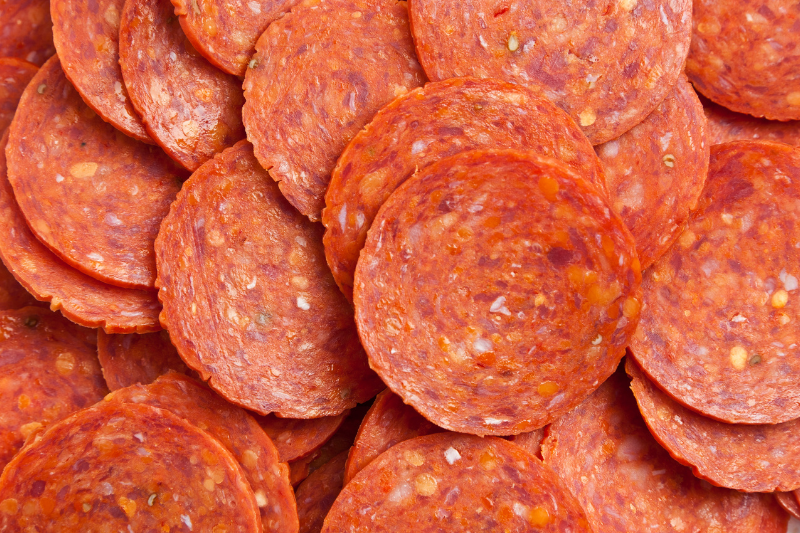
Pepperoni is not a good weight-loss food — its calorie density is nearly three times that of chicken breast, its protein-to-calorie ratio is poor, and its sodium levels are among the highest of any common meat.
That said, in small, infrequent amounts used as a flavor accent rather than a protein source, it doesn't have to derail an otherwise solid diet — read on for the full breakdown.
Pepperoni's Nutritional Profile at a Glance
A single 1-ounce serving of pepperoni — roughly 14 thin slices — contains 141 calories, 13g of fat, 5.4g of protein, and 443mg of sodium, with zero fiber.
Scale that up to 100 grams and you're looking at 504 calories, 46.3g of fat, 19.2g of protein, and 1,582mg of sodium.
The macro split tells the real story: 84% of pepperoni's calories come from fat, with only 15% from protein. For a meat product, that's a striking imbalance — and it's the root of most of pepperoni's weight-loss drawbacks.
On the micronutrient side, there are a few genuine bright spots. A 3-ounce serving delivers:
- 46% of your daily B12
- 45% of selenium
- 40% of manganese
- 34% of vitamin K2 — a relatively rare nutrient found mainly in fermented and cured animal products, linked to bone and cardiovascular health
So while pepperoni isn't nutritionally empty, those micronutrients come packaged with a significant caloric and sodium cost.
Why Calorie Density Is the Core Problem
Calorie density measures how many calories a food packs per gram — and pepperoni's number is hard to ignore. At 5.04 cal/g, it's nearly three times denser than chicken breast (1.65 cal/g) and 95% lean ground beef (1.48 cal/g).
For context, nutrition researchers classify anything above 3.0 cal/g as high energy density. Pepperoni blows past that threshold by a wide margin.
The reason comes down to water content. Chicken breast is roughly 65% water by weight; pepperoni is only 30%. Since water adds weight without adding calories, lower water content means more calories packed into every gram you eat.
That single difference largely explains the density gap between pepperoni and leaner proteins.
The practical implication is striking. One ounce of pepperoni contains roughly the same number of calories as four cups of broccoli. You'd feel considerably fuller eating the broccoli.
This matters for weight loss because research consistently shows that people tend to eat a relatively stable volume of food each day — not a stable number of calories.
When the foods you eat are calorie-dense, you consume far more energy before fullness kicks in.
Studies tracking participants over 18 months found that reducing high-energy-dense foods was independently linked to lower BMI and greater overall weight loss.
The Protein Problem — and Why It Matters for Satiety
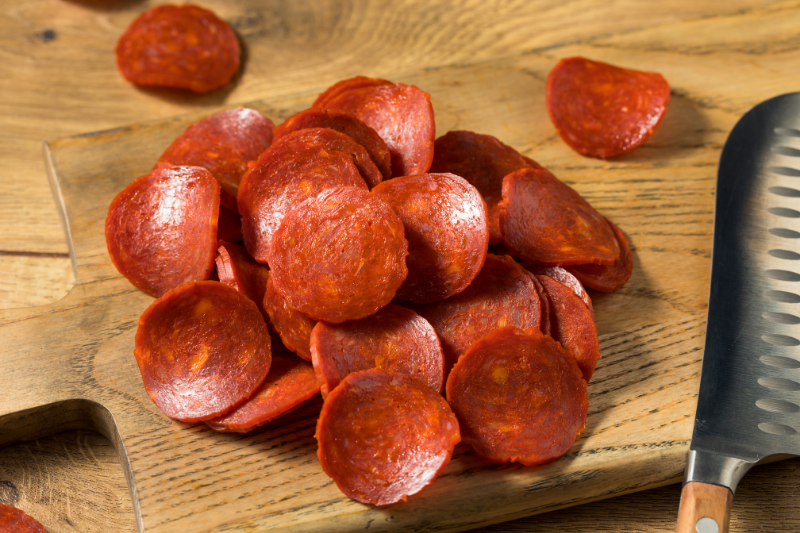
Protein is one of the most reliable levers in weight loss — it keeps you full, burns more calories during digestion, and helps preserve muscle while you're in a deficit. Pepperoni delivers it poorly on every one of those fronts.
The protein-per-calorie gap between pepperoni and leaner meats is significant:
- Pepperoni: 3.8g protein per 100 calories
- Chicken breast: 18.8g per 100 calories
- Turkey breast: 20.4g per 100 calories
To hit 30 grams of protein — a reasonable target for a filling meal — you'd need to eat roughly 780 calories worth of pepperoni. The same amount of protein from chicken breast costs around 160 calories.
Beyond the numbers, there's a metabolic angle worth understanding. Protein carries a thermic effect of 20–30%, meaning your body burns a meaningful chunk of those calories just digesting it.
Fat, by contrast, has a thermic effect of just 0–3%. Since 84% of pepperoni's calories come from fat, very little of what you eat gets “spent” in digestion.
There's also the protein leverage hypothesis to consider. Research suggests appetite stays elevated until protein reaches roughly 20–21% of total calorie intake.
Pepperoni sits at 15% — below the threshold where protein meaningfully suppresses hunger.
Studies comparing high-protein, low-energy-density snacks against high-fat alternatives have consistently shown the former wins on appetite control and delays the urge to eat again sooner.
Sodium, Ultra-Processing, and Hidden Weight-Loss Hurdles
One ounce of pepperoni accounts for 19% of the recommended 2,300mg daily sodium limit. Eat two ounces and you're approaching half your daily allowance from one snack.
That level of sodium intake prompts the body to retain water to maintain osmotic balance — anywhere from 1 to 5 pounds depending on individual sensitivity — and that water weight can linger for 2 to 4 days.
The fat-loss math underneath remains unaffected, but for someone tracking their weight daily, seeing the scale jump after a pepperoni-heavy meal can feel discouraging enough to abandon the diet entirely. That's a real behavioral risk, even when progress is actually happening.
The ultra-processing concern runs deeper than sodium alone. Under the NOVA classification system, pepperoni qualifies as ultra-processed, containing industrial additives like sodium nitrite, BHA, BHT, and dextrose.
A landmark NIH randomized controlled trial found that participants on an ultra-processed diet consumed 508 more calories per day than those eating unprocessed food — even when both diets were matched for calories, macronutrients, sugar, sodium, and fiber.
Over two weeks, the ultra-processed group gained 0.9kg while the unprocessed group lost 0.9kg.
The likely mechanism is hyperpalatability. The combination of salt, fat, and umami in pepperoni creates what food researchers call a “hedonic override” — where the reward value of eating effectively drowns out your fullness signals, pushing you to keep eating past the point where you'd otherwise stop.
Does Pepperoni Work on Keto or Low-Carb Diets?
On paper, pepperoni looks like a keto-friendly food. It has near-zero carbs — roughly 0 to 1 gram net per serving — and its high fat-to-protein ratio lines up well with standard ketogenic macro targets.
It's a popular snack in low-carb circles, often baked into chips as a crunchy, portable option.
The compatibility comes with an asterisk, though. Stricter keto communities tag pepperoni as “dirty keto” — meaning it meets the carb threshold but falls short on ingredient quality.
The industrial additives in most commercial brands, including dextrose, sodium nitrate, and BHA/BHT, are the sticking point for people who care about what's actually in their food, not just the macro split.
More importantly, keto produces weight loss through caloric restriction and appetite suppression from ketosis — not because high-fat foods have any inherent fat-burning property.
Within that framework, pepperoni is simply a calorie-dense option that keeps you less full per calorie than alternatives like eggs or chicken thighs. Those foods fit keto just as well and do a better job of keeping hunger in check.
How to Include Pepperoni Without Derailing Your Diet
Pepperoni doesn't need to be off the table — it just needs a defined role. Think of it as a seasoning rather than a protein source, and the calculus changes considerably. Here's what that looks like in practice:
- Cap portions at 1 oz per sitting — about 14 thin slices and 141 calories. It's enough to add real flavor without a significant caloric hit.
- Keep frequency to 2–3 times per week rather than daily. This aligns with broader processed meat guidance and keeps cumulative sodium in check.
- Pair it with high-fiber, high-volume foods — vegetables, whole grains, or fruit. Pepperoni's intensity punches above its weight as a flavor accent, so a little goes a long way on a plate built around lower-density foods.
- Account for sodium across the rest of your day. If pepperoni is on the menu, go lighter on other high-sodium foods to avoid compounding water retention effects.
If you want the flavor with less caloric cost, turkey pepperoni is the clearest swap available. At roughly 70 calories per ounce — about half the calories of regular pepperoni — with 6 to 9 grams of protein per serving, it delivers meaningfully more satiety per calorie.
When shopping for either variety, look for nitrate-free or uncured options with shorter ingredient lists. You won't always find them, but they're worth choosing when you can.
Conclusion
Pepperoni is a flavor tool, not a weight-loss food — its calorie density, poor protein-to-calorie ratio, and high sodium work against the core mechanics of losing weight.
That said, a few slices used as seasoning on an otherwise balanced plate won't meaningfully hold you back.
Portion control and frequency are what separate pepperoni as an occasional accent from pepperoni as a dietary problem.