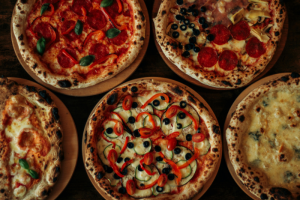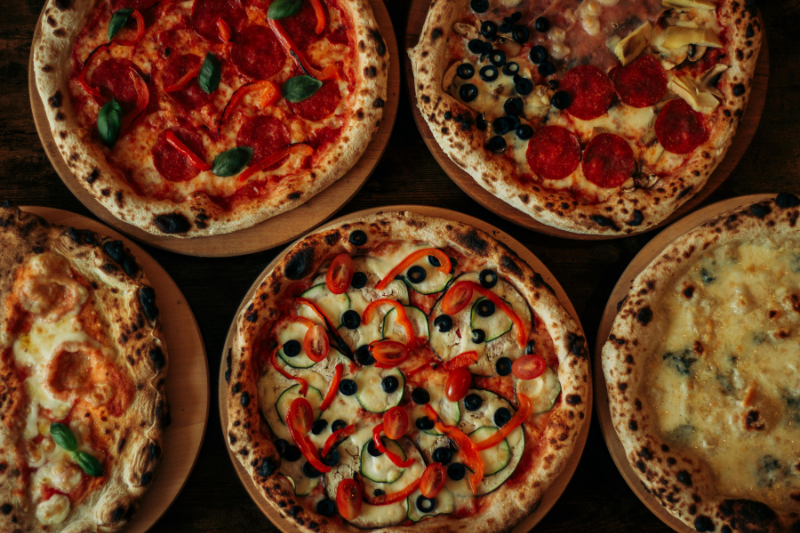
Pizza can absolutely be part of a weight-loss diet — what determines whether it helps or hurts you comes down to how much you eat, how often, and what you put on it.
Keep reading to see what the science says about pizza's effect on your weight, and exactly how to make it work in your favor.
What's Actually in a Slice of Pizza
A single slice of regular-crust cheese pizza contains roughly 285 calories, 12g of protein, 36g of carbs, 10g of fat, and 640mg of sodium.
Those numbers look manageable — until you consider that most people eat two slices, and that pizza delivers relatively little protein per calorie compared to other meals.
Two cheese slices give you 24g of protein for 570 calories, while a chicken breast dinner gets you 45g for about 450 calories.
The calorie range across pizza styles is also wider than most people realize:
- Thin crust cheese: ~210 calories per slice
- Regular crust cheese: ~285 calories per slice
- Meat Lover's Pan: ~430 calories per slice
Toppings shift the numbers further — vegetables add fewer than 20 calories per slice, while a fully loaded supreme adds 120–180 calories over plain cheese.
Then there's sodium: a two-slice meal delivers around 1,280mg — over 55% of the daily recommended limit — which can cause 2–5 pounds of temporary water retention and a misleading jump on the scale.
Why Pizza Makes It So Hard to Stop Eating
Pizza isn't just tasty — its specific combination of fat and carbohydrates triggers what researchers call a supra-additive reward response in the brain's dorsal striatum, meaning the reaction is more intense than either fat or carbs would produce on their own.
A 2018 neuroimaging study found that people were willing to pay more for fat-plus-carb foods and were notably poor at estimating their calorie content — two patterns that are particularly problematic when you're trying to eat less of something.
It also meets the clinical definition of a “hyper-palatable” food, landing in the fat-plus-sodium cluster identified by Fazzino and colleagues.
In a study of 82 healthy adults, eating hyper-palatable foods during a single meal predicted greater weight and body fat gain a full year later — even after accounting for calorie density and ultra-processed food content.
The effect appears to work around normal satiety signals, which helps explain why two slices rarely feels like enough.
The population data tells the same story. On days Americans eat pizza, it accounts for roughly 27% of their total calorie intake — about 744 calories from pizza alone.
And in Kevin Hall's NIH trial, the most rigorous study of its kind, participants on an ultra-processed diet consumed 508 extra calories per day and gained 0.9kg in just two weeks compared to losing the same amount on an unprocessed diet with identical macronutrients.
Should You Cut Pizza Out Entirely?
The short answer, according to the Mayo Clinic, Cleveland Clinic, and the Academy of Nutrition and Dietetics, is no. All three institutions agree that pizza can stay in a weight-loss plan — the goal is managing it, not eliminating it.
The research backs this up pretty clearly. A study of 223 adults found a strong correlation (r=0.65) between flexible dieting and less overeating, lower body mass, and better psychological outcomes.
Rigid restriction, by contrast, was linked to disinhibited eating and higher BMI. A separate study of 106 women in a weight-loss program found the same pattern: flexible restraint predicted more weight lost, while rigid restraint predicted less.
Two practical frameworks put this into action:
- The 80/20 rule — eat whole, nutrient-dense foods 80% of the time and leave 20% for discretionary choices. Two thin-crust cheese slices at roughly 420 calories represent about 21% of a 2,000-calorie daily budget, which fits comfortably within that window.
- IIFYM (If It Fits Your Macros) — pizza is on the table as long as it fits within your daily calorie and macronutrient targets for the day.
The common thread across both approaches is that no food needs to be permanently off-limits. What matters is whether your overall pattern supports a caloric deficit — and pizza, eaten with some intention, can exist within one.
The Psychology of Banning Pizza (And Why It Backfires)
Telling yourself pizza is completely off-limits tends to produce the opposite of the intended effect. Research by Mann and Ward shows that prohibiting a food increases both how often you think about it and how much you want it — a dynamic that gets harder to manage the longer the restriction continues.
What makes this worse is the abstinence violation effect. When someone following a strict no-pizza rule eventually eats a slice, they don't experience it as a minor detour — they experience it as total failure.
That cognitive shift triggers the “I've already blown it” response, and one slice becomes the whole box. Herman and Polivy's milkshake studies demonstrated this repeatedly: dieters consumed more food after eating a “forbidden” item, not because of the calories, but because the psychological rules had already been broken. Critically, the same calorie load from a permitted food did not trigger overeating.
The guilt you attach to a food also predicts your long-term outcomes. A study tracking adults over 18 months found that people who associated indulgent foods with guilt had lower perceived control over their eating and less weight-loss success than those who framed the same foods as an enjoyable treat.
Planned indulgences, on the other hand, appear to support adherence — one study found that a planned high-calorie day per week produced equivalent BMI reduction to strict dieting, but with meaningfully higher motivation.
That last point matters more than it might seem. Roughly 80% of dieters regain their lost weight within five years. At that scale, the ability to stay consistent over time outweighs the impact of any single food choice — pizza included.
How to Eat Pizza Without Blowing Your Calorie Budget
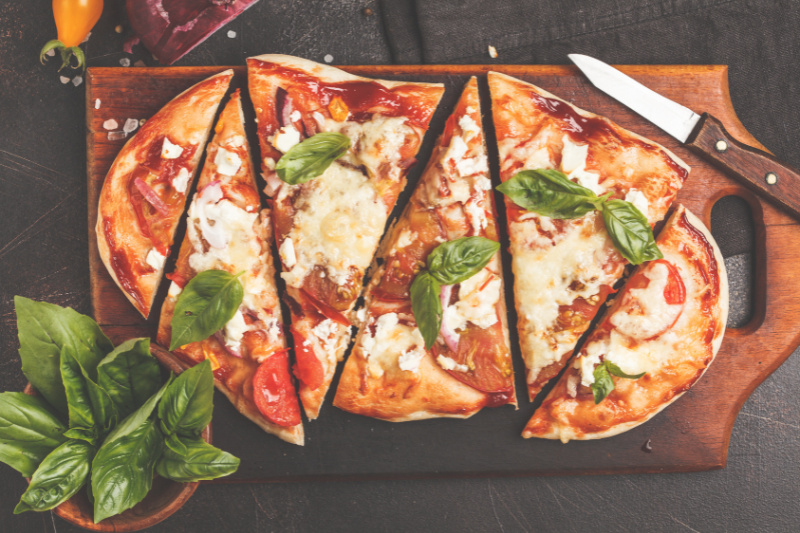
The two changes that make the biggest difference are crust and toppings. Switching from regular or deep dish to thin crust saves 100–300 calories per slice — up to 600 calories over a two-slice meal.
Swapping processed meats and extra cheese for vegetables cuts another 120–180 calories per slice, and vegetable toppings add fewer than 20 calories combined. Those two adjustments alone can turn a calorie-heavy meal into a manageable one.
If you want even more control, making pizza at home is the most reliable option. Homemade versions typically run 100–200 calories per slice compared to 300–600+ for delivery, and you control every ingredient. Alternative crusts push the numbers down further:
- Cauliflower crust: 100–150 calories per slice
- Whole wheat crust: moderate calorie reduction with added fiber
- Greek yogurt dough: roughly 55–100 calories per slice
Eating out requires a bit more strategy. Before you order, check the chain's nutrition information online — restaurants with 20 or more locations are required to provide it.
When you order, request light cheese, choose marinara over Alfredo sauce (which saves over 100 calories per slice), and skip the breadsticks and soda, which can easily double the meal's total calorie count. E
ating a large salad before your pizza is also worth the habit — it takes the edge off hunger before the slices arrive.
One detail worth knowing: pizza has a glycemic index of 60–80, but its high fat content slows digestion, which keeps blood sugar elevated for 4–6 hours rather than the typical 2–3. Pairing pizza with fiber-rich vegetables and opting for whole-grain crust helps moderate that response.
As for frequency, a reasonable guide is traditional pizza once a week, or homemade healthier versions one to two times per week — enough to keep it in your routine without it consistently eating into your calorie targets.
Conclusion
Pizza is neurologically one of the easiest foods to overeat, but the evidence is clear that banning it tends to cause more damage to your diet than the calories ever would.
The smarter approach is simple: thin crust, vegetable toppings, one to two slices alongside a salad, and you have a satisfying meal that fits within a caloric deficit.
People who lose weight and keep it off aren't the ones who never eat pizza — they're the ones who eat it deliberately, enjoy it, and move on without guilt.