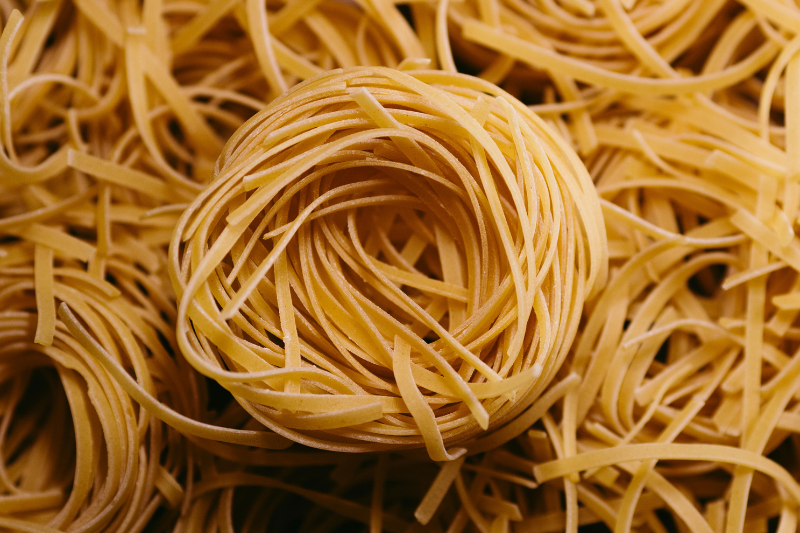
Protein pasta can support weight loss, but not because it cuts calories — it works by delivering more protein and fiber per serving, which helps you feel fuller and eat less overall.
Keep reading for a closer look at the science behind it, what the research actually shows, and whether it's worth making the switch.
What Makes Protein Pasta Different From Regular Pasta
Regular pasta is made from semolina flour — a refined wheat that's high in carbs and relatively low in protein. Protein pasta swaps out some or all of that flour for high-protein ingredients, and depending on which type you choose, the nutritional difference can be significant.
There are three main categories:
- Pure legume pastas — made entirely from chickpea, lentil, black bean, or edamame flour (brands like Banza, Tolerant, Explore Cuisine, and Kaizen)
- Wheat-legume blends — semolina mixed with lentil flour or pea protein, like Barilla Protein+
- Added-protein varieties — traditional wheat pasta fortified with whey or soy protein isolates
The nutritional gap between these types is wider than most people expect. Across the board, protein pasta roughly doubles the protein content and triples the fiber of regular pasta, while also carrying a meaningfully lower glycemic index. But the specifics vary a lot by variety.
Edamame pasta is the standout — packing 21–25g of protein per serving with just 7–11g of net carbs, making it closer to a legume dish than a traditional pasta.
Red lentil pasta, on the other hand, earns attention for its glycemic index, which can be as low as 22 — remarkably low for any starchy food.
Barilla Protein+ sits at the opposite end of the spectrum. It tastes the most like regular pasta and is widely available, but it only adds about 3g more protein per serving than standard Barilla. Dietitians have called that difference negligible — and in practical terms, it is.
Four Ways Protein Pasta Can Support Weight Loss
Protein pasta doesn't create a caloric deficit on its own — but it works through four well-documented physiological mechanisms that make eating less a little easier.
1. It makes you feel fuller, so you eat less without trying
This is the strongest mechanism. Protein suppresses ghrelin (the hunger hormone) while boosting CCK and GLP-1, two hormones that signal fullness.
In practice, the effect is meaningful: when participants raised protein from 15% to 30% of their daily calories, they spontaneously ate 441 fewer calories per day — with no deliberate restriction — and lost 4.9 kg over 12 weeks.
More directly relevant, people who ate legume-based pasta consumed about 20% less energy at their next meal compared to those who had regular pasta.
2. It keeps blood sugar more stable
Lower glycemic index means glucose enters your bloodstream more slowly, which reduces insulin spikes and the energy crashes that tend to drive snacking.
Chickpea pasta has a GI of around 39 when freshly cooked — already well below refined wheat pasta — but that drops to 33 when cooled and reheated, partly because cooling doubles its resistant starch content.
One large dietary trial found that combining higher protein with a lower glycemic index was the single most effective pattern for keeping weight off long-term.
3. Your body burns more calories digesting it
Protein has a significantly higher thermic effect than other macronutrients — your body uses 20–30% of protein's caloric content just to digest and absorb it, compared to 5–10% for carbohydrates and almost nothing for fat.
That means roughly 25–30 calories out of every 100 consumed from protein are spent on digestion alone. Higher-protein meals have been shown across multiple studies to increase total daily energy expenditure in a measurable way.
4. It helps you hold onto muscle while losing fat
When you're eating at a caloric deficit, your body doesn't just burn fat — it can break down muscle too, which slows your metabolism over time. Adequate protein intake counters this.
Research shows that protein intake above 1.3g per kilogram of body weight per day is associated with maintained or increased muscle mass during weight loss.
High-protein dieters have been shown to preserve around 0.43 kg more fat-free mass than those on standard-protein diets — and as a result, their resting energy expenditure stays roughly 142 kcal/day higher, which compounds over weeks and months.
What the Actual Weight Loss Numbers Look Like
The research on high-protein diets and weight loss is consistent — but the effect sizes are modest, not dramatic.
Across 24 randomized controlled trials, high-protein diets produced 0.79 kg greater weight loss and 0.87 kg greater fat mass loss compared to standard-protein diets.
A separate 2021 meta-analysis covering 37 trials put the advantage at 1.6 kg. These aren't trivial differences, but they're not transformative either.
The starkest contrast comes from a six-month trial comparing high-protein and high-carbohydrate diets directly: the high-protein group lost 8.9 kg versus 5.1 kg for the high-carb group — a gap wide enough to be practically meaningful over time.
What the pasta-specific evidence actually shows
The most directly relevant finding for protein pasta is a study showing that people ate about 20% less at subsequent meals after consuming legume-based pasta compared to regular pasta.
That's a real and useful effect — but worth noting is that the study was industry-funded, and the reduced intake may have partly reflected lower palatability rather than superior satiety signaling alone.
Perhaps more telling: in a separate 12-week study, people lost weight eating pasta as part of a low-glycemic diet regardless of whether the pasta itself was high in protein.
That points to something dietitians consistently emphasize — the total meal composition is doing more of the work than any single ingredient.
The honest picture is that protein pasta works through real mechanisms and offers a consistent, if incremental, advantage. Swapping pasta types alone won't move the needle much.
What you pair it with, how much you eat, and how the overall meal is structured matters considerably more.
The Caveats Dietitians Want You to Know
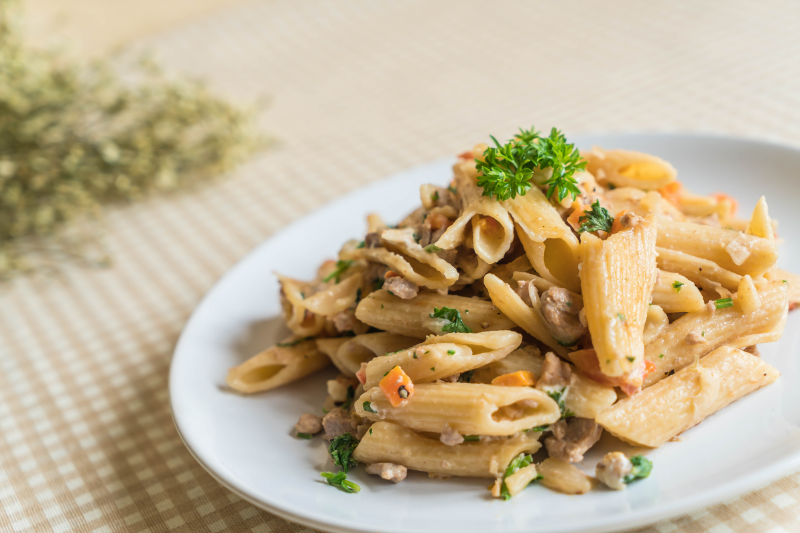
The mechanisms are real, but registered dietitians are quick to put protein pasta in perspective. No single food determines weight loss — portions, overall dietary pattern, and consistency do the heavy lifting.
A straightforward example: a single 4-ounce chicken breast delivers 26g of protein. Adding one to a plate of regular pasta likely does more for your protein intake than switching pasta types entirely.
The health halo problem
One of the more practical risks with “healthier” foods is that people eat more of them, assuming the label gives them room to do so. With protein pasta, that can quietly erase any benefit.
A standard serving is just 2 oz dry — roughly 1 cup cooked — but restaurant portions routinely run three to four times that amount. The protein content doesn't change the calorie math if the portion doubles.
Digestive discomfort is common
Legume-based pastas are high in fiber and oligosaccharides, which can cause gas, bloating, and IBS flare-ups, particularly if you're not used to eating much fiber. A few practical notes:
- Increase your intake gradually rather than making an abrupt switch
- Drink more water to help your digestive system adjust
- If chickpea pasta causes bloating, lentil-based varieties tend to be easier to tolerate
A few other practical considerations worth knowing
Protein pasta typically costs $3–6 per box compared to $1–3 for regular pasta — a real difference if you're eating it regularly. Taste is also genuinely mixed.
Some varieties are described as grittier or earthier, and legume pastas can turn mushy if overcooked. Barilla Protein+ comes closest to the taste and texture of traditional pasta, though it offers the smallest nutritional upgrade of any variety.
One concern that occasionally surfaces is anti-nutrients — compounds like phytic acid and lectins found in legumes that can reduce mineral absorption.
In practice, cooking degrades these significantly, and a varied diet provides more than enough nutrients to offset any minor reduction.
Who Should Actually Use Protein Pasta (And Who Probably Doesn't Need It)
Protein pasta isn't for everyone — and for a lot of people, it's genuinely unnecessary. Whether it's worth it depends largely on how you eat and what you're trying to accomplish.
It makes the most sense if you:
- Follow a vegetarian or vegan diet and want a convenient way to get more plant-based protein without planning around a separate protein source
- Track macros and want protein built into every component of a meal
- Prefer simpler, one-pot meals where the pasta itself carries more nutritional weight
When protein pasta is combined with other protein sources, the numbers get genuinely impressive. A dish of chickpea pasta with pesto and chicken, for instance, can deliver 49g of protein and 22g of fiber in a single serving — the kind of meal that keeps most people full for hours.
For most omnivores, the case is weaker
If you regularly eat meat, fish, eggs, or dairy, you're likely already hitting adequate protein targets without any help from your pasta.
Regular pasta paired with a lean protein and vegetables achieves essentially the same nutritional balance — usually at lower cost and with a more familiar taste and texture.
That said, there's a practical middle ground worth considering: mixing half regular pasta with half a higher-protein variety.
You get a meaningful boost in protein and fiber, the texture stays closer to what you're used to, and the cost difference becomes much less of a factor. It's a low-effort adjustment that doesn't require fully committing to a variety you might not enjoy.
The Bottom Line on Protein Pasta and Weight Loss
Protein pasta is a legitimate nutritional upgrade over regular pasta — not because it cuts calories (it doesn't, meaningfully), but because it shifts the macronutrient balance toward more protein and fiber while lowering glycemic impact.
The science supporting each underlying mechanism — satiety, thermogenesis, blood sugar control, and muscle preservation — is well-documented and replicated across dozens of trials.
The finding that legume-based pasta reduces subsequent energy intake by around 20% is clinically meaningful, not a rounding error.
But none of that changes one fundamental reality: no pasta variety creates a caloric deficit on its own. If portions are too large, the rest of the meal is unbalanced, or overall eating habits are working against you, the type of pasta on your plate is largely irrelevant.
The smartest approach is simpler than the marketing makes it seem. Choose a pasta you'll actually enjoy eating in reasonable portions, pair it with adequate protein and plenty of vegetables, and let those elements do the work together.
Whether that protein comes from the pasta itself or the food beside it matters far less than getting the overall meal right — and doing it consistently.
Conclusion
Protein pasta offers real nutritional advantages — more protein, more fiber, and a lower glycemic impact — but it works best as one part of a well-constructed diet, not a standalone fix.
The research supports the mechanisms, the benefits are genuine, and for the right person it's a worthwhile swap.
At the end of the day, though, the pasta variety matters far less than the portions you eat, the meals you build around it, and the habits you stick to over time.