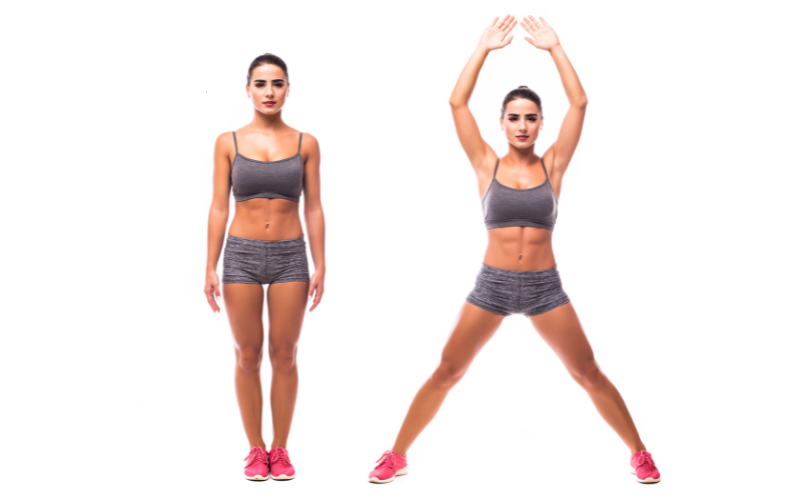
Jumping jacks can help you lose weight, but only as a small piece of the puzzle, not a fix on their own.
A few minutes a day burns a modest number of calories and won't move the scale much unless it's paired with a calorie deficit through diet.
Keep reading to see exactly how many calories they burn, how they compare to other cardio, and how to actually use them to see real results.
How Many Calories Do Jumping Jacks Actually Burn?
Body weight has a bigger effect on your calorie burn than most people expect. Someone weighing 120 pounds burns around 8 calories a minute doing jumping jacks, while a 250-pound person can burn up to 16 calories a minute at the same effort level. That's roughly double the burn just from carrying more body weight during the same movement.
Ten minutes a day lands most people around 100 calories burned, though your exact number shifts with your weight:
- 155 pounds: about 100 calories in 10 minutes
- 125 pounds: about 90 calories in 10 minutes
- 185 pounds: about 120 calories in 10 minutes
Most calculators settle on 8 to 12 calories per minute for a typical adult, which is a useful range to keep in mind rather than chasing an exact figure.
The reason jumping jacks burn what they do comes down to MET values, a measurement system for exercise intensity. Jumping jacks are classified as vigorous calisthenics at 8.0 METs, putting them in a similar intensity bracket as running at 6 mph.
Push the pace and range of motion further, and intensity can climb to 8 to 14 METs during an all-out effort. The calorie math behind this is straightforward: multiply MET value by 3.5, then by your body weight in kilograms, then divide by 200 to get calories burned per minute.
Here's what that looks like in practice:
- Five minutes of moderate-to-vigorous jumping jacks burns about 47 calories for someone weighing 150 pounds
- A 154-pound person doing vigorous jumping jacks burns roughly 88 to 92 calories in 10 minutes
- 100 jumping jacks, which takes about 2 minutes to complete, burns around 19 to 20 calories for a 150-pound person
None of these numbers are enormous on their own, but they add up if you're consistent.
If you want to push your calorie burn higher, you have a few practical options. Slowing down and doing more reps increases time under effort, while speeding up and doing fewer reps raises intensity instead—both approaches work, just through different mechanisms.
Adding a resistance band above your knees increases muscular demand without changing the movement pattern. Switching to variations like squat jacks, power jacks, or star jumps also raises the intensity ceiling, since these versions require more force and range of motion than a standard jumping jack.
How Jumping Jacks Stack Up Against Other Cardio Exercises
Compared side by side with other common cardio options, jumping jacks land squarely in the middle of the pack:
- Jump rope: 10 to 16 calories per minute
- Burpees: 8 to 15 calories per minute
- Running (6 mph): 8 to 12 calories per minute
- Jumping jacks: 8 to 16 calories per minute
- Brisk walking: about 5 calories per minute
That range shows jumping jacks can rival running or even edge into jump rope territory when done at high intensity, while still comfortably outperforming a brisk walk.
In terms of pure calorie efficiency, jumping jacks don't top the list. Jump rope burns more per minute at its upper range, and burpees demand more total muscle recruitment per rep.
But jumping jacks make up for this with a much lower barrier to effort and skill. Jump rope requires timing and coordination that takes practice to develop, and burpees are physically demanding enough that many beginners can't sustain them for long periods.
Jumping jacks ask for neither specialized skill nor equipment, which makes them easier to sustain at a moderate-to-vigorous pace for longer stretches.
That accessibility is really the whole appeal. You don't need a jump rope, a gym, or even much floor space—just enough room to move your arms and legs.
This matters more than it might seem, because the exercise you'll actually do consistently beats the “perfect” exercise you skip. Jumping jacks work in a hotel room, a small apartment, or during a quick break at the office, with zero setup and zero cost.
So when do jumping jacks make the most sense over other cardio? A few scenarios stand out:
- You're traveling or short on space and can't access a gym or open area for running
- You want a quick way to raise your heart rate before a strength session or between sets
- You're newer to exercise and want something with a lower skill barrier than jump rope
- You need a no-equipment option that still qualifies as vigorous-intensity activity
If your goal is squeezing out the maximum calorie burn per minute and you already have the coordination for it, jump rope or burpees may edge out jumping jacks.
But for consistency, convenience, and ease of entry, jumping jacks hold their own against nearly anything else in the cardio lineup.
Can Jumping Jacks Alone Help You Lose Weight?
Weight loss comes down to one core principle: burning more calories than you take in. Jumping jacks add to that equation on the “calories out” side, but they're only one small input into a much bigger system.
No amount of exercise can outpace a calorie surplus from food, which is why diet ends up being the dominant factor in whether you actually lose weight.
You've probably heard that burning 3,500 calories equals one pound of fat lost. That rule sounds precise, but it's outdated and oversimplified. It ignores metabolic adaptation—the way your body's metabolism slows down as you lose weight, which means the same calorie deficit produces less weight loss over time than the old formula predicts.
Because a pound of fat requires burning through thousands of calories, using jumping jacks as your sole weight-loss method would mean doing somewhere in the range of 20,000 to 30,000 jumping jacks just to lose a single pound. That number alone makes clear why jumping jacks work better as a supporting tool than a standalone plan.
Research on exercise without dietary change backs this up directly. A study following women who exercised three times a week for four weeks, with no changes to their diet, found they lost no weight at all. The researchers behind that study concluded plainly that exercise on its own does not lead to weight loss in women.
Broader reviews comparing diet-only approaches to diet-plus-exercise programs reinforce the same pattern: diet drives the majority of the results, and programs combining both outperform exercise-only approaches by a wide margin over the course of a year.
Here's something worth noting: no rigorous study has ever tested jumping jacks by themselves for weight loss. Every time jumping jacks show up in research, they're bundled into a larger circuit alongside other bodyweight movements, which makes it impossible to credit fat loss to jumping jacks specifically.
In one such trial involving adults doing a mix of 18 different bodyweight exercises (including jumping jacks) over eight weeks, the treatment group saw a small decrease in body fat percentage and waist circumference compared to a control group—modest improvements, and again, not attributable to jumping jacks alone.
Meta-analyses looking at jump and plyometric training as a category tell an even clearer story. Pooled data across more than a thousand participants found no significant effect on body-fat percentage and no significant effect on lean mass from this type of training. What did improve consistently were strength, power, and cardiovascular fitness.
That distinction matters:
- Jump-based training reliably makes you fitter, stronger, and more powerful
- It does not reliably reduce body fat on its own
- Fat loss tracks total energy balance, not any single type of movement
So the honest answer is that jumping jacks alone won't get you to meaningful weight loss. They can improve your fitness, support muscle engagement, and add to your daily calorie burn, but the heavy lifting for fat loss happens through what you eat, not through this one exercise in isolation.
The Smartest Way to Use Jumping Jacks for Weight Loss (HIIT & Circuits)

If jumping jacks alone won't get you to your goal, the next question is how to use them well. The answer lies in how you structure them, not just how often you do them.
Jumping jacks fit naturally into HIIT and Tabata-style formats, where short bursts of high effort alternate with brief rest periods.
This structure pushes your heart rate up faster and keeps it elevated longer than doing the same movement at a steady, moderate pace, which makes each minute you spend more productive.
A few interval structures work particularly well:
- Classic Tabata: 20 seconds of all-out effort, 10 seconds of rest, repeated for 8 rounds (4 minutes total)
- Longer intervals: 30 to 60 seconds of work with short rest periods, repeated for 4 to 8 rounds
- Circuit integration: Jumping jacks paired with squats, push-ups, and mountain climbers in rotating stations
Any of these turns a simple bodyweight movement into a genuine cardiovascular challenge without needing equipment or a large time commitment.
One benefit worth understanding correctly is the “afterburn effect,” known scientifically as excess post-exercise oxygen consumption, or EPOC.
This refers to the extra calories your body burns after a workout ends, as it works to return to its resting state. For a 20-minute jumping jack interval session, that afterburn adds roughly 15 to 25 extra calories.
In general, EPOC accounts for somewhere around 6 to 15 percent of the calories burned during the workout itself, with 7 percent being a commonly cited average.
It's worth being realistic here. The idea that HIIT keeps your metabolism revved up for 24 to 48 hours is exaggerated, at least for accessible exercises like jumping jacks.
Most of the afterburn effect gets used up within the first 30 to 60 minutes after you finish. The real value of HIIT isn't some dramatic extended calorie burn—it's time efficiency and the ability to build or maintain cardiovascular fitness in a short window.
Jumping jacks also work well outside of dedicated interval sessions. They make a solid warm-up before a strength workout, raising your heart rate and loosening up your shoulders, hips, and legs before heavier lifting.
They're equally useful as a cardio interval dropped between strength sets, keeping your heart rate elevated during rest periods instead of letting it fully settle.
How much of this you need depends on your goal:
- General health: 150 minutes per week of moderate activity, or 75 minutes per week of vigorous activity, plus two days of muscle-strengthening work. Since vigorous jumping jacks count as vigorous-intensity activity, roughly 75 minutes a week could satisfy this on its own.
- Weight loss or preventing regain: 200 to 300 minutes per week is the recommended range, with research showing body weight tends to decrease in a roughly linear pattern as weekly aerobic activity increases, up to about 300 minutes.
- Getting started: Beginners can start with 3 to 5 sessions per week of 20 to 30 reps, then build from there by adding reps, sets, or intensity over time.
A practical progression some trainers recommend is 3 to 4 sets of 5-minute intervals, done 2 to 3 times a week, then scaled up as your fitness improves.
Beyond Weight Loss — Other Benefits and Practical Considerations
Weight loss isn't the only reason jumping jacks are worth doing. Several other benefits make them worth keeping in your routine even once fat loss isn't the primary goal.
On the cardiovascular side, jumping jacks raise your heart rate quickly, which over time improves aerobic capacity, lowers blood pressure, and supports better circulation.
They also engage a wide range of muscles in a single movement—your calves, quads, hamstrings, and glutes handle the jumping and landing, while your hip abductors and adductors control the leg movement out and back in.
Your shoulders, back, and core get worked too, since your arms are moving through a full range of motion the entire time. Retaining and building this muscle matters beyond aesthetics, since more muscle mass supports a higher resting metabolic rate.
There's also a bone health angle that often gets overlooked. Jumping jacks are a plyometric, weight-bearing exercise, meaning each landing applies impact force that stimulates bone formation.
Even relatively small doses, somewhere in the range of 10 to 20 daily jumps, can support bone strength over time, though jumping jacks produce lower impact forces than higher-intensity jumps.
Two other benefits round out the picture:
- Blood sugar control: Short bursts of activity after eating increase muscle glucose uptake, which helps blunt the blood sugar spike that follows a meal
- Coordination and balance: The rhythmic, full-body nature of the movement improves neuromuscular coordination and agility over time
Joint Impact and Who Should Be Cautious
Jumping jacks look simple, but they're deceptively high-impact. Every landing sends force through your knees, ankles, hips, and spine, which becomes a real concern for anyone dealing with obesity, arthritis, or a prior lower-body injury.
If you fall into one of those categories, landing softly on a padded surface, keeping your knees slightly bent, and stopping immediately if you feel pain are all necessary precautions.
If jumping jacks aren't a good fit for your joints, a low-impact alternative solves the problem without losing the benefits. The “step jack,” sometimes called a “half jack,” has you step one foot out to the side while raising your arms instead of jumping.
This removes the impact entirely while still delivering cardio benefit and muscle engagement, and it's commonly recommended by physical therapists and trainers for people with knee or ankle issues.
Two Myths Worth Clearing Up
Spot reduction doesn't work. You cannot target fat loss in a specific area, like your belly, by doing jumping jacks or any other localized exercise. A large-scale review pooling more than a thousand participants across multiple studies found essentially no effect from targeted exercise on regional fat loss. Fat loss happens systemically across your whole body, not in the specific area you're moving.
Plateaus are normal, not a sign you're doing something wrong. As you lose weight, your metabolism adapts, meaning the same jumping jack routine burns fewer calories than it once did. Pushing past a plateau usually requires two adjustments: increasing intensity or volume in your workouts, and revisiting your diet to make sure your calorie deficit is still intact. Without both, progress naturally stalls.
A Practical Plan: Combining Jumping Jacks, Diet, and Strength Training
Knowing the research is one thing; putting it into a routine you'll actually stick with is another. Here's how to structure things from week one onward.
Where to Start
If you're new to this, keep it simple: 3 to 5 sessions per week, with 3 to 5 sets of 30 to 60 seconds of jumping jacks, resting between sets as needed.
This builds you toward the 75-minute vigorous-activity guideline without overwhelming you early on. Land softly on a cushioned surface from the start, since good landing habits matter more once you increase intensity later.
Progressing to Circuits and HIIT
Once the basic movement feels manageable, shift toward more structured formats:
- Introduce Tabata-style intervals (20 seconds on, 10 seconds off, for 8 rounds)
- Fold jumping jacks into a bodyweight circuit alongside squats, push-ups, and mountain climbers
- Gradually build total weekly activity toward the 200 to 300-minute range associated with meaningful weight loss
This progression matters because your body adapts to repeated stimulus. What challenges you in week one won't challenge you by week six, so increasing intensity or volume keeps results moving instead of stalling out.
Don't Skip Strength Training
Twice a week, add dedicated strength training to your routine. This isn't optional if muscle retention matters to you, and it should.
Preserving muscle protects your resting metabolism, meaning your body continues burning more calories at rest even as you lose weight. It also satisfies the muscle-strengthening component of general activity guidelines, which cardio alone doesn't cover.
Track What You Eat, Not Just What You Burn
Here's the part people underestimate: a single jumping jack session burns somewhere between 50 and 150 calories. That's easy to erase with one extra snack or a slightly larger portion at dinner.
Tracking your food intake, even loosely, ensures the calorie deficit you're working for through exercise doesn't get quietly undone by eating it back. Diet remains the dominant lever here, and monitoring it is what keeps your effort from going to waste.
When to Adjust Your Approach
A few signals tell you it's time to change something:
- No weight change after 4 to 6 weeks: The problem is almost always diet, not your jumping jack routine. Tighten your calorie intake rather than simply adding more reps.
- Joint pain during or after sessions: Switch immediately to low-impact variations like step jacks, and don't push through discomfort.
- A stalled plateau after previous progress: Increase intensity or volume in your workouts, and re-examine whether your calorie deficit is still where it needs to be.
Put together, this plan treats jumping jacks for what they are: a useful, accessible piece of a larger system built on diet, strength training, and consistent cardio, not a shortcut that works on its own.
Conclusion
Jumping jacks won't single-handedly get you to your weight-loss goal, but they're a genuinely useful tool when paired with a calorie deficit and strength training.
Used consistently, whether as part of a HIIT circuit or a quick warm-up, they add up to real cardiovascular and metabolic benefits over time.
Start small, stay consistent, and let your diet do the heavy lifting while jumping jacks support the rest.