
No, edibles won't help you lose weight — for most people, THC actually ramps up appetite and adds calories from the food itself, working against any weight-loss goal.
Keep reading to see what the research actually shows, including the one cannabinoid that might genuinely help.
The Short Answer — What Edibles Actually Do to Your Appetite
When you eat a THC edible, it binds to CB1 receptors in your brain's hypothalamus and reward centers, and this is what sets off the hunger response. You're not actually running low on energy or nutrients.
Your brain just starts acting like you are, because THC hijacks the same signaling system your body normally uses to regulate real hunger.
The scale of this effect is well documented. In a controlled study out of Johns Hopkins, volunteers who smoked THC cigarettes over a two-week period increased their daily calorie intake by 40%.
Almost all of that came from snacking on candy and other sweets between meals, not from eating bigger meals. The munchies, in other words, show up as extra junk food on top of your normal eating, not as a shift in your regular appetite.
More recent research backs this up and adds an important detail: cannabis doesn't just make you hungrier, it makes you keep eating even after you're full.
A 2025 study found that cannabis increases both your drive to seek out food and how rewarding that food feels, and this held true regardless of:
- The dose consumed
- The person's age or sex
- How recently they'd already eaten
That last point matters. Normal hunger signals are supposed to shut off once you've eaten enough. THC appears to override that shutoff switch entirely, which is why people can polish off a whole bag of chips right after a full meal and not think twice about it.
This is also why the term “munchies” undersells what's actually happening. It's not physical hunger in the traditional sense — it's your brain's reward circuitry getting hijacked, making food feel more appealing and more urgent to seek out, even when your body doesn't need it. That distinction is the whole reason edibles work against weight loss rather than for it.
The Confusing Part — Why Regular Cannabis Users Tend to Weigh Less
Here's where things get genuinely strange. If THC reliably increases appetite and calorie intake, you'd expect regular users to weigh more than everyone else. Large-scale population surveys show the opposite.
Across multiple national datasets, cannabis users consistently show lower average BMI and lower obesity rates than non-users, even though they're eating more overall.
One of the more compelling pieces of evidence comes from a long-term study tracking roughly 33,000 U.S. adults over three years. Everyone in the study gained some weight over time, which is typical.
But people who used cannabis consistently throughout the study period gained noticeably less than non-users. The researcher behind the study pointed out that while a few pounds of difference might not sound dramatic on its own, finding that same pattern across tens of thousands of people with wildly different lifestyles and habits is hard to dismiss as noise.
So why would eating more lead to weighing less? A few theories have been proposed:
- CB1 receptor downregulation — with regular use, the brain may reduce its sensitivity to cannabinoid signaling over time, potentially affecting how the body stores energy and regulates metabolism
- Improved insulin sensitivity — some data suggests regular users process blood sugar more efficiently, though the mechanism isn't fully worked out
- Substitution effects — cannabis users tend to drink less alcohol, and alcohol is a significant, often-overlooked source of empty calories
- Behavioral awareness — some users may simply be more conscious of their eating habits or health choices overall, independent of cannabis itself
None of these explanations have been confirmed. They're plausible, and each has some supporting data behind it, but what we have is a correlation sitting on top of several competing theories, not a settled cause-and-effect relationship.
It's entirely possible that one, several, or none of these factors is actually driving the pattern, and that something else entirely — unrelated to cannabis directly — explains why users skew leaner on paper.
Does Cannabis Actually Cause Weight Loss? The Case for Skepticism
Population data can only tell you so much. It shows patterns, not causes, and there's a big difference between the two. To actually test whether cannabis causes lower BMI, researchers need a study design that can rule out confounding factors like income, lifestyle, age, and other habits that might explain the link on their own.
That's where a genetic research method comes in, one that uses naturally occurring genetic variation to mimic the conditions of a randomized trial without actually assigning people to use cannabis.
It's currently the closest thing available to a real causal test on this question. And the result was clear: no meaningful evidence that lifetime cannabis use affects BMI, waist circumference, or waist-to-hip ratio.
The researchers behind it were direct about what this means, cautioning against treating cannabis as some kind of fix for the obesity epidemic and suggesting the lower-BMI pattern seen in other studies likely comes down to confounding factors rather than anything cannabis is actually doing to the body.
There's also a more concerning wrinkle. A study on adolescent mice given regular low doses of THC found that as adults, the mice did show reduced fat mass and some resistance to diet-induced weight gain — but not in a healthy way.
Their fat cells lost the ability to properly release stored energy, and some fat cells started producing proteins normally only found in muscle tissue.
Researchers described this as a “pseudo-lean” state: an appearance of leanness that's actually driven by a malfunctioning metabolism rather than good health.
Human data adds another complication. In the CARDIA study, daily cannabis users did show a noticeably lower average BMI than non-users.
But those same daily users also had a substantially higher risk of prediabetes compared to non-users. That combination undercuts the idea that a lower number on the scale automatically means better metabolic health.
Put together, these findings paint a much more cautious picture than the simple “cannabis users are leaner” headline suggests:
- The strongest causal test available found no real weight-loss effect
- Animal data suggests apparent leanness can come from fat-cell dysfunction, not fat loss
- Human data links regular use to elevated prediabetes risk despite lower BMI
Lower BMI isn't automatically evidence of a health benefit, and in this case, it might be masking a metabolic problem instead of pointing to one being solved.
Why Edibles Specifically Work Against Weight Loss
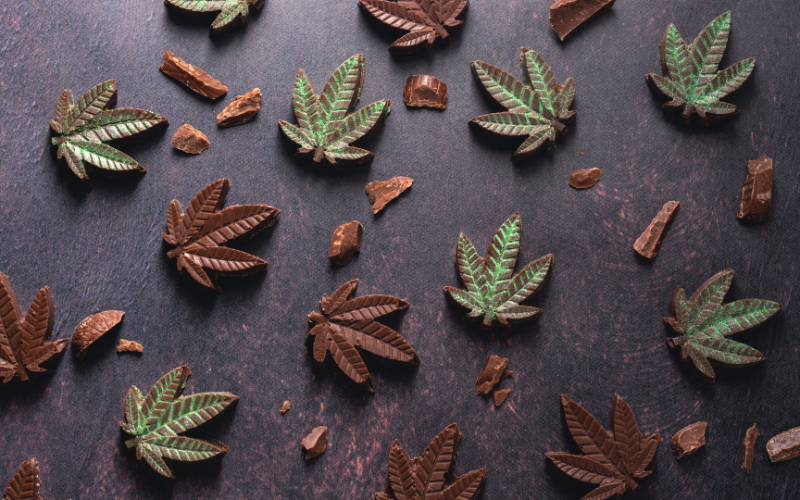
Everything covered so far applies to cannabis in general. Edibles, though, have their own set of problems that make them an especially poor choice if weight loss is the goal.
When you eat THC instead of smoking or vaping it, your liver processes it before it ever reaches your bloodstream in its original form.
This process converts THC into a different compound that's significantly more potent and lasts much longer than the THC you'd get from inhaling.
So gram for gram, an edible doesn't just deliver a milder, food-based version of the same experience — it delivers a stronger, more prolonged one, which means a stronger and longer appetite-stimulating effect too.
That extended timeline creates a second problem: onset. Edibles typically take anywhere from 30 minutes to two hours to kick in. Compare that to smoking, where effects show up almost immediately.
That delay leads a lot of people to assume the first dose didn't work, so they take more before the original dose has even had a chance to activate.
This pattern, often called dose-stacking, means edible users frequently end up consuming far more THC than they intended, which only amplifies the appetite and calorie effects already at play.
Then there's the food itself. Unlike smoking, where the THC delivery method carries zero calories, edibles are calories by definition:
- Low-dose gummies: often in the range of 10–30 calories each, with some sugar-conscious brands running as low as 8–15
- Traditional infused baked goods: typically carry the same 150–200+ calories as their non-infused counterparts
- Poorly labeled products: some gummy packages have historically contained over 1,000 calories per package
So even setting aside the appetite-stimulating effect, you're adding real dietary calories on top of whatever else you eat afterward.
Finally, edibles carry a distinct safety concern tied directly to dose-stacking and delayed onset: they're consistently linked to a disproportionate share of cannabis-related emergency room visits, especially compared to how much of the overall cannabis market they represent.
Overconsumption symptoms include severe anxiety, paranoia, vomiting, and a rapid heart rate. None of this is weight-related directly, but it underscores how easy it is to lose control of dosing with edibles in a way that smoking simply doesn't allow for.
THCV — The Cannabinoid With Actual Weight-Loss Evidence
If there's a real weight-loss story in cannabis, it isn't THC. It's a lesser-known compound called THCV, and its mechanism is essentially the opposite of what THC does.
Where THC activates CB1 receptors and stimulates appetite, THCV blocks those same receptors at low doses, which means it works against hunger signals rather than amplifying them. It's sometimes nicknamed “diet weed” for exactly this reason, and at low doses it isn't intoxicating in the way THC is.
The most direct evidence comes from a 2025 randomized, placebo-controlled trial testing daily THCV/CBD oral strips in adults with obesity over a 90-day period, with no diet or exercise changes required. The results, broken down by dosage group:
- High dose: an average loss of about 9 pounds, with 7 out of 10 participants losing weight
- Low dose: an average loss of roughly 5.7 pounds
- Placebo: essentially no change
The trial also reported drops in abdominal girth, LDL and total cholesterol, and, in the low-dose group, systolic blood pressure. On paper, that's a meaningful result.
It comes with real caveats, though, and they're worth taking seriously:
- The high-dose group included only 10 people, which is a small sample to build confidence around
- The study was run by the founder and CEO of the company selling the product, which is a direct commercial interest
- The statistical approach used was more permissive than the standard method typically expected in rigorous trials
- Most participants who'd never used THC before tested positive for THC on standard drug screens by the end of the trial, which matters a lot if you're subject to workplace testing
There's some independent support beyond that single trial. A separate, industry-funded but more rigorously designed study tested THCV in people with type 2 diabetes and found it significantly lowered fasting blood sugar and improved pancreatic function over 13 weeks, suggesting THCV has a legitimate role in metabolic health beyond just the weight-loss angle.
The most important thing to understand is this: THCV is not what's in a standard THC edible. Regular gummies, chocolates, and baked goods are formulated around THC, the appetite-stimulating compound.
THCV products are a completely different category, formulated specifically to isolate this appetite-suppressing effect, and they're far less common on the market. If you've been eating regular edibles hoping for a THCV-like effect, you've been using the wrong compound entirely.
Practical Takeaways for Anyone Considering Edibles and Weight
Given everything above, here's how to actually apply this information.
Standard THC edibles simply aren't a reliable weight-loss method, and the evidence points in the opposite direction. They stimulate appetite, deliver calories through the food itself, and carry a higher risk of overconsumption compared to other cannabis formats.
If you happen to lose weight while using them regularly, that's not something to count on or repeat intentionally. It's an outcome that runs against what the research shows should typically happen.
That conclusion isn't necessarily permanent. It would take a large, independently funded, placebo-controlled trial specifically showing that THC edibles cause weight loss in humans to meaningfully shift this picture, and no such study currently exists.
If THCV genuinely interests you, approach it carefully rather than jumping straight to a purchase:
- Look for products that are third-party lab-tested, so you actually know what you're getting
- Talk to a physician before starting, especially if you're managing any existing health conditions
- Keep in mind that THCV can trigger a positive result on standard THC drug tests, which matters if you're subject to workplace or legal testing
For anyone already using regular THC edibles for other reasons — sleep, pain, anxiety — and hoping to limit the weight impact, a few adjustments help:
- Choose lower-calorie products, ideally in the single-digit to 15-calorie range per piece, over baked goods that carry 150+ calories each
- Favor products with a higher CBD-to-THC ratio, since CBD doesn't stimulate appetite and may modestly suppress it
- Keep healthy snacks prepped and available in advance, so munchies-driven eating defaults to better options
- Wait the full window, roughly one to two hours, before considering another dose, to avoid stacking on top of an edible that hasn't fully kicked in yet
It's also worth knowing when to pull back or seek help. Watch for signs of overconsumption like a racing heart, severe anxiety, or vomiting, and treat escalating use or any symptoms suggestive of prediabetes as reasons to reassess.
Seek emergency care immediately for chest pain, persistent vomiting, fainting, or extreme confusion after taking an edible.
Ultimately, if weight loss is the actual goal, the highest-value places to put your effort remain the same ones with decades of solid evidence behind them: consistent dietary changes, regular physical activity, and, where appropriate, FDA-approved medications discussed with a doctor. Cannabis, in any form currently available to consumers, isn't a substitute for those approaches.
Conclusion
Standard THC edibles work against weight loss, not for it — they stimulate appetite and add calories, while any leanness linked to cannabis use shows up only with regular, long-term use and remains unproven as a direct effect.
THCV stands apart as the one cannabinoid with real, if early, weight-loss evidence, but it's a different compound entirely from what's in typical gummies and chocolates.
If losing weight is your actual goal, diet, exercise, and proven medical treatments remain your best bet, with cannabis playing no reliable role in that process.