No, tequila won’t help you lose weight, since the agave fibers behind that claim get broken down and turned into alcohol during production, leaving you with about 97 calories of pure alcohol per shot.
Keep reading to learn where the myth started, what the research actually shows, and how to drink tequila without undoing your progress.
Where the Myth Came From and What the Agave Research Shows
The idea traces back to March 2014, when Mercedes G. López of Cinvestav-Irapuato in Guanajuato, Mexico, presented agavins as a possible sweetener for people with obesity and diabetes at the American Chemical Society’s 247th National Meeting in Dallas. Most mice given agavins in their drinking water ate less, lost weight and had lower blood glucose than mice given glucose, fructose, sucrose, agave syrup or aspartame. Agavins also raised GLP-1, which in turn raises insulin.
The work had a few catches, though:
- It was a conference presentation, not a peer-reviewed paper at the time
- It used small groups: seven groups of four mice
- Mondelez International and Agavaceae Produce paid for it
- López pitched agavins as a light sweetener, not a reason to drink tequila
Headlines turned it into “drink tequila, lose weight” anyway, and the claim still resurfaces. Even then, dietitians warned it was a big leap from mice given agavins to people drinking tequila.
Later animal work did hold up. Mice on a high-fat diet given Agave tequilana fructans, for example, gained about 30% less weight and had less high blood sugar and fatty liver.
Human evidence is much thinner. In the main weight-focused trial, 28 adults with obesity on a 1,500-calorie diet took either 96 mg of agave fructans per kg of body weight daily or a placebo for 12 weeks. Only body fat differed significantly between groups, dropping about 10% with the fructans. With no weight-change data reported, the trial doesn’t prove agave fiber causes weight loss.
Other trials are mixed. At 7.8 g a day, agave fructans led to no weight loss in people with IBS-C, and 16 g of inulin daily for 6 weeks didn’t change appetite in 35 adults with type 2 diabetes, though some trials show modest effects.
And none of it applies to tequila, which contains no agave fructans at all.
Why Agave Fiber Never Makes It Into Your Glass
Tequila production strips out the very fiber the weight loss claim depends on, and it happens in three stages:
- Cooking breaks the fructans down. Agave heads are traditionally steamed for about 36 hours, and in one traditional distillery, about 98% of the fructans were gone after 25.5 hours. Fructose made up over 80% of the carbohydrate, with fructans down to about 5%. Modern distilleries also use autoclaves, acid or enzymes.
- Fermentation turns the freed sugar into ethanol. That’s the whole reason for cooking, and any fructans left over simply count as lost alcohol yield.
- Distillation leaves the rest behind. Sugars and fibers don’t vaporize, so finished tequila has 0 g carbohydrate, 0 g sugar and no fiber.
Agave syrup isn’t a workaround either. It’s mostly free fructose and was one of the sweeteners the agavin mice outperformed.
There’s one small wrinkle. Mexico’s tequila standard (NOM-006-SCFI-2012) allows up to 1% by weight of caramel color, oak extract, glycerin and sugar-based syrup, with no label disclosure required. A “100% agave” bottle only means the sugar came from blue agave. Blanco is the class defined without additives, so “zero sugar” isn’t guaranteed with aged tequilas.
Tequila Calories Compared With Other Drinks and Cocktails
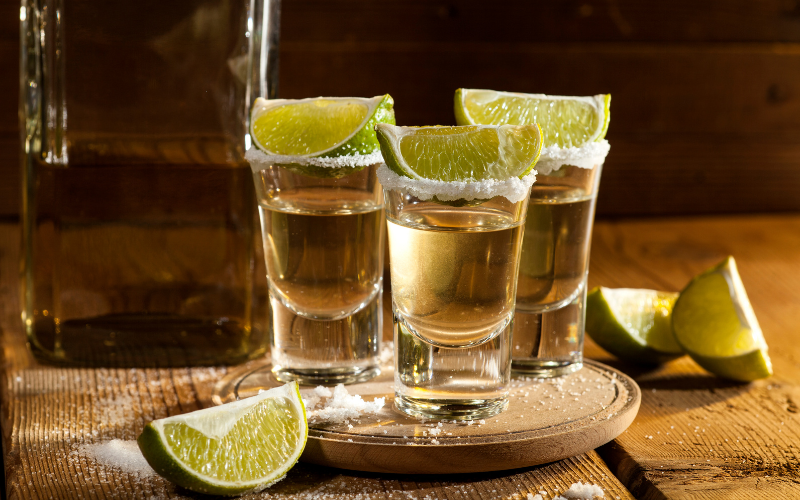
A 1.5-oz shot of 80-proof tequila has about 97 calories, or about 64 per ounce. With 0 g carbs, sugar, fat and protein, every calorie comes from alcohol, which carries about 7 calories per gram. Stronger bottles cost more: about 110 calories at 90 proof and about 124 at 100 proof.
That puts tequila level with vodka, gin, rum and whiskey at 80 proof, so it isn’t a lower-calorie spirit. It does come in under most beer and wine per standard drink (about 14 g of alcohol), where regular beer runs about 153 calories per 12 oz, light beer about 103 and a 5-oz glass of wine 120 to 125.
The mixer is where your calories really climb:
| Drink | Calories | Sugar or carbs |
|---|---|---|
| Tequila soda with lime | 97–110 | Close to zero |
| Ranch Water | 100–130 | — |
| Paloma with sparkling water and a splash of juice | 120–140 | — |
| Tequila and tonic | 140–170 | 15–20 g carbs |
| Paloma with 6 oz grapefruit juice | About 169 | — |
| Paloma with grapefruit soda | 200–300 | 25–35 g sugar |
| Classic margarita | 200–300 (about 274 for 8 oz) | — |
| Tequila Sunrise | About 250 | 21 g sugar |
| Chain-restaurant frozen margarita | About 290 | 39 g sugar |
| Large restaurant margarita (12–16 oz) | 400–600+ | — |
One large restaurant margarita can match four to six straight shots, so your mixer and glass size matter far more than which spirit you pour.
How Alcohol Works Against Fat Loss
Alcohol puts fat burning on hold. When healthy men drank 24 g of alcohol (under two standard drinks), fatty acid release from fat tissue fell 53% and whole-body fat burning fell 73%. Less than 5% of the alcohol became fat directly. Instead, the body turned it into acetate and burned that in place of fat, leaving fat from your meal more likely to be stored. “Your body burns alcohol first” is broadly right, but claims that fat burning stops for 24 to 36 hours go beyond the evidence.
Alcohol also makes you hungrier, a pattern known as the apéritif effect. In a study of 35 healthy-weight women, an alcohol infusion led to a bigger lunch than saline, along with stronger brain responses to food smells. In mice, alcohol switches on hunger-promoting AgRP neurons. And drink calories usually pile on top of what you eat rather than replace it.
Here’s what longer-term research shows:
- Light-to-moderate drinking isn’t linked to fat gain, but heavy drinking is more consistently tied to weight gain, and spirits in particular are associated with it
- In the Look AHEAD trial, adults with type 2 diabetes in an intensive lifestyle program who didn’t drink lost 5.1% of their starting weight at four years, compared with 2.4% for consistent heavy drinkers
- When white wine supplied 10% of a calorie-restricted diet, weight loss matched a group getting those calories from grape juice
Counted alcohol, in other words, won’t stop weight loss, but it won’t help either.
Tequila, Blood Sugar and Health Risks
Straight tequila has no carbs, so it won’t spike your blood sugar, but that’s not the same as better control. “Good for blood sugar” claims confuse the spirit with agave fiber. In the only human study of tequila itself, 8 healthy young men drank 30 mL (about 1 oz) daily for 30 days. Their weight barely moved (66.3 to 66.5 kg), homocysteine rose 19%, and glucose and insulin sensitivity trended the wrong way. The study was small and uncontrolled, but it showed no benefit.
Alcohol also keeps your liver from making new glucose and dulls your body’s response to lows. If you take insulin or sulfonylureas, drinking, especially on an empty stomach, can cause dangerous lows that may be delayed until overnight and can look like drunkenness. It can raise liver fat and triglycerides as well, a concern if you already have metabolic risk factors.
The 2025–2030 Dietary Guidelines for Americans, released January 7, 2026, swapped the two-drinks-for-men, one-for-women limits for simply drinking less, a change the American Association for the Study of Liver Diseases criticized for setting no daily limits. You should skip alcohol entirely if you’re:
- Pregnant
- Recovering from alcohol use disorder
- Taking medications that interact with it
Be wary of marketing at either extreme, too. Tequila doesn’t “dissolve fat,” and drinking doesn’t make fat loss “impossible.”
How to Drink Tequila Without Derailing Your Weight Loss
Don’t drink tequila to lose weight. Drinking less, or not at all, will do more for you than switching to a “better” alcohol.
If you’re curious about agavins, look for agave inulin, sold as a supplement or food ingredient. Human trials used about 5 to 10 g a day, or about 96 mg per kg of body weight in the obesity trial. Expect modest effects at best, plus possible bloating or gas, and treat it as fiber rather than a fat-loss product.
If you do drink tequila, these habits limit the harm:
- Measure 1.5 oz and count about 100 calories per pour
- Mix with soda water or sparkling mineral water and fresh lime, not margarita mix, regular grapefruit soda, tonic, orange juice or grenadine
- Order a skinny or fresh-lime margarita, or ask for less triple sec and syrup, and skip large frozen ones
- Choose blanco to avoid undisclosed sweeteners
- Decide in advance how many drinks you’ll have and what you’ll eat, and avoid late-night snacking
- Fit drink calories into your daily budget instead of adding them on top
- If you have diabetes or take glucose-lowering drugs, don’t drink on an empty stomach, check your glucose (including before bed) and talk to your clinician first
Mouse results don’t translate directly to people, and no study has tested distilled tequila for fructans. Still, the production process and 0 g of carbs make the answer clear: tequila won’t help you lose weight, and the best it can do is keep the setback small.
Conclusion
Tequila’s weight loss reputation rests on agave fiber that never makes it from the plant to the bottle, so what you’re really drinking is about 97 calories of alcohol per shot.
That alcohol slows fat burning, nudges your appetite up and usually adds calories on top of your meals, no matter which spirit you choose.
If you enjoy tequila, keep it simple with soda water and lime, measure your pours and count those calories toward your daily total.