Ghee can support weight loss when used in strict moderation (1-2 teaspoons daily) as a replacement for other fats, thanks to its unique fatty acid composition that may boost metabolism and increase satiety—but its high calorie density means even small excess amounts will cause weight gain instead.
Keep reading to understand exactly how ghee affects your body, the proper way to use it without sabotaging your goals, and why the scientific evidence is more nuanced than marketing claims suggest.
What Makes Ghee Different From Regular Butter
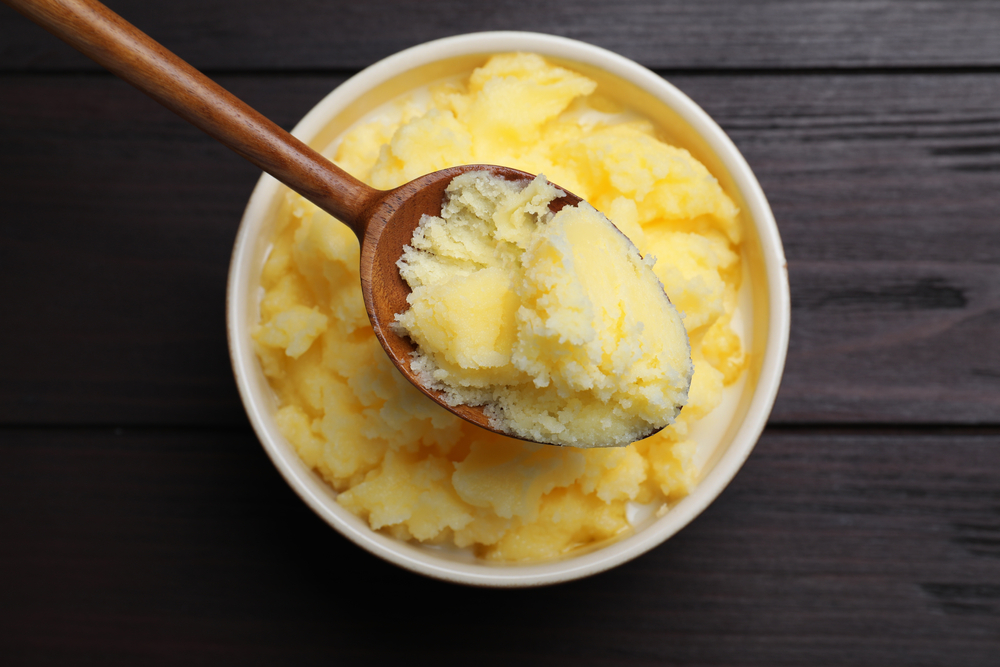
Ghee starts as butter but goes through a transformation that changes its entire composition.
When you simmer butter, the water evaporates and the milk solids separate out, leaving behind nearly pure butterfat—about 99% fat and just 1% moisture.
This clarification process removes almost all the lactose and casein, which means most people who can't tolerate dairy can usually handle ghee without issues.
Here's what you're actually getting in that tablespoon:
- 112-120 calories of pure fat energy
- Virtually no protein or carbohydrates
- Minimal to zero lactose (typically less than 0.01 grams)
- No water content that can cause splattering during cooking
Your body processes ghee differently than it does regular butter.
The removal of milk solids means you're consuming concentrated fatty acids without the proteins that some people react to.
This concentrated form also means the fat composition becomes more prominent—the medium-chain triglycerides, conjugated linoleic acid, and butyric acid aren't diluted by water or milk proteins.
The calorie density is where things get interesting for weight loss discussions.
Regular butter has roughly the same calories per tablespoon, but ghee's clarified nature makes it easier to use in larger amounts without realizing it.
A teaspoon disappears into warm water or coffee more smoothly than butter would, and its higher smoke point (around 485°F) makes it tempting to cook with generously.
This composition difference sets up the central tension in the weight loss question: ghee contains potentially beneficial fatty acids, but it's also an extremely concentrated calorie source.
Understanding this balance is essential before you decide whether to add it to your routine.
The Fatty Acids in Ghee That May Affect Weight Management
The weight loss claims around ghee stem from its specific fatty acid profile.
These aren't just generic fats—they're compounds that interact with your metabolism, gut health, and fat storage in distinct ways.
Medium-chain triglycerides (MCTs) take a different metabolic pathway than the long-chain fats you'll find in most foods.
Your liver converts them directly into energy or ketones instead of routing them into fat storage.
Research suggests this process can bump up your energy expenditure by 5-15%, which translates to roughly 100-150 extra calories burned each day.
That's not dramatic, but it's not nothing either—over time, it could make a modest difference.
Conjugated linoleic acid (CLA) shows up in studies as a potential fat reducer.
The research indicates you might see a 1-3% decrease in body fat percentage over 6-12 weeks when you combine CLA intake with proper diet and exercise.
The mechanism involves ramping up the activity of enzymes that break down fat you've already stored while potentially blocking the formation of new fat cells.
Butyric acid works on a different front entirely.
This short-chain fatty acid feeds the cells lining your gut, tamps down inflammation, and supports the bacteria living in your digestive system.
When your gut functions better, you absorb nutrients more efficiently and your metabolic processes run more smoothly—both relevant for maintaining a healthy weight.
You'll also find omega-3 fatty acids in ghee, including DHA.
Studies have connected DHA consumption with reduced abdominal fat in people actively trying to lose weight, suggesting it might help target the stubborn fat around your midsection.
Here's the reality check you need: Dietitians at Cleveland Clinic point out that these beneficial compounds exist in ghee at “trace” levels that may be “insignificant” for producing real health changes.
You're not getting therapeutic doses of MCTs or CLA from a teaspoon of ghee—you're getting small amounts that might offer marginal benefits at best.
The gap between what research shows these fatty acids can do in isolation and what you'll actually get from ghee consumption is substantial.
How Ghee Might Support Your Weight Loss Efforts
If you're wondering whether ghee actually helps or just adds calories, the answer depends entirely on how you use it.
The mechanisms exist, but they only work within the right context.
Your body processes the MCTs in ghee quickly, converting them to immediate energy rather than shuttling them into storage.
This fast processing creates a higher thermic effect—meaning your body burns more calories just digesting and metabolizing the fat.
Think of it as a slight metabolic acceleration that happens after you eat ghee, though the effect is modest.
The satiety factor matters more for most people.
When you add fat to a meal, you slow down how quickly carbohydrates hit your bloodstream.
This steadies your blood sugar instead of sending it on a roller coaster, and that stability translates to fewer cravings an hour later.
Ghee also influences your hunger hormones—specifically cholecystokinin and peptide YY—which signal fullness to your brain.
If you've ever noticed that fat keeps you satisfied longer than carbs alone, this is why.
On the digestive side, ghee stimulates your body to release digestive enzymes and supports the microbiome living in your gut.
Better digestion means you extract nutrients more efficiently and eliminate waste more effectively, creating conditions where your metabolism can function properly.
A gut that's inflamed or struggling with poor bacteria balance fights against your weight loss efforts.
Ghee helps you absorb vitamin D, which your thyroid needs to regulate metabolic rate and energy levels.
When your thyroid functions optimally, you maintain a higher baseline metabolism throughout the day.
There's also evidence suggesting ghee helps mobilize fat from storage cells so your body can burn it for fuel—but this only happens when you're in a caloric deficit.
The fat mobilization won't override excess calories.
Every single one of these benefits evaporates if you don't control portions.
You can't pour ghee liberally and expect the metabolic advantages to compensate for the calorie load.
The satiety effect works when you use measured amounts; the metabolism boost only helps if you're not simultaneously creating a caloric surplus.
This is where most people go wrong—they focus on the mechanisms while ignoring the math.
The Critical Limitations You Need to Understand
The calorie density problem overshadows everything else. At 112-120 calories per tablespoon, ghee can sabotage your weight loss faster than it can help.
Most people underestimate how quickly those calories add up—a generous pour into your morning coffee, a tablespoon to cook vegetables, another drizzle on your rice, and you've consumed 300-400 calories from ghee alone.
That's more than many people's entire breakfast, and it's remarkably easy to do without noticing.
Ghee is 60-65% saturated fat.
While newer research has softened the blanket condemnation of saturated fats from whole food sources, excessive intake still poses risks.
If you're genetically predisposed to high cholesterol or already dealing with cardiovascular concerns, loading up on ghee may increase your LDL cholesterol and elevate your disease risk.
The threshold varies from person to person, but the concentration in ghee means you can hit problematic levels quickly.
The scientific evidence itself tells a conflicting story.
Some studies show benefits for certain biomarkers; others show neutral or negative effects.
The research on ghee specifically—not just its individual fatty acids in isolation—remains limited and inconclusive.
You'll find studies supporting cardiovascular benefits and studies raising red flags, often using different populations and methodologies that make direct comparison difficult.
Here's what no amount of ghee can fix: a poor diet or sedentary lifestyle.
You can't eat processed foods all day, skip exercise, and expect ghee to unlock weight loss.
It cannot compensate for fundamental problems with your overall eating pattern or activity level.
Weight loss comes down to one non-negotiable reality—you must create a caloric deficit.
The type of fat you eat matters for health, satiety, and perhaps marginal metabolic effects, but it doesn't override thermodynamics.
If you consume more calories than you burn, you'll gain weight whether those calories come from ghee, olive oil, or any other source.
This is where overconsumption destroys the entire premise.
Even if ghee's MCTs burn an extra 100 calories daily, eating just one extra tablespoon wipes out that advantage and adds 20 calories on top of it.
The metabolic benefits become irrelevant when you're operating in caloric surplus.
You can't out-metabolize excess calories.
How to Actually Use Ghee for Weight Loss (Dosage and Methods)
If you're going to use ghee for weight loss, precision matters.
The recommended amount is 1-2 teaspoons (5-10 grams) daily maximum—not tablespoons.
That's roughly 40-80 calories, small enough to fit into a calorie-controlled diet without derailing your deficit.
Timing and application methods:
- Morning on an empty stomach: Stir 1 teaspoon into warm water or milk to stimulate digestive enzymes and metabolism before your first meal
- With meals: Add to vegetables, rice, dal, or roti to slow carbohydrate absorption and enhance nutrient uptake from fat-soluble vitamins
- In bulletproof coffee: Blend ghee with black coffee for sustained energy during intermittent fasting or keto protocols
- As a cooking fat: The high smoke point (482-485°F) makes ghee stable for sautéing without breaking down into harmful compounds
Skip ghee at night. Your digestion slows during sleep, and the rich fat content sits heavy when your metabolic processes are winding down for rest.
The rule that determines success or failure: Replace other fats with ghee instead of adding it on top of what you're already eating.
If you normally cook with two tablespoons of oil, use one teaspoon of ghee instead and cut the oil.
Don't pour ghee into your coffee and continue eating butter on your toast—you'll just stack calories and gain weight. This substitution principle is non-negotiable.
Quality shapes the nutrient profile significantly.
Look for grass-fed A2 ghee made from the milk of indigenous cows like Gir cows, ideally prepared using the traditional bilona method where curd is churned to separate butter before slow heating.
This process preserves more beneficial compounds and creates higher concentrations of CLA and omega-3s compared to commercial production.
Avoid buffalo ghee entirely—it's associated with weight gain rather than loss.
Keep your total daily fat intake at 20-30% of your total calories, regardless of the source.
If you're eating 1,800 calories daily, that's 40-60 grams of fat total.
Your teaspoon or two of ghee (5-10 grams) should fit within that limit alongside other fat sources like nuts, avocados, and any oils used in cooking.
Setting Realistic Expectations About Ghee and Weight Loss
Ghee is not a fat-burning superfood, and it won't magically accelerate weight loss.
The marketing claims vastly overstate what the research actually shows.
At best, ghee offers modest advantages over some other fats thanks to its fatty acid composition—the MCTs, CLA, and butyric acid may provide slight metabolic benefits and better satiety compared to, say, vegetable oil or margarine.
But the operative word is “slight.”
Your success has nothing to do with ghee specifically and everything to do with total caloric balance.
You can eat ghee daily and gain weight if you're in caloric surplus.
You can avoid ghee entirely and lose weight in a deficit.
The ghee itself is not the determining factor—it's simply one option among many fats you might choose to include in a controlled eating plan.
Think of ghee as a nutrient-dense fat that fits into an overall healthy eating pattern, not as a weight loss tool.
It can add flavor, improve the absorption of certain vitamins, and potentially keep you satisfied longer than some alternatives. That's the realistic scope of what it offers.
Some people shouldn't experiment with ghee at all:
- Those with cardiovascular disease or elevated LDL cholesterol
- Anyone dealing with gallbladder issues
- People on strict calorie-restricted diets where every calorie counts
- Individuals with specific lipid management requirements from their doctor
For these groups, the saturated fat content and calorie density pose more risk than any potential benefit justifies.
Real, sustainable weight loss comes from creating a moderate caloric deficit through whole foods, adequate protein, sufficient fiber, regular physical activity, and stress management.
These are the non-negotiable fundamentals.
Ghee can enhance this approach when you measure portions carefully and substitute it for less healthy fats, but it cannot replace any of these principles.
The honest bottom line: the difference between using ghee versus olive oil, avocado oil, or another quality fat source is marginal at best for weight loss purposes.
If you enjoy ghee, understand its properties, and can control portions strictly, it can be part of your strategy.
If you're looking for it to be the thing that finally makes weight loss work, you're going to be disappointed.
Conclusion
Ghee can fit into a weight loss plan when you use 1-2 teaspoons daily as a replacement for other fats, not as an addition to your current diet.
The beneficial fatty acids may offer marginal advantages in metabolism and satiety, but these benefits disappear instantly if you exceed your calorie needs.
Focus on creating a sustainable caloric deficit through whole foods and exercise—ghee is just one small piece of that puzzle, not the solution itself.