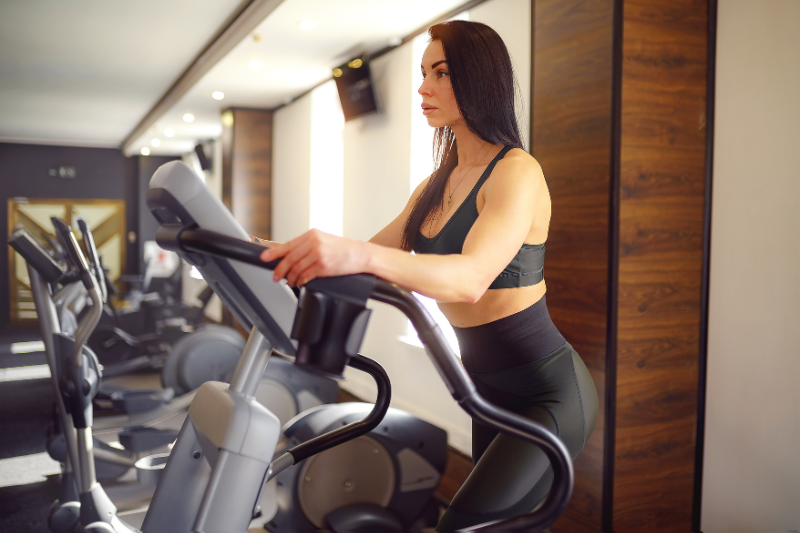
Yes, the stair stepper is good for weight loss — it ranks among the top calorie-burning indoor cardio machines, and when paired with a solid diet and consistent training, it can produce real, measurable fat loss results.
Keep reading for a breakdown of the research, how it stacks up against other machines, and exactly how to use it to get the most out of every session.
How Many Calories Does the Stair Stepper Burn?
Calorie burn on the stair stepper scales with your body weight and how hard you push. A 155-lb adult burns roughly 216–360 calories in 30 minutes — that's about 6–8.4 calories per minute at moderate effort.
Push into vigorous or HIIT territory and a 185-lb person can hit 13–17 calories per minute, which puts a single session well above 400 calories.
For context, the stair stepper burns 50–100% more than brisk flat walking and holds its own against the elliptical and stationary bikes at matched effort levels.
Two things worth knowing before you trust those numbers, though:
- The on-machine display lies. Most stair stepper consoles overestimate calorie burn by 10–20%, so treat those figures as rough benchmarks, not hard totals.
- The handrails cost you more than you think. Gripping or leaning on them offloads your body weight from your legs, cutting actual burn by 20–30% — some data puts it closer to 40%. Light fingertip contact for balance is fine; bearing weight on the rails is not.
Get those two things right and the numbers above hold up. Get them wrong and you're burning significantly less than the machine tells you.
How It Compares to Other Cardio Machines
A 2024 study measuring energy expenditure across seven indoor cardio machines at high effort produced a clear ranking:
- Treadmill — 15.18 kcal/min
- Stair climber — 13.35 kcal/min
- Elliptical — 12.82 kcal/min
- Spin bike — 12.45 kcal/min
- Rowing machine — 11.45 kcal/min
The gap between the stair climber and everything below it is consistent — it reliably outperforms the elliptical, every stationary bike variant, and the rowing machine at matched effort.
A separate University of Wisconsin study backs this up, clocking the stair mill at roughly 354 calories per 30 minutes versus 378 on the treadmill at high intensity. That's close enough to call them nearly equal when you're working hard.
Running and fast jump rope still edge it out, but the stair stepper's advantage over most other machines comes down to mechanics. It forces a vertical lifting pattern, which is far more metabolically demanding than horizontal movement.
Among the cardio options you'll find in a typical gym, it sits second only to running — and for people who can't or don't want to run, that's a meaningful distinction.
What Does the Research Say About Fat Loss?
The evidence is promising but comes with an important caveat that's worth understanding upfront.
On the positive side, a randomized controlled trial in women found that regular stair climbing produced a 1.4% reduction in body weight and a 7.8% drop in body fat, along with meaningful improvements in HDL cholesterol, LDL, and triglycerides.
A separate 2023 pilot study found that even minimal doses work — just three 20-second bouts of vigorous stair climbing, five days a week for four weeks, led to significant reductions in body weight, BMI, and waist circumference.
A large 2020 meta-analysis covering 3,566 participants reinforced a consistent theme: adults with obesity need at least 300 minutes per week of moderate activity for clinically meaningful fat loss, with the best body composition results coming from combining high-intensity cardio with resistance training.
Here's the caveat: a 2024 randomized trial found that four weeks of intense stair climbing improved cardiovascular fitness but left body weight and body fat completely unchanged. The difference between that study and the ones showing fat loss almost certainly comes down to diet.
Fat loss is roughly 80% diet and 20% exercise. A 500-calorie daily deficit produces about 1–2 pounds of fat loss per week — and no amount of stair climbing reliably closes that gap without dietary change to back it up. The stair stepper is a strong tool; it's just not a substitute for eating in a deficit.
Which Muscles Does It Work — and Why That Matters for Weight Loss
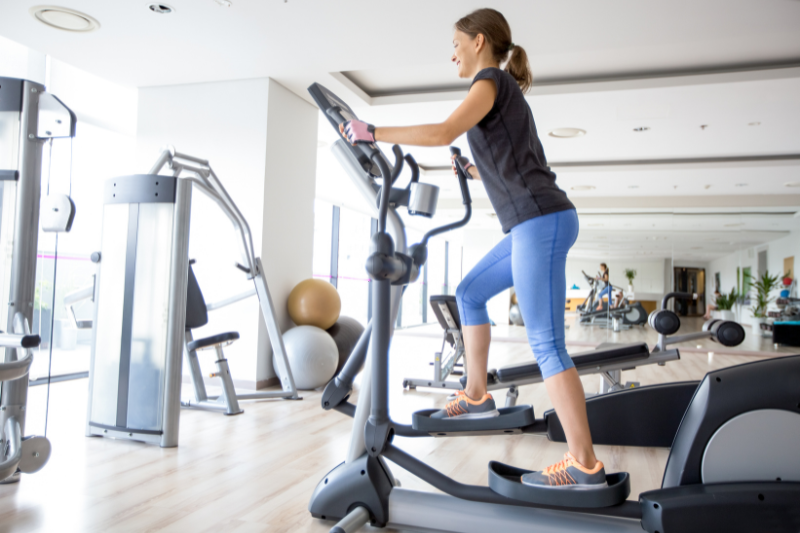
The stair stepper recruits the body's largest muscle groups simultaneously — glutes as the primary mover, quads, hamstrings, calves, and the core stabilizing throughout, especially when your hands are off the rails. That breadth of muscle recruitment is exactly why it burns more calories than machines that isolate smaller groups.
It also drives meaningful afterburn. The more muscle mass involved in a workout, the greater the EPOC — the elevated calorie burn that continues after you stop exercising.
Vigorous stepper sessions can keep your metabolic rate elevated by around 13% for up to three hours post-workout, which adds to your total daily calorie expenditure beyond what the session itself accounts for.
There's a longer-term benefit too. Engaging large posterior-chain muscles during a calorie deficit helps preserve lean mass, which matters because muscle tissue drives your resting metabolic rate. Less lean mass means a slower metabolism — a common reason fat loss stalls.
Two technique notes worth applying:
- Press through your heel, not your toes. This shifts the load from quad-dominant to glute-and-hamstring-dominant, making each step more effective.
- Avoid mini-steppers. Their shallow range of motion doesn't produce enough hip flexion to meaningfully activate the glutes — the muscle you most want working.
One honest limitation: the stair stepper is a strong cardio tool but a weak muscle-builder past the beginner stage. For preserving and building lean mass, you need dedicated resistance training alongside it.
How Often Should You Use the Stair Stepper for Weight Loss?
The right frequency depends on where you're starting and what you're trying to achieve.
For general activity guidelines, 75 minutes of vigorous stepper work per week is enough — three 25-minute sessions covers it. For active fat loss, you'll want to push that to 3–5 sessions of 20–45 minutes per week, combined with at least two days of resistance training.
Here's how to structure sessions by experience level:
| Level | Duration | Intensity |
|---|---|---|
| Beginner | 10–15 min | Level 4–5 |
| Intermediate | 20–30 min | Level 6–8 |
| Advanced | 30–45 min | Level 9–13 |
On heart rate zones, the target depends on your goal — 60–70% of max HR for fat-oxidation endurance work, 70–80% for general aerobic conditioning, and 85–95% for HIIT intervals.
Speaking of HIIT — it's worth prioritizing if time is limited. A 20-minute HIIT session on the stepper can match 40–50 minutes of steady-state for total caloric output, plus it generates more afterburn. Two formats with solid evidence behind them:
- 30 seconds hard / 30 seconds easy × 8–10 rounds
- 20 seconds sprint / 40 seconds recovery × 10–15 rounds
Cap HIIT at 2–3 sessions per week to allow adequate recovery, and fill remaining days with steady-state or strength work.
One note on the viral 25-7-2 protocol — 25 minutes at level 7, twice a week, hands off the rails. It's a reasonable starting point, but two sessions a week falls short of the volume needed for meaningful fat loss on its own. Pair it with strength training and additional movement on other days.
Conclusion
The stair stepper is one of the more effective cardio tools available — calorie-dense, joint-friendly relative to running, and uniquely good at recruiting the large muscle groups that drive both burn and afterburn.
That said, results come down to four things: eating in a calorie deficit, keeping your hands off the rails, adding progressive overload over time, and pairing your sessions with resistance training.
Get those right, climb three to five times a week at vigorous intensity, and the stair stepper will deliver consistent, sustainable fat loss.