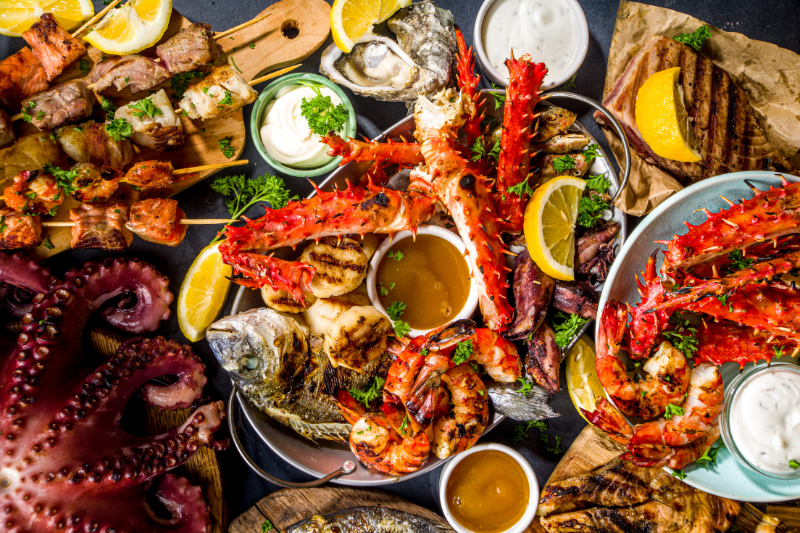
Seafood can help with weight loss, but not in the dramatic way you might expect — the real advantage comes down to its protein quality and low calorie density, not any special fat-burning property.
The evidence backs it up, and if you want to know exactly which seafood to eat, how much, and how to prepare it without canceling out the benefits, keep reading.
What the Research Says About Seafood and Weight Loss
The most rigorous trial on this topic — the SEAFOODplus YOUNG study — put 324 overweight adults on a calorie-restricted diet and split them into groups eating cod, salmon, fish oil capsules, or no seafood.
After four weeks, the men eating fish or taking fish oil lost roughly 1 kg more than the control group. A follow-up study pushed that further, finding that eating cod five times a week produced 1.7 kg greater weight loss than eating no seafood at all.
Zoom out to the broader body of evidence and the picture holds, though modestly. A meta-analysis pooling multiple randomized trials found fish consumption linked to 0.59 kg less body weight and 0.81 cm less waist circumference compared to controls.
A long-running Harvard cohort study tracking over 120,000 people across 16 to 24 years found that each additional daily serving of seafood was associated with 0.34 lb less weight gained every four years — one of the better results among all protein sources studied.
That said, the caveats matter. The SEAFOODplus trial's weight-loss advantage appeared only in men — women showed no measurable benefit, and no one has fully explained why.
Longer 12-month trials generally find no significant difference between fish-emphasizing and standard calorie-restricted diets, suggesting early gains may level off. Fish oil supplements alone show virtually no effect on body weight.
The takeaway: whole fish works better than isolated omega-3s, short-term results are real but small, and seafood works best as a consistent dietary swap rather than a standalone fix.
Why Seafood Supports Weight Loss (The Actual Mechanisms)
Fish protein is the most satiating protein ever formally measured. On the Satiety Index — a scale where white bread sits at 100 — fish scores 225, compared to 176 for beef, 150 for eggs, and 133 for lentils.
That's not a small gap. In a head-to-head crossover trial, people who ate fish at lunch consumed 11% fewer calories at dinner than those who had beef.
The likely explanation involves slower amino acid digestion and a higher tryptophan ratio that nudges serotonin signaling upward — though the practical point is simpler: fish keeps you fuller, longer.
There are three overlapping properties that drive this:
- Protein's thermic effect burns 20–30% of its own calories during digestion, far above carbohydrates (5–10%) or fat (0–3%). A 120-calorie serving of fish protein costs your body 24–36 calories just to process.
- Calorie density is exceptionally low. Three ounces of cod delivers 19g of protein at just 89 calories. The same weight of 85% lean ground beef runs roughly 215 calories.
- Zero carbohydrates in virtually all finfish, making seafood compatible with almost any dietary pattern.
Omega-3 fatty acids (EPA and DHA) add another layer. They activate fat oxidation genes, reduce inflammation in fat tissue, and may help preserve lean muscle during a calorie deficit — though their direct impact on the number on the scale is modest at best.
Micronutrients round out the picture. Iodine, found in meaningful amounts in fish like cod, supports thyroid function and resting metabolic rate.
Selenium, vitamin D, and B12 are concentrated in fatty fish and shellfish. Zinc, particularly abundant in oysters, plays a role in insulin signaling.
None of these alone will move the needle dramatically, but collectively they make seafood one of the more nutritionally complete protein sources you can eat on a calorie deficit.
The Best Seafood Choices for Weight Loss
Not all seafood pulls equal weight here. For pure protein-per-calorie efficiency, lean white fish and shellfish are hard to beat — options like cod, haddock, pollock, shrimp, scallops, crab, and canned light tuna derive roughly 80–90% of their calories from protein, putting them among the most calorie-efficient protein sources in any grocery store.
Fatty fish tell a different story. Salmon, sardines, and mackerel carry more calories, but they also deliver unmatched levels of omega-3s, vitamin D, and B12 — a trade-off worth making one to two times a week.
If you're choosing between salmon varieties, wild sockeye (~144 kcal per 3 oz) runs leaner than farmed Atlantic (~175 kcal) while still providing around 1,000 mg of omega-3s per serving.
A practical weekly split looks something like this:
- Most meals: cod, haddock, pollock, shrimp, scallops, crab, or canned light tuna for maximum protein at minimum calories
- 1–2 meals per week: salmon, sardines, mackerel, or trout for omega-3s and fat-soluble vitamins
- Occasionally: oysters, clams, and mussels — lower in protein volume but exceptionally dense in micronutrients like zinc, iron, and B12
Oysters in particular stand out nutritionally despite their modest protein count — three ounces of eastern oysters provides more zinc than almost any other food, alongside meaningful selenium and vitamin D. They're worth rotating in even if they aren't your primary protein source.
The simplest default: make lean white fish or shellfish your go-to, and let fatty fish fill the omega-3 gap a couple of times a week.
How Preparation Makes or Breaks the Calorie Count
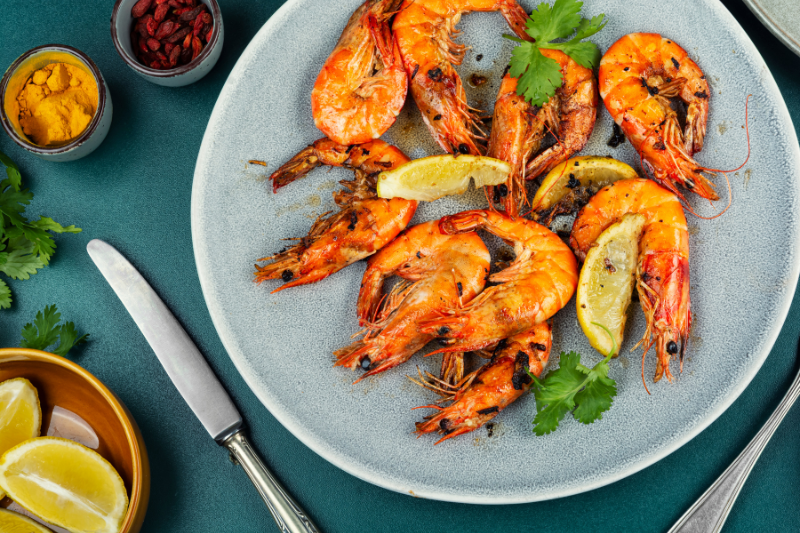
Choosing the right fish gets you halfway there. How you cook it determines whether that choice actually matters. A 3-oz baked cod fillet runs about 90 calories.
Batter-fry it and you're looking at 147–179 calories. Add two tablespoons of tartar sauce and the total crosses 300 — more than triple the original.
Order fish-and-chips at a restaurant and you could be sitting anywhere between 850 and 1,600 calories with 2,000–3,500 mg of sodium on the side.
Sushi is another place where “healthy seafood” can quietly unravel. Sashimi holds at 25–40 calories per ounce — clean and lean. A shrimp tempura roll tops 500 calories; dragon and rainbow rolls can push 600. The fish isn't the problem. The preparation is.
Methods that add essentially no calories: baking, broiling, grilling, steaming, poaching, en papillote, and air-frying. Pan-searing in a teaspoon of olive oil adds roughly 40 calories — a reasonable trade for texture and flavor.
The same logic applies to canned fish. Water-packed tuna contains about 73 calories per 3 oz; oil-packed runs closer to 168. Across a week of lunches, that gap adds up.
Condiments follow a similar split:
- Negligible: lemon juice (~4 kcal/tbsp), fresh salsa (~5 kcal), herbs, hot sauce
- Worth watching: butter (~102 kcal/tbsp), mayo (~90 kcal), cream sauces — these can easily exceed the calorie count of the fish itself
The preparation hierarchy isn't complicated. Dry heat or steam, lemon and herbs over heavy sauces, water-packed over oil-packed.
These aren't dramatic sacrifices — they're just the habits that keep seafood working the way the research suggests it should.
How Much Seafood to Eat and Safety Considerations
For weight loss, 2–4 servings per week is the practical target — with a standard serving being 4 oz raw, or roughly 3 oz cooked (about the size of your palm).
The Dietary Guidelines for Americans recommend at least 8 oz weekly, and the American Heart Association lands at 1–2 non-fried servings per week.
The weight-loss sweet spot sits toward the higher end of that range, mostly lean fish with one or two fatty-fish meals mixed in.
Mercury is the main safety consideration, and the FDA/EPA guidance is clear-cut:
- Avoid entirely: king mackerel, shark, swordfish, tilefish from the Gulf of Mexico, bigeye tuna, orange roughy, and marlin — particularly important for pregnant or breastfeeding women and young children
- Limit to one serving per week: albacore and yellowfin tuna, halibut, grouper, mahi mahi, and Chilean sea bass
- Eat freely: the best weight-loss choices — cod, shrimp, salmon, sardines, and canned light tuna — all fall within the FDA/EPA's “Best Choices” category
Sodium deserves attention, especially with processed forms. Fresh salmon contains around 60 mg per 3 oz. Canned tuna in water jumps to roughly 280 mg.
Smoked salmon hits 600 mg, and lox reaches 1,700 mg — approaching the American Heart Association's recommended daily ceiling in a single serving.
A few other considerations worth knowing:
- Shellfish allergy affects around 6.5 million Americans, making it the most common adult food allergy in the U.S. It typically persists for life and can be severe.
- Raw seafood carries real risks — Vibrio bacteria causes an estimated 80,000 illnesses annually in the U.S., and Anisakis parasites are a concern in raw fish. Pregnant, elderly, and immunocompromised individuals should avoid raw oysters and sushi entirely.
- Shrimp's cholesterol content (~180 mg per 3 oz) is no longer considered a problem for most people. Research shows it actually improves the LDL-to-HDL ratio and lowers triglycerides.
- Gout sufferers should limit high-purine options like anchovies, sardines, herring, mackerel, and scallops. Salmon and shrimp are generally well tolerated in moderate amounts.
The Simple Practical Plan That Actually Works
The most impactful move isn't adding seafood on top of what you already eat — it's replacing red and processed meat with it. Large cohort data shows unprocessed red meat is associated with 0.30 lb of weight gain per four years, and processed meat with 0.59 lb.
Swapping those meals for fish doesn't just remove the problem; it substitutes one of the most satiating, calorie-efficient protein sources available.
The weekly structure is straightforward:
- 2–4 servings of seafood per week, with a standard serving being 3 oz cooked
- Most meals: lean options — cod, haddock, pollock, shrimp, or canned light tuna
- 1–2 meals: fatty fish — salmon, sardines, mackerel, or trout for omega-3s and fat-soluble vitamins
- Preparation: dry heat or steam as the default; lemon, herbs, and hot sauce over butter, mayo, or cream sauces
- Safety: stay within the FDA/EPA “Best Choices” list and you won't need to think about mercury
That's genuinely the whole plan. No elimination, no complexity — just a consistent swap that the long-term evidence supports.
The honest framing here matters: seafood isn't a dramatic fat-loss intervention. What it does reliably is keep you fuller on fewer calories, make it easier to sustain a deficit, and produce measurable weight benefits over time when it replaces less favorable protein sources.
Applied consistently, that modest statistical nudge becomes a practical, sustainable tool — and that's exactly what most people need.
Conclusion
Seafood earns its place in a weight-loss diet not through any dramatic mechanism, but because it delivers more protein per calorie than almost anything else you can eat, keeps hunger in check, and consistently outperforms red and processed meat in long-term weight outcomes.
The practical side is just as straightforward — two to four servings a week, lean fish as your default, simple preparation, and smart condiment choices.
Do that consistently, and seafood stops being a vague “healthy option” and starts being a genuinely useful part of how you manage your weight.