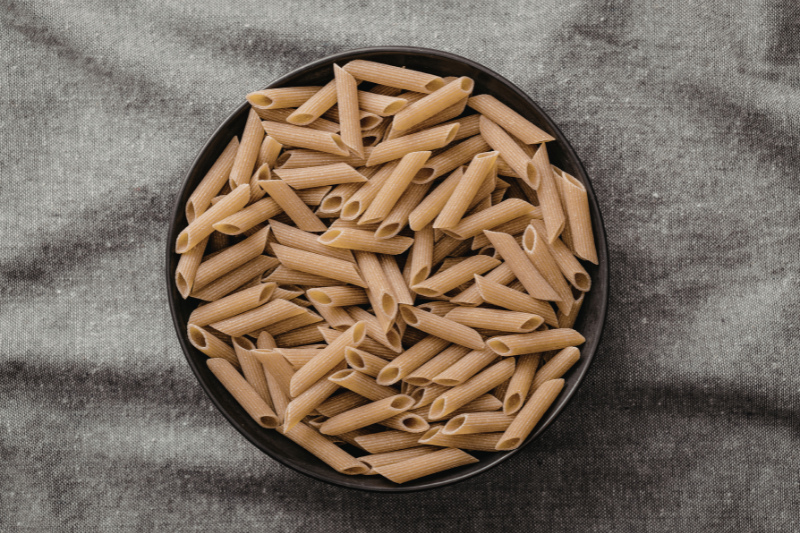
Whole wheat pasta can support weight loss, but only as part of a broader approach — the swap alone won't move the scale.
Keep reading to see exactly what the research shows, where the real benefits come from, and how to actually make it work.
How Whole Wheat and White Pasta Actually Compare
The calorie difference between whole wheat and white pasta is smaller than most people expect. Per cooked cup, whole wheat comes in at around 174 calories, 35g carbs, 4.6g fiber, and 7g protein.
White pasta runs about 221 calories, 43g carbs, 2.5g fiber, and 8g protein. That's a gap of roughly 47 calories — not nothing, but not enough to explain a meaningful difference in weight outcomes on its own.
The fiber gap is where things actually get interesting. Whole wheat pasta contains about 9.2g of fiber per 100g dry versus just 3.2g for white — nearly three times as much. That's the number worth paying attention to, and we'll come back to why shortly.
On the micronutrient side, the picture isn't entirely one-directional either:
- Whole wheat delivers roughly 3x more magnesium and manganese, plus more selenium and zinc
- White pasta wins on synthetic folic acid, added iron, and thiamin — nutrients added back during enrichment
Neither version is clearly superior across the board, so the idea that white pasta is nutritionally empty isn't quite accurate.
The glycemic index gap is also narrower than the marketing suggests. Whole wheat pasta scores around 52 on the GI scale; white pasta sits at about 55. Both fall in the low-to-moderate range — and that's largely because of how pasta is structured.
Durum wheat forms a dense gluten-starch matrix that physically restricts enzyme access to starch, which blunts blood sugar spikes regardless of whether bran is present.
In fact, spaghetti and penne made from the same durum wheat as couscous and bread produce roughly 40% lower blood glucose responses than those other formats. The pasta shape and structure matter more than the color of the noodle.
What Clinical Studies Show About Pasta and Weight
The research here splits along study design lines, and that distinction matters.
In randomized controlled trials — where researchers control what people eat — simply swapping refined grains for whole grains doesn't produce automatic weight loss.
Two large meta-analyses pooling dozens of RCTs found no significant reduction in body weight from the exchange alone.
One of them did pick up a small 0.48% reduction in body fat percentage, which hints at a real but modest effect that body weight alone doesn't capture.
Long-term observational data tells a more compelling story. In a 12-year study tracking over 74,000 women, those with the highest whole-grain intake had a 49% lower risk of major weight gain compared to those eating the least.
That's a large difference — though cohort studies reflect dietary patterns, not isolated food swaps, so the whole-grain intake likely signals a broader way of eating.
The pasta-specific evidence is actually more encouraging than the general whole-grain data:
- A pooled analysis of 30 RCTs found that eating pasta within a low-glycemic-index diet produced roughly 0.63 kg of weight loss compared to higher-GI control diets, with no increase in waist circumference
- A large Italian cohort of over 23,000 people found pasta intake was inversely associated with both BMI and waist-to-hip ratio — the opposite of what most people assume
The pattern across this research points to the same conclusion: pasta doesn't drive weight gain, and whole wheat pasta in the right dietary context can nudge things in a positive direction.
The operative phrase is “right dietary context.” The food itself is rarely the problem — portion size, sauce choices, and the overall quality of the diet are what determine the outcome.
Why Whole Wheat Pasta Keeps You Fuller
This is where whole wheat pasta earns its reputation — not through calorie savings, but through measurable effects on hunger hormones and appetite signaling.
In one crossover trial, participants eating whole wheat pasta with 11g of fiber versus refined pasta with 3g showed, at the 60-minute mark:
- 23% less hunger
- 16% less desire to eat
- 29% lower ghrelin (the hormone that drives appetite)
- 44% higher PYY (a hormone that signals fullness)
A separate meta-analysis confirmed the pattern holds broadly: whole-grain pasta consistently increases fullness and reduces hunger compared to refined.
The 1995 Satiety Index put numbers to this in a different way — whole wheat pasta scored 188% versus 119% for white pasta, using white bread as the 100% baseline. That works out to roughly 58% more filling per calorie.
The mechanism behind this isn't complicated. Whole wheat pasta's fiber slows gastric emptying, which flattens the post-meal glucose curve and keeps food in your stomach longer.
Undigested carbohydrates that reach the lower intestine trigger the release of GLP-1 and PYY — both satiety hormones.
Further along, colonic bacteria ferment that fiber into short-chain fatty acids like acetate, propionate, and butyrate, which bind receptors that reinforce the fullness signal and improve insulin sensitivity. It's a layered effect that plays out over several hours.
The broader implication is worth noting. Research suggests that adding 14g of fiber daily — roughly what you'd get from two servings of whole wheat pasta — corresponds to about 10% lower calorie intake and approximately 1.9 kg of weight loss over four months without any deliberate restriction.
Given that around 95% of Americans fall short of daily fiber targets, a single serving of whole wheat pasta covering 15–24% of that gap is a practical, low-effort way to move the needle.
The Pitfalls That Cancel Out the Benefits
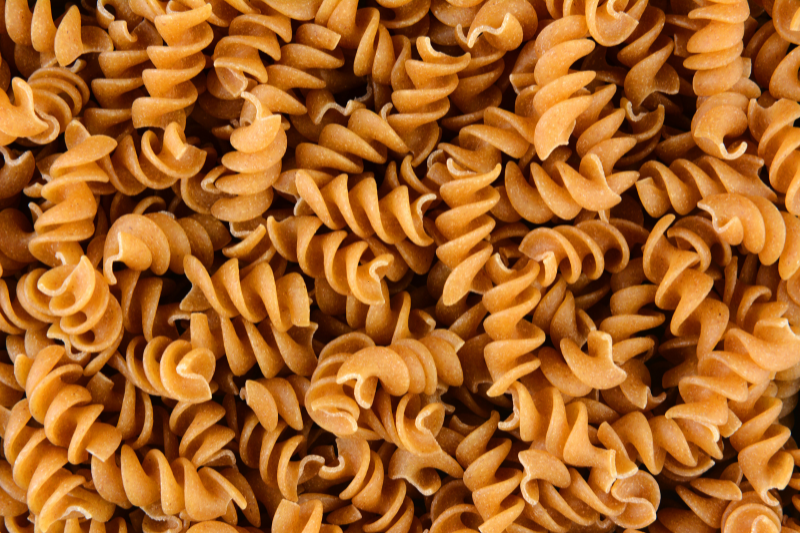
Switching to whole wheat pasta is a reasonable move, but it comes with a few traps that are easy to fall into.
The biggest one is portion size. Whole wheat pasta carries a similar calorie load to white pasta, so the type of pasta you buy matters far less than how much ends up on your plate.
What makes this worse is the health halo effect — research shows that whole-grain labeling leads people to over-portion by up to 28% compared to conventionally labeled products.
The perception of healthiness quietly licenses larger servings, and that's enough to erase the modest advantage whole wheat offers.
Sauce choices compound the problem just as quickly. A cream-based sauce or a generous handful of cheese can add 400 or more calories to a plate, completely swamping any benefit from the grain swap. Tomato-based sauces are the straightforward fix here.
A few other limitations worth knowing:
- Digestive adjustment: Jumping from low to high fiber intake too quickly commonly causes bloating, gas, and cramping. Increasing intake gradually over 2–4 weeks, alongside more water, keeps things manageable
- Not universally suitable: Whole wheat pasta contains gluten and is off the table for anyone with celiac disease, non-celiac gluten sensitivity, or a wheat allergy
- It's still milled grain: Whole wheat pasta is processed more finely than intact whole grains like oats or quinoa, so its fiber and nutrient benefits, while real, aren't on the same level
Label reading also deserves attention. Terms like “multigrain,” “stone-ground,” or “made with whole grain” don't guarantee you're getting a whole-grain product.
The first ingredient should specifically say “whole wheat” or “whole-grain durum wheat semolina,” and a useful benchmark is at least 6g of fiber per 2-oz dry serving. Anything short of that is likely more refined than the packaging implies.
How to Eat Whole Wheat Pasta for Weight Loss
Knowing the nutrition is one thing — translating it into an actual plate is another. These habits are where the theory becomes practical.
Measure your portions. A reasonable serving is ½ to 1 cup of cooked pasta per meal, roughly the size of a tennis ball. Restaurant portions typically run 2–4 times that amount, which is where most people's calorie math quietly falls apart. A kitchen scale or measuring cup takes the guesswork out of it entirely.
Cook it al dente. Softer pasta has a glycemic index of around 55–60; al dente drops that to roughly 40. The firmer texture preserves the protein-starch matrix that slows glucose absorption, which means steadier energy and a longer window before hunger returns. Overcooked pasta speeds up digestion and brings hunger back sooner.
Bulk up with vegetables. Mixing ½ cup of whole wheat pasta with 1–2 cups of zucchini noodles or other spiralized vegetables gives you a visually generous, filling bowl at significantly fewer calories. The volume does real work here — satiety is partly a function of how much food your stomach registers.
Add lean protein every time. Grilled chicken, shrimp, white fish, lentils, and beans all pair well and layer on top of the satiety signals the fiber is already providing. Protein and fiber together make for a much more effective appetite-control combination than either one alone.
Keep sauces simple. Tomato- and vegetable-based sauces run about 70–100 calories per half cup. Cream sauces, vodka sauce, and carbonara can cost you 400+ calories before you've touched anything else on the plate.
A practical template that pulls all of this together: 1 cup cooked whole-wheat spaghetti, 1 cup roasted vegetables, 3 oz grilled chicken, ½ cup marinara, and a teaspoon of olive oil lands at around 400 calories — a complete, satisfying meal.
One more worth knowing: refrigerating cooked pasta for about 24 hours before reheating increases its resistant starch content. This modestly improves the glucose response and provides additional fuel for gut bacteria — a small but effortless upgrade that costs nothing extra.
The Bottom Line on Whole Wheat Pasta and Weight Loss
Whole wheat pasta is a smart replacement for refined pasta in a weight-loss diet — but that's different from calling it a weight-loss food. The distinction matters.
Its advantage over white pasta has little to do with calorie savings; the gap is too small to drive meaningful results.
What actually moves the needle is fiber-driven satiety and the gut-hormone signaling that follows — the same mechanisms that reduce hunger, lower ghrelin, and raise PYY for hours after a meal. Those effects are real, but they're also context-dependent.
The context that gets the most out of whole wheat pasta looks something like this: controlled portions, a generous amount of vegetables, a lean protein source, and a tomato-based sauce.
That combination — broadly in line with a Mediterranean-style eating pattern — is where whole wheat pasta delivers on its potential. Swap in a cream sauce and a heaping restaurant-sized bowl, and the whole-grain advantage disappears quickly.
When whole wheat pasta fails to support weight loss, the pasta itself is rarely the reason. Portion size and sauce choices account for most of the gap between expectation and result.
The most useful way to think about it: one worthwhile swap among several, not a standalone fix. Pair it with the habits covered in this article, and it earns its place on the plate.