CoolSculpting won't make a noticeable difference on the scale, since a single flank cycle removes only about 40 mL of fat (roughly 1.3 ounces) and a full abdomen-and-flank plan removes about 265 mL (around half a pound).
What it does change is the shape of a stubborn bulge, usually thinning the treated fat layer by about 10–25%, so keep reading for a more detailed explanation of what to expect.
CoolSculpting Is a Fat-Reduction Treatment, Not a Weight-Loss Tool
The FDA clears CoolSculpting for cold-assisted lipolysis, meaning it's meant to change the appearance of visible fat bulges in people with a BMI of 30 or less.
It isn't cleared as a weight-loss treatment, and the manufacturer says so directly. Even its own before-and-after patients carry footnotes when they also lost weight through diet and exercise, such as one who dropped 12.4 lb.
Cleared treatment areas include:
- Upper arm, bra fat, back fat and banana roll
- Thigh, abdomen and flank
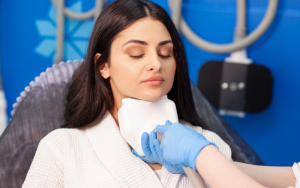
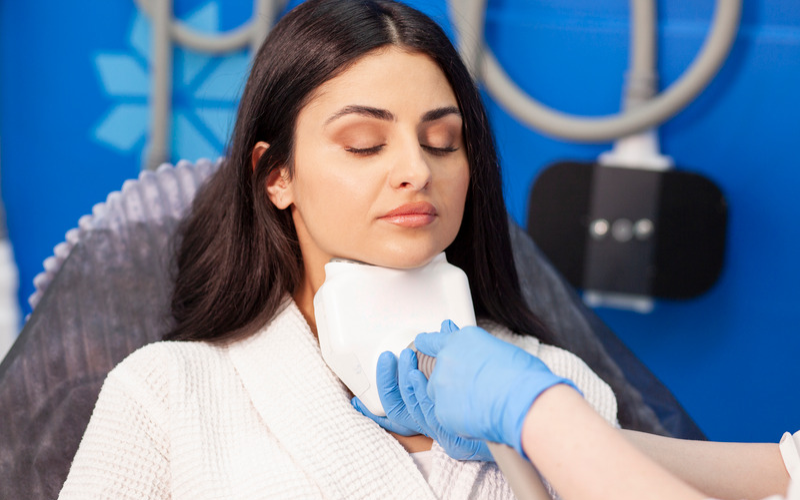
- Submental and submandibular areas (under the chin and jaw), which are cleared up to a BMI of 46.2
The treatment only reaches the pinchable fat under your skin, so don't expect metabolic benefits. In the pivotal flank study, serum lipids and liver enzymes didn't change.
The weight data point the same way. A pooled analysis of 10 studies and 285 patients found no significant change in body weight (mean difference −1.81, 95% CI −3.93 to 0.31, p = 0.09). A Korean chart review of 41 patients showed an average change of just −0.15 kg at 3 months.
Keep in mind that trials required participants to stay within 5% of their baseline weight, so they measured contour change, not weight loss.
How Much Fat Does It Actually Remove? The Numbers in Everyday Units
Start with volume. In one flank cycle, the treated side lost 56.2 mL of fat at 2 months, while the untreated side lost 16.6 mL on its own. The net difference of about 39.6 mL works out to roughly 36 g, or 1.3 ounces, at a fat density of about 0.9 g per mL.
A full plan sounds bigger but still adds up to very little. In a trial of 112 people (74.1% female) treated with up to 24 cycles on the abdomen and flanks, the mean reduction was 149.1 mL after the first session and 264.8 mL by 12 weeks after the last.
That's about 240 g, or half a pound. The standard deviation was 411.4 mL, which means some people lost far more and some lost almost nothing.
Thickness is where the effect shows up. You can typically expect a fat layer that's 2–5 mm (about 0.08–0.2 inch) thinner per treated area. Studies measure this in different ways, so the ranges vary:
- Ultrasound: 10.3–25.5% reduction
- Caliper: 14.67–28.5% reduction
- A review of 18 studies: 2.0–5.1 mm by ultrasound and 2.3–7 mm by caliper
Results also differ by area. Clinical data show an 18.7% reduction on the flank, 1.9 mm on the abdomen, 2.8 mm on the inner thigh, 2.5 mm on the outer thigh, 2.0 mm under the chin and 3.2 mm on the upper arm. A colder, shorter flank protocol reached 3.92 mm.
Circumference changes are modest too. Abdominal circumference dropped about 3.56 cm (1.4 inches) at 12 weeks, while the thigh change (−1.28 cm) wasn't statistically significant.
Be wary of the outliers. One 30-woman study reported a 46.6% abdominal reduction, and the “up to 20–25%” marketing claim came from a 10-person study with data from 6 people. Both are upper-end figures, not averages.
You may also see analyses reporting BMI drops of about 1.7–1.8 points. For a 1.66 m patient, that would take roughly 5 kg of weight loss, far more than the fat removed. It most likely reflects mixed protocols, added diet changes and very high heterogeneity (I² = 94%), not the device itself.
Timeline and Number of Sessions: What Happens and When
Results arrive slowly, so plan on waiting. You may notice early change at about 3 weeks, and the most visible difference usually comes between 1 and 3 months. About 75% of the total fat-layer reduction happens within the first 2 months, and final results settle at roughly 3–6 months.
Here's how that plays out:
- Around 3 weeks: early change begins.
- 1–3 months: the difference is most visible.
- 3–6 months: results reach their final shape.
Many people need more than one session per area. Spacing them 4–8 weeks apart is common, though some clinics prefer 6–8. A second round helps, but it adds less than the first. In one hip-area study, two treatments produced a 28.5% reduction compared with 19.7% for one.
Size matters too. A large area like the front of the abdomen often needs 4 or more applicator placements in a single visit to get an even result.
Once the treated fat cells are destroyed, they don't regenerate. Two men followed for 6 and 9 years kept their reduction, but that's a very small sample, so treat it as encouraging rather than proven.
The fat cells that remain can still grow, though. If your weight climbs, the treated area can fill back out, so your results depend on keeping your weight stable.
What Shapes Your Results (and Who Is a Good Candidate)
Several factors decide how much you'll see, and some of them are out of your hands.
Your body and the treatment area. Ideal candidates are at or near their goal weight, with a BMI of 30 or less for body areas. The fat itself matters too. Vacuum applicators need a pinchable fold, and the fat layer should be at least 1 cm thick. For areas you can't pinch, such as the outer thigh, surface applicators exist. Results also differ by site. The abdomen responds measurably, while the arms and thighs often show smaller circumference changes. Even then, individual variation is large, as the ±411 mL spread in the volume trial shows.
Technology and technique. Newer applicators run colder for less time (for instance, −11°C for 35 minutes). Matching the applicator to the bulge also counts, since partial coverage can leave a step or dent. Post-treatment massage increased reduction in one early study.
Who tends to do well:
- Someone near goal weight, with a stable weight
- A distinct, pinchable bulge that hasn't responded to diet and exercise
- Good skin tone and realistic expectations
Who usually doesn't:
- Anyone whose goal is a lower number on the scale
- People with obesity and diffuse fat
- Those with significant skin laxity or fat under 1 cm
Medical exclusions. Cryoglobulinemia, cold agglutinin disease and paroxysmal cold hemoglobinuria rule treatment out entirely. Other conditions haven't been studied, so they call for caution: pregnancy, cold urticaria, Raynaud's disease, a hernia near the site, recent surgery or scar tissue, impaired circulation or sensation, and neuropathy.
Side Effects and the Risk of Paradoxical Adipose Hyperplasia
Most side effects are temporary. In pooled data, numbness showed up in 49.5% of patients, redness in 44.5%, swelling in 30.5% and pain in 28.8%.
These usually clear within days to weeks, though numbness can occasionally last more than 12 weeks. Less common problems include contour irregularities or dents, hyperpigmentation and late-onset pain.
The one that deserves a closer look is paradoxical adipose hyperplasia (PAH). Here, the treated area grows instead of shrinking, usually 2–5 months after treatment. It doesn't go away on its own and may need liposuction or surgery to fix.
How often it happens depends on who you ask:
- Official figures: 1 to 10 per 10,000 treatments (0.01–0.1%), with another estimate of about 1 in 3,000 (0.033%).
- First report, 2014: 0.0051%, or 1 in 20,000.
- Miami practice, May 2013 to May 2016: 0.72%, about 1 in 138 cycles. All 11 affected patients were Hispanic (8 men, 3 women), and most were treated on the abdomen with a large applicator.
- Canadian review (8 centers, 2,114 patients, 8,658 cycles): 0.43% overall. Older devices produced 2.0% (7 of 350), while newer ones produced 0.11% (2 of 1,764).
- Pooled analysis (28 studies, 13,078 patients): 0.22% (95% CI 0.10–0.47%), about 1 in 455, though the evidence is low certainty.
Taken together, the independent data suggest a real risk of roughly 1 in 500 to 1 in 1,000 or more. It's probably lower with current devices, and men may face a higher risk. The odds are small, but the consequence is a surgical fix, so it belongs in your decision.
Setting Realistic Goals and Making a Smart Decision
Measure success in inches, millimeters and photos, not pounds. A good outcome is a flatter bulge and perhaps 1–4 cm off your waist, with no change on the scale. Get your weight steady for several months before treatment, and keep it within a few pounds afterward.
Questions to ask your provider:
- Am I a good candidate, and what result is reasonable for me?
- How many cycles and sessions will I need, and what's the total cost?
- Which device generation and applicators do you use, and is it CoolSculpting Elite?
- Who performs the treatment, and what physician oversight exists?
- How many patients have you treated, how many developed PAH, and what's your policy and cost coverage if I do?
- What are my options if I'm dissatisfied?
Read before-and-after photos with a critical eye. Look for identical lighting, posture, distance and clothing, along with dates and session counts. Check whether the patient's weight changed, since some featured patients lost 12.4 lb and 29.6 lb through diet and exercise. Favor photos taken at least 8–12 weeks after the last session.
Track your own results:
- At baseline, take front, side and back photos, measure with a tape at fixed landmarks like the navel, and record your weight.
- Repeat at 4, 8 and 12 weeks, then again at 6 months.
- Judge the outcome at 12 weeks or later, before you book a second session.
Watch for a firm, well-defined enlargement 2–5 months out. If you see one, report it promptly and don't retreat the area.
Keep the evidence limits in mind, too. Most efficacy data are industry-funded, samples often run 10–60 people, follow-up mostly covers 2–6 months, and measurement methods differ. The gram and ounce figures in this article are estimates based on a fat density of about 0.9 g/mL.
CoolSculpting works as a contouring option for someone at a stable weight. It delivers the most when your expectations match the data.
Conclusion
CoolSculpting won't move the number on your scale, but it can thin a stubborn bulge by about 10–25% when you're near your goal weight and the fat is pinchable.
Results take 3–6 months to settle, many people need a second session, and a small risk of paradoxical adipose hyperplasia means you should choose your provider carefully.
If you set your expectations in inches and millimeters instead of pounds, you'll be in the best position to judge whether it's worth it.