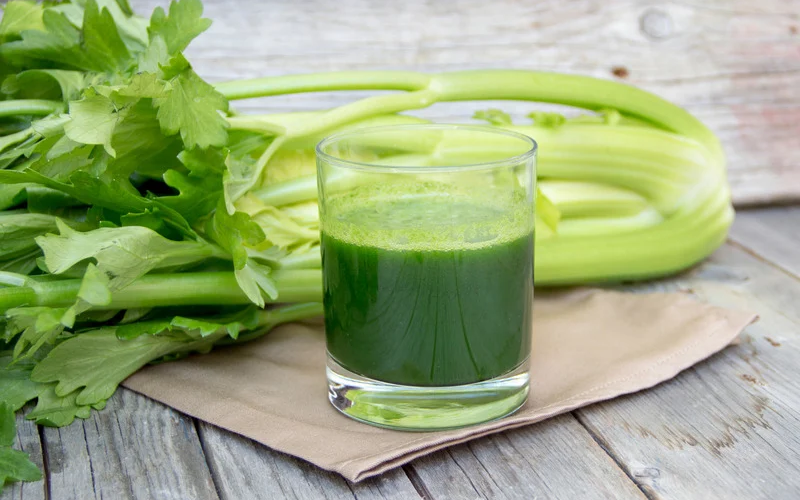
No, celery juice doesn't make you lose weight. No human trial has shown it causes weight loss, and any pounds you drop while drinking it come from eating fewer calories overall, losing water, or changing other habits at the same time.
Keep reading for a closer look at the evidence, what's in the glass, and what works better.
What the Research Actually Says About Celery Juice and Weight Loss
No randomized controlled trial has tested celery juice against body weight. That gap matters, because it means every claim you see online rests on indirect evidence: studies of capsules, extracts, animals, or other juices entirely.
The closest human trial is a 2023 pilot study in Shiraz, Iran. It enrolled 50 overweight or obese adults with type 2 diabetes, and 36 finished (18 per group).
Participants took 750 mg a day of celery powder in capsules or a starch placebo, and both groups followed a low-calorie diet for 12 weeks.
The celery group saw no significant weight difference compared with placebo, and cardiometabolic markers didn't improve either. Keep in mind that this trial tested capsules, not juice, so even a concentrated form of celery failed to beat a placebo on weight.
Where celery does show an effect
A 2025 meta-analysis pooled 10 trials with 511 participants and found that celery lowered blood pressure, fasting glucose, and triglycerides.
Weight wasn't measured at all. The stronger results came from celery seed or doses above 1,000 mg a day, which is a very different thing from a glass of juice.
Animal studies and why headlines overstate them
The mouse study behind many headlines gave mice on a high-fat diet a probiotic-fermented celery juice for 12 weeks (15 mice per group).
Plain, unfermented juice produced only a slight improvement. Store-bought and homemade juice isn't fermented, and mice aren't people, so the result doesn't carry over.
Celery seed extract in diabetic rats pointed the other way. The rats gained weight, which reversed the weight loss caused by their diabetes.
These were concentrated extracts rather than juice, but the finding shows how easily animal data gets bent into a weight-loss story.
A single case report
The only data on juice itself is a case report of an older man who drank celery juice daily for 6 months. His blood pressure changed, but his weight didn't, and his BMI stayed at 25 throughout.
What's in a Glass of Celery Juice (and Why It Matters for Weight)
The numbers below are typical values for one cup, which is about 236 to 240 mL. They shift depending on the database you check and on how the juice is made, so treat them as ranges rather than exact figures.
- Calories: About 33 to 42 kcal per cup. A 16-oz serving, which is the amount many celery juice routines call for, comes to roughly 66 to 84 kcal.
- Carbs and sugar: 7 to 9.4 g of carbohydrate, including 3 to 5.6 g of sugar. All of it occurs naturally, and it's far lower than what you'd get from fruit juice or soda.
- Sodium: About 189 to 215 mg per cup, or roughly 380 to 430 mg in a 16-oz glass. Raw celery has about 80 mg per 100 g, which is high for a vegetable.
- Potassium: 614 to 670 mg per cup.
- Vitamin K: 69 to 89 µg per cup, which is more than half the daily value.
The fiber question
Databases list about 3.8 g of fiber per cup, but that figure assumes the pulp stays in. Most home-pressed juice is strained, and straining removes the bulk of the fiber. For comparison, 100 g of whole raw celery has about 14 to 16 kcal and 1.6 g of fiber.
What this means for weight management
Celery juice is a very low-energy drink, and that's its one real weight-related asset. If it replaces something with more calories, your total intake goes down.
The catch is what it leaves out. It has almost no protein and, once strained, little fiber. Those are the two nutrients that do the most to keep you full.
Whole celery gives you the same low calorie count plus the fiber and the chewing, which is why it's the better choice if fullness is your goal.
Popular Claims Versus the Evidence
Most of what you hear about celery juice and weight loss traces back to Anthony William, who calls himself the “Medical Medium” and has no medical or scientific training.
He recommends 16 oz every morning on an empty stomach, and 24 to 32 oz for people with chronic illness. Here's how his main claims hold up.
Claims about the liver
- “Celery juice dissolves fat stored in the liver.” No study has measured liver fat after anyone drank celery juice, so there's nothing to back this up.
- “Weight gain comes from a toxic liver, not a slow metabolism.” This contradicts how energy balance works. Your liver and kidneys already handle detoxing, and no evidence shows that any juice cleanses the body.
- “Undiscovered sodium cluster salts.” No such compounds appear in the scientific literature, so the claim can't be checked.
Claims about timing and dose
Nothing supports the idea that you must drink it alone, on an empty stomach, at exactly 16 oz. Drinking it on an empty versus a full stomach makes little difference.
If you do feel better after a morning glass, the likely reason is simpler: having only juice for breakfast extends your overnight fast, which can lower your calorie intake.
The “negative-calorie” myth
Some people claim celery burns more calories to digest than it provides. That's false, even for whole celery.
- In an Oxford Brookes study, 15 women ate 100 g of celery, which supplies 16 kcal, and burned 13.76 kcal digesting it. That's close but still less than they took in, and the study didn't account for energy lost in waste.
- A 2019 preprint from Alabama found that bearded dragons got a net energy gain from their celery meals.
Juice makes the argument weaker still, since the chewing and the fiber that demand extra effort are gone.
Bottom line
The only claim that holds up is the modest one: celery juice is a low-calorie drink. Every claim about a specific fat-burning or liver-driven weight-loss effect lacks support.
Why You Might Still Lose Weight (and What's Really Behind It)
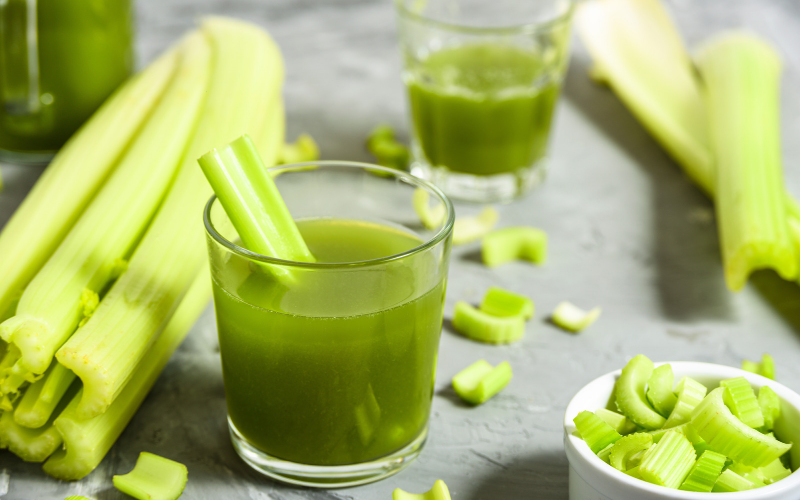
Plenty of people do lose weight while drinking celery juice. The reasons below are illustrations of how that can happen, not guarantees, and none of them depend on anything special in the celery.
Calorie displacement
This is the most realistic route. If you swap a soda, a sweetened coffee drink, or a glass of fruit juice for celery juice, your total calorie intake drops. If you add it on top of your usual diet instead, you take in a few extra calories, so the swap is what matters.
Pre-meal preloading
Drinking something before a meal can help you eat less, and water has the better evidence here.
- 2010 trial: 48 adults aged 55 to 75 drank 500 mL of water before each of three meals and lost about 2 kg more over 12 weeks than those who didn't.
- 2015 trial: 84 adults with obesity lost 1.3 kg more at 12 weeks. Those who drank water before all three meals lost 4.3 kg, compared with 0.8 kg for those who did it once or not at all.
Celery juice might work in a similar way, but nobody has tested it, and it adds sodium and cost that water doesn't. Hydration itself helps modestly, though it isn't a fat-loss mechanism on its own.
Early water-weight drops
A quick drop on the scale in the first few days is often water and gut contents, not fat. In a UCLA study, healthy adults on a 3-day juice-only diet lost 1.7 kg, and only 0.91 kg of that was still gone two weeks later.
Juice retailers cite this study as proof that cleanses work. It points instead to short-term calorie restriction plus water and gut-content loss.
Liquid versus solid food
In a Penn State study, eating a whole apple before lunch cut lunch calories by 15%, or 187 kcal, and it beat both applesauce and apple juice.
Adding fiber to the juice didn't make it any more filling. So if you replace a fiber-rich breakfast with celery juice, you may end up hungrier later and eat more.
Gut health
You might hear that juicing helps your microbiome, and that this in turn helps with weight. A 2025 Northwestern study found that a 3-day juice-only diet increased inflammation-linked bacteria, especially in the mouth.
The study was small and used mixed juices, but it gives you no reason to expect a microbiome benefit from juicing.
Risks and Who Should Be Careful
For most healthy adults, moderate celery juice use isn't dangerous. The points below show who's at risk and where problems tend to come from.
Hunger and lost fiber
Juicing strips out most of the fiber that makes whole celery filling. That's why celery juice shouldn't replace a meal. If it does, you're likely to be hungry again soon.
Sodium
A cup has about 189 to 215 mg of sodium, so a 16-oz glass runs 380 to 430 mg, and more at the 24 to 32 oz doses some routines call for.
That matters if you have high blood pressure, heart failure, or kidney disease, or if you follow a salt-restricted diet. Sodium also muddies short-term water-weight changes, which makes the scale harder to read.
Digestive upset
Celery contains mannitol, a poorly absorbed sugar alcohol. Low-FODMAP guidance puts a safe serving at only about 10 g of raw celery, and a glass of juice holds several stalks' worth.
Bloating, gas, and loose stools are common, especially if you have IBS. That “flushed” or lighter feeling some people report may simply be a laxative effect, not fat loss.
Medication interactions
Each cup has 69 to 89 µg of vitamin K, which can blunt the effect of warfarin. People on warfarin need a steady vitamin K intake, so a new daily celery juice habit is worth raising with your prescriber first.
Kidney risk with heavy juicing
This risk is rare, but it's serious.
- A Mayo Clinic case series found that 3 of 65 patients with oxalate kidney injury had a diet-related cause, and all three already had chronic kidney disease.
- A 2022 case report linked a spinach-heavy daily juice routine to end-stage kidney disease. It supplied about 1,500 mg of oxalate a day, roughly 10 times a typical diet.
Celery itself is relatively low in oxalate, at about 18 to 27 mg per 100 g. The risk centers on mixed green juices, large volumes, dehydration, existing kidney disease, gastric bypass, or high-dose vitamin C.
Other issues to know about
- Sun sensitivity: Celery contains psoralens, which can make skin more sensitive to UV light.
- Allergy: Celery allergy can range from oral itching to anaphylaxis.
- Disordered eating: Juice cleanses are linked to disordered eating and a negative relationship with food.
- Store-bought blends: Many bottled products mix in fruit juice to mask the bitterness. That adds sugar and calories and cancels the drink's main advantage.
How to Use Celery Juice Sensibly and What Works Better
If you like celery juice, you can keep drinking it. Just treat it as a low-calorie drink swap, not a fat burner, and don't expect it to do more than that.
Getting the most out of it
- Use it as a swap, never an add-on. It only helps if it replaces something with more calories, such as a soda or a sweetened coffee drink. It should never replace a meal.
- Choose whole or blended celery over strained juice. Eating celery sticks, or blending celery with the pulp left in, keeps the fiber that helps you feel full.
- Keep portions moderate. About 8 oz is a sensible ceiling. The 16 to 32 oz recommendations come from a non-medical source, and they raise your sodium, mannitol, and vitamin K intake with no proven benefit.
- Read labels on bottled juice. Pick 100% celery with no added sugar or fruit juice, and check the sodium per serving.
Check with a clinician first if you:
- take warfarin or blood pressure medication,
- have kidney disease or a history of kidney stones, or have had gastric bypass,
- have IBS,
- follow a low-sodium diet, or
- are pregnant.
If you're allergic to celery, skip it entirely.
Skip the cleanses
Celery juice cleanses aren't worth the effort. The losses mostly come back, and juice-only plans lack the protein and fiber you need to stay full.
Try a water preload instead
If you want a pre-meal habit that has trial support, drink about 500 mL (16 oz) of water roughly 30 minutes before each main meal, alongside a reduced-calorie diet. Trials show about 1.3 to 2 kg of extra weight loss over 12 weeks. Celery juice could be used the same way, but it's unproven, adds sodium, and costs more.
Track your results honestly
Weigh yourself under consistent conditions for at least 4 weeks, since the first few days of change are mostly water and gut contents.
If you do lose weight, ask what else changed. Fewer sugary drinks, less snacking, or more activity are the likely reasons, and those are the changes worth keeping.
What works over the long run
Durable weight loss comes from a sustained calorie deficit built on an overall eating pattern with enough protein and fiber, plus regular activity and good sleep. No single food or drink does that work for you.
Conclusion
Celery juice is a low-calorie drink, not a weight-loss tool. A lack of trials doesn't prove it has no effect, but given what's in the glass, a large independent effect on body weight is very unlikely.
Keep in mind that nutrition figures vary by source, and some of the safety points come from case reports rather than celery juice studies.
Put your energy into habits with a track record: a steady calorie deficit, enough protein and fiber, regular activity, and good sleep.
If your business builds health or nutrition products, we can help you create software that gives people information they can trust.